

Corporate digital investment is the systematic allocation of financial, human and organisational resources to technologies such as the cloud, artificial intelligence, cyber security and automation, with the aim of improving efficiency, competitiveness and growth. Companies that take this approach do not do so simply to follow a trend: they do it because the data speaks for itself. The digitised businesses They show an average EBITDA of 18.4 per cent, compared with 4.2 per cent in traditional sectors. This gap is by no means insignificant: it means that every euro invested in digital transformation generates almost four times as much operational value as those who remain tied to analogue processes. For a manager or entrepreneur, ignoring this figure is tantamount to ceding ground to competitors every quarter.
Why companies invest in digital: the real competitive advantages
Digital investments deliver measurable benefits across four key areas: productivity, customer experience, decision-making speed and market positioning. Understanding each of these areas will help you set the right priorities for your organisation.
Productivity and reduction in operating costs
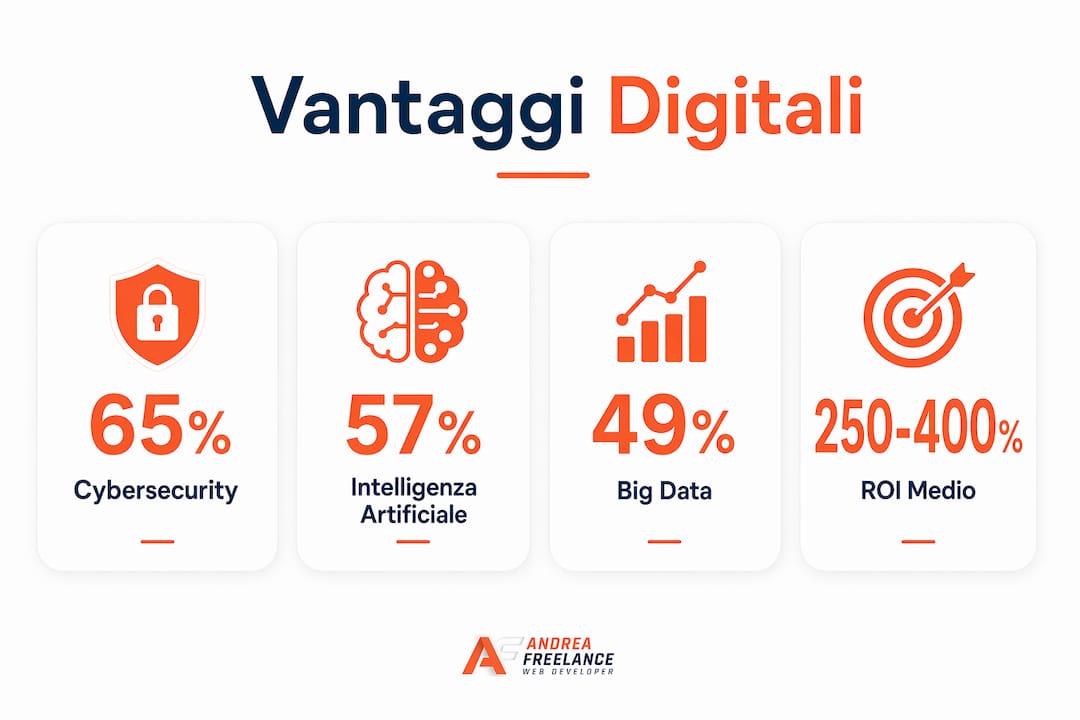
The automation of repetitive processes, from document management to electronic invoicing, reduces operational time and human error in a direct and quantifiable way. A manufacturing company that adopts ERP systems integrated with automation modules can reduce order processing times by 40–60 per cent, freeing up resources for high value-added activities. The ICT budget of Italian businesses is growing by 1.8 per cent annually, with an average ROI of 250–400 per cent within three years for effectively digitised SMEs. This means that the investment pays for itself handsomely in the medium term, not over a ten-year period.

Improving the customer experience and customer loyalty
Modern customers expect rapid responses, personalisation and multi-channel access to services. Companies that use digital technology to collect and analyse behavioural data can anticipate customer needs, reduce churn and increase average revenue per customer. An e-commerce business that implements an AI-based recommendation system, for example, typically sees a 15–25 per cent increase in the average order value. Retaining customers costs five times less than acquiring new ones: every percentage point of retention gained through digital channels translates directly into profit margin.
Faster decision-making with data and analytics
Decisions based on real data replace those based on gut feelings or delayed monthly reports. Business Intelligence tools such as Microsoft Power BI, Tableau or Google Looker Studio enable executives to monitor KPIs in real time and take action before a problem escalates into a crisis. This competitive advantage is particularly significant in volatile markets, where those who react first gain market share.
- Increase in productivity thanks to the automation of repetitive tasks and the reduction in manual errors
- Cost reduction operational through digitised processes and the integration of information systems
- Superior customer experience with data-driven personalisation and multi-channel support
- Faster decisions thanks to dashboards and real-time analytics
- Business protection through investment in cybersecurity and regulatory compliance
The 65 per cent of large companies invests in cybersecurity, 57 per cent in artificial intelligence and 49 per cent in Big Data. These figures reflect a clear hierarchy of priorities: first, the digital perimeter is protected; then, data is utilised to create value.
Pro tip: Before embarking on any digital investment, map out your current processes and identify the three bottlenecks that take up the most time or generate the most errors. Starting from there ensures a visible return on investment in the short term and builds internal support for the project.
How Italian companies are using digital technology: technologies and strategies in 2026
The landscape of digitalisation in Italy shows a clear divide between large enterprises and SMEs, with technologies being adopted at very different rates. Understanding this context will help you manage your expectations and choose the strategies best suited to the size of your business.
For Italian businesses, the priority technologies in 2026 are ranked as follows:
- Cloud computing: the technology with the highest projected penetration. The cloud will reach a 91 per cent adoption rate among Italian SMEs over the three-year period 2026–2028, thanks to the flexibility of costs and the scalability of services.
- Cybersecurity: a top priority for large enterprises, with investment also on the rise in SMEs following the increase in ransomware attacks and the NIS2 regulations.
- Artificial Intelligence: still not widely adopted in SMEs. 76 per cent of Italian SMEs have not yet invested in AI in 2026, leaving a significant competitive advantage to those who act first.
- Industry 4.0 and industrial automation: mainly used in the manufacturing sector, with connected machinery, IoT sensors and integrated MES systems.
- Digital marketing and online presence: optimised websites, SEO, and Google Ads and Meta Ads campaigns as the primary channels for customer acquisition.
The difference between SMEs and large enterprises is not just a matter of available budget. Large organisations have dedicated IT teams; they can manage multi-year projects and absorb the costs of integrating legacy systems with new platforms. SMEs, on the other hand, achieve the best results with a modular approach: they start with a specific area, measure the results, and then expand.
A concrete example: an SME in the logistics sector that digitised its dispatch management process using software such as Shippo or Sendcloud reduced order fulfilment times by 35 per cent and delivery errors by 60 per cent within six months. The project involved just three people and required a modest initial investment.
| Technology | SME Adoption | Adoption by large enterprises | Priorities for 2026 |
|---|---|---|---|
| Cloud computing | Growing rapidly (91% by 2028) | Already well-established | High |
| Cybersecurity | Media | High (65%) | High |
| Artificial Intelligence | Low (24 per cent have invested) | High (57 per cent) | Medium-High |
| Big Data and Analytics | Low | High (49%) | Media |
| Process automation | Average figures in the manufacturing sector | High | High |
Cultural challenges are often the most underestimated obstacle. The’AI will be integrated in 2026 in workflows to automate repetitive tasks, thereby improving efficiency and compliance. However, this integration only works if the people using the tools understand their value and have been trained to make the most of them.
Pro tip: If you run an SME and want to find out where to start with digitalisation, take a look at the tailor-made digital solutions available to medium-sized businesses. An experienced partner can help you avoid making the wrong investments and draw up a realistic roadmap.
What mistakes are holding companies back in their digital transformation?
Digital transformation fails more often for organisational reasons than for technological ones. Understanding the most common mistakes puts you in a position to avoid them before they become costly.
The first mistake is the facade digitisation: purchasing software, creating social media profiles or launching a website without establishing a data culture within the organisation. Digitalisation without a data culture and without active protection reduces the competitive value of the investment rather than increasing it. The result is spending money without getting anything in return.
The second mistake is the staff resistance, which is often underestimated by managers. Staff fear losing their jobs or being unable to adapt to new tools. The solution is not to impose change from the top down, but to identify the “digital ambassadors” within the teams: people who are passionate about technology and who guide their colleagues in its day-to-day use.
The third mistake is the approach “Everything straight away”. Many companies try to digitise every process at once, overburdening the organisation and spreading resources too thinly. The “all at once” approach is the main mistake made when digitising SMEs: limited pilot projects are more effective for testing the technology before a full roll-out.
- Vague objectives: Launching a digital project without defined KPIs makes it impossible to measure its success and justify further investment
- Insufficient integration: purchasing tools that do not communicate with one another creates information silos and results in duplication of manual work
- No line-up: rolling out new software without providing staff with adequate training leads to frustration and a reluctance to use the tools
- The wrong partner: relying on technology providers who are unfamiliar with your sector or the size of your business leads to unsuitable solutions
Pro tip: Before choosing any technology, set a specific and measurable objective: “reducing customer response times by 30 per cent within six months” is a valid objective. “Becoming more digital” is not. The clarity of the objective determines the quality of the investment.
How to measure the ROI of digital investments
The return on digital investment is measured on two distinct levels: the benefits hard, which can be quantified in euros and hours, and the benefits soft, which affect customer satisfaction and the company’s reputation. A A comprehensive ROI must include both categories, in order to provide a realistic picture of the value generated.
The hard benefits include a reduction in the time spent on manual processes, fewer errors and lower associated correction costs, savings on physical space thanks to the cloud, and increased turnover from new digital channels. Soft benefits include an improvement in the Net Promoter Score, a reduction in the customer churn rate, increased staff satisfaction and a stronger online reputation.
The SMEs that define clear KPIs achieve a return on investment (ROI) 2.1 times higher than the average, with a payback period of between 8 and 14 months. This figure shows that planning is not merely a bureaucratic exercise: it is the factor that distinguishes successful projects from those that run aground.
| Type of benefit | Key Performance Indicator (KPI) | How to measure it |
|---|---|---|
| Operational productivity | Hours saved per process | Comparison of times before and after implementation |
| Customer satisfaction | Net Promoter Score (NPS) | Periodic post-interaction surveys |
| Commercial efficiency | Lead conversion rate | CRM and sales analytics |
| Customer retention | Monthly churn rate | Quarterly CRM data analysis |
| Digital visibility | Organic traffic and SEO ranking | Google Search Console, Google Analytics |
For projects aimed at digitising the recruitment process, for example, tools such as those described in the guide to digitalised selection process show that HR benefits, too, can be measured using specific KPIs. Continuous monitoring is not just about justifying past investment: it helps us understand where to take action to improve future results.
One aspect that is often overlooked is regulatory compliance. The GDPR, the NIS2 Directive and the regulations on electronic invoicing impose digital standards which, if managed proactively, can become a competitive advantage. Compliant companies find it easier to secure contracts with the public sector and with large private-sector clients that require security certifications.
Key points
Companies invest in digital transformation because it delivers a measurable competitive advantage: higher EBITDA, faster processes and greater customer loyalty compared to those who do not embrace digitalisation.
| Full stop | Details |
|---|---|
| Tangible and measurable ROI | Digitalised SMEs achieve a return on investment (ROI) of 250–400 per cent within three years, with clearly defined key performance indicators (KPIs). |
| The cloud as an immediate priority | Cloud adoption among Italian SMEs is set to reach 91 per cent by 2028: this is the most accessible starting point. |
| Avoid the “everything at once” approach” | Limited-scope pilot projects reduce risks and increase the likelihood of success prior to full-scale roll-out. |
| Measuring hard and soft benefits | Digital ROI encompasses both direct financial savings and improvements in NPS, customer retention and online reputation. |
| Culture is just as important as technology | Without staff training and in-house digital ambassadors, even the best software will produce disappointing results. |
My vision after 20 years of digital projects
After more than twenty years of working with Italian businesses of all sizes, I have learnt one thing that sector reports struggle to capture: the problem is rarely the technology. The technology is available, accessible and often already funded by public incentives such as the Transition Plan 5.0. The problem is almost always the vision.
I have seen companies spend tens of thousands of euros on ERP software without first deciding who would manage the data and for what purpose. I have seen SMEs purchase e-commerce platforms without even a basic professional website, without SEO, and without a traffic acquisition strategy. The result is invariably the same: frustration, abandonment of the project and a loss of trust in digital technology in general.
The one thing that always works is to start with your own digital presence. A a well-designed, professional website It is the most controllable digital asset a company can have. It does not depend on a social network’s algorithms, cannot be taken down by a platform’s policy, and does not incur commissions on every sale. It is yours, speaks your language and works for you 24 hours a day.
The second piece of advice I always give is to choose a technology partner who understands your business, not one who sells off-the-shelf solutions. Technology must serve your processes, not the other way round. When an interface is not very intuitive or a system is too complex for the team, efficiency falls rather than rises. This is the paradox I see most often: powerful tools used poorly produce less value than simple tools used well.
Finally, don’t underestimate the importance of training. The active involvement of staff and ongoing training are the factors that distinguish companies that achieve results from those that end up with unused software. Investing in digital technology without investing in the people who will use it is like buying a luxury car without teaching anyone how to drive it.
— Andrea
How Andreafreelance supports your digital growth
A proprietary digital presence is the cornerstone of any effective business digitalisation strategy. For over 20 years, Andreafreelance has been offering services for the creation, redesign and optimisation of corporate websites using technologies such as WordPress, WooCommerce and Prestashop, designed specifically for Italian SMEs and professionals. Investing in a professional website improves visibility, qualified traffic and digital reputation in a direct and measurable way. If your current website is not converting visitors or does not reflect the quality of what you offer, the restyling with an efficient workflow by Andreafreelance is the most practical starting point for boosting your online competitiveness in 2026.
FAQ
Why do businesses choose digital solutions over traditional methods?
Businesses are opting for digital solutions because they generate an average EBITDA of 18.4 per cent, compared with 4.2 per cent in traditional sectors, whilst offering faster processes, lower operating costs and a measurably superior customer experience.
What is the average return on investment (ROI) from a digital investment for an SME?
SMEs that have successfully digitised their operations achieve an average ROI of 250–400 per cent within three years. Companies that set clear KPIs break even within 8 to 14 months, with an ROI 2.1 times higher than the average.
Where should an Italian SME start when it comes to digitalisation?
The most accessible starting point is cloud computing, with adoption forecast to reach 91 per cent by 2028. Before investing in AI or Big Data, it is advisable to consolidate your own digital presence with a professional website and basic analytics tools.
How do you measure the success of a digital transformation project?
Success is measured by combining hard KPIs, such as hours saved and a reduction in errors, with soft KPIs such as the Net Promoter Score and retention rate. Monitoring must be ongoing and not limited to the project’s launch phase.
What are the main challenges facing Italian companies in their digital transformation?
The main challenges are cultural resistance amongst staff, the lack of clearly defined KPIs, and the “everything at once” approach, which spreads resources too thinly. Identifying internal digital ambassadors and launching small-scale pilot projects are the most effective strategies for overcoming these challenges.