


Many small and medium-sized Italian businesses believe that website ranking strategies are reserved solely for large companies with substantial budgets. In reality, effective SEO techniques are accessible and essential for increasing local visibility, attracting new customers and competing in the digital marketplace. This article guides you through the cornerstones of organic search engine optimisation, from technical optimisation to local SEO, right through to ongoing performance monitoring. You’ll discover how to apply practical strategies to improve your professional website’s ranking and achieve measurable results over time.
Contents
- key points
- the fundamental pillars of website positioning strategies
- Optimising your website for local search rankings: techniques and tools
- create content and carry out on-page optimisation for effective professional websites
- monitoring, analysis and ongoing updating of SEO strategies
- Discover our professional website optimisation services
- Frequently asked questions about website ranking strategies
Key Points
| Full stop | Details |
|---|---|
| Integrated SEO pillars | Technical, on-page and off-page SEO must be combined to improve visibility and results. |
| Local SEO for SMEs | A local presence enables you to attract potential customers in the vicinity and generate qualified traffic. |
| Google Business Profile | A well-maintained profile improves visibility in the local pack and enhances the brand’s credibility. |
| Initial technical audit | Starting with a comprehensive technical audit enables you to resolve issues relating to crawlability, speed and indexing before creating content or links. |
key points
| Topic | What you’ll learn |
|---|---|
| SEO Pillars | The three key components: technical, on-page and off-page factors for effective search engine optimisation |
| Local SEO | Specific techniques for local visibility and optimising Google Business Profile |
| Contents | Content creation strategies and on-page optimisation for professional websites |
| Monitoring | Tools and metrics for analysing performance and continuously updating strategies |
| Link building | Qualitative approaches to boosting a website’s authority and improving organic rankings |
the fundamental pillars of website positioning strategies
The website positioning strategies are built on three interconnected pillars that work together to improve organic visibility. Understanding how these elements fit together enables you to create a robust and measurable SEO plan for your business.
Technical SEO lays the groundwork by optimising the structural aspects of the website. Page load speed, clean URL architecture, responsive design and HTTPS security are elements that search engines evaluate even before analysing the content. A technically sound website makes it easier for crawlers to scan the site and improves the user experience – two factors that Google rewards with higher rankings in search results.
On-page SEO involves optimising visible content. This involves targeted keyword research, creating original and relevant content, descriptive meta tags and a logical heading structure. Each page must address a specific search intent, offering real value to visitors. The natural integration of keywords into titles, descriptions and the body text helps search engines understand the topic and display your site to the right people.
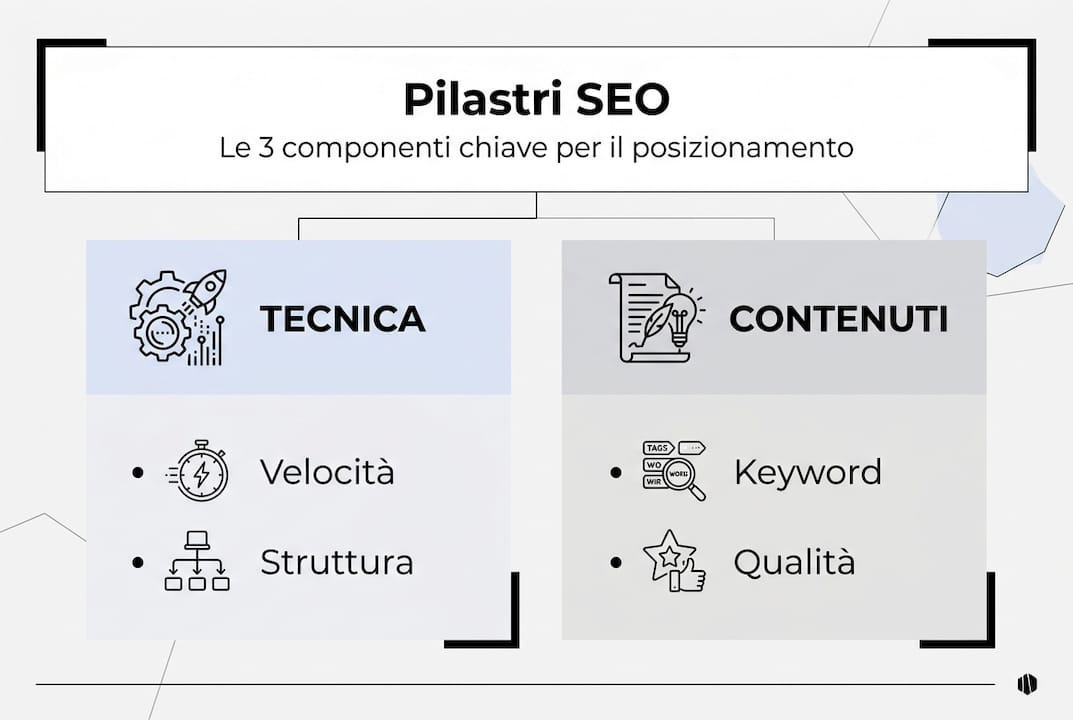
Off-page SEO builds your domain’s authority through external signals. High-quality link building from authoritative sites, brand mentions and optimising your Google Business profile are all activities that boost your credibility in Google’s eyes. For SMEs and professionals operating in local markets, local SEO becomes particularly strategic: appearing in geotargeted searches drives qualified traffic from potential customers in your area.
Key elements of an integrated SEO strategy:
- A website loading time of less than 3 seconds to reduce the bounce rate
- A descriptive and hierarchical URL structure that facilitates navigation and indexing
- Mobile-first design to ensure usability across all devices
- Active SSL certificate for security and user trust
- Markup schema for structured data that improves snippets in search results
An effective strategy utilises all three pillars simultaneously. You cannot compensate for a weak technical structure with excellent content, nor can you expect lasting results without link building. The services of website positioning and SEO Professionals integrate these elements into a coherent plan that delivers measurable results in the medium term.
Pro tip: Always start with a comprehensive technical audit before investing in content or link building. Resolving issues relating to crawlability, speed and indexing lays the foundations for all other optimisations and maximises the return on subsequent SEO investments.
Optimising your website for local search rankings: techniques and tools
Local SEO presents a strategic opportunity for small and medium-sized businesses that serve customers in specific geographical areas. Optimising your local presence means appearing in search results for queries such as “lawyer in Milan” or “plumber in central Rome” when potential customers are looking for services nearby.
Google Business Profile is the key tool for local visibility. A complete and up-to-date listing appears in the local pack – the section with a map that Google displays at the top of the results for location-based searches. Enter accurate details regarding your address, opening hours, business category and telephone number. Add professional photos of your premises, products or services every week to keep your listing active and engaging.
Reviews play a crucial role in local rankings. Google assesses the quantity, quality and frequency of reviews to determine which businesses to display first. Encourage satisfied customers to leave genuine feedback and always respond, whether to positive or negative comments. This interaction demonstrates professionalism and a focus on customer service, factors that influence both the algorithm and purchasing decisions.
High-quality link building from local sources boosts your domain’s local authority. Collaborate with trade associations, chambers of commerce, local online newspapers and other authoritative websites in your area. Guest posts on relevant local blogs, sponsorship of local events and partnerships with other complementary businesses create natural backlinks that Google interprets as signals of local relevance.
Essential steps to improve local search rankings:
- Verify and claim your Google Business Profile if you haven’t already done so
- Ensure your NAP (Name, Address, Phone) details are consistent across all online portals and directories
- Create dedicated pages for each geographical area served, with specific content
- Optimise your meta tags by including target towns or neighbourhoods in the descriptions
- Post weekly updates on your Google listing featuring offers, news or useful tips
- Collect reviews regularly and reply to every piece of feedback within 48 hours
- Use the LocalBusiness markup schema for structured data on the website
| Instrument | Main function | Cost | Ideal for |
|---|---|---|---|
| Google Business Profile | Managing your local listing and reviews | Free | All local activities |
| BrightLocal | Audit of citations and monitoring of local rankings | Subject to a fee | SEO agencies and professionals |
| Moz Local | Data distribution across multiple directories | Subject to a fee | Multi-site operations |
| Google Search Console | Analysis of local queries and performance | Free | Organic monitoring |
| Semrush Local | Review management and listing management | Subject to a fee | Businesses with a medium to high budget |
Pro tip: Monitor local performance by creating custom reports in Google Analytics that filter traffic by city or region. Cross-reference this data with conversions to identify which geographical areas generate the most qualified customers, and focus your optimisation efforts on those areas.
The tools of search engine optimisation Professional services help you scale up these activities and measure concrete results. Investing time in local SEO yields tangible returns because you tap into existing demand from people in your area who are ready to buy.
create content and carry out on-page optimisation for effective professional websites
Content is at the heart of on-page SEO and determines whether your website effectively answers users’ queries. Creating original, useful and optimised content requires a strategic approach that balances the needs of search engines with value for readers.

Keyword research comes before any content creation activity. Identify the keywords your target audience actually uses when searching for the solutions you offer. Tools such as Google Keyword Planner, Ubersuggest or Answer the Public reveal search volumes, competitive difficulty and related queries. Focus on specific long-tail keywords that indicate high purchase intent, such as “e-commerce website quote Milan” rather than generic terms like “website”.
Keywords should be integrated naturally into the text. Include the main keyword in the title tag, the meta description, the H1 heading and the first 100 characters of the content. Use semantic variations and synonyms in the following paragraphs to avoid keyword stuffing. Google understands context and rewards content that covers a topic comprehensively rather than mechanically repeating the same phrase.
The structure of the content influences both the user experience and how crawlers scan the page. Use hierarchical headings (H1, H2, H3) to organise the information into logical sections. Short paragraphs of 3–4 sentences improve readability on mobile devices. Bulleted and numbered lists make it easier to scan the text quickly. Optimised images with descriptive alt text enrich the content and provide opportunities for ranking in image search results.
I professional websites They stand out for their loading speed and mobile usability. Compress images without losing quality, enable browser caching and minimise CSS and JavaScript. Test the site on different devices to ensure that menus, forms and calls to action work perfectly on small screens.
| On-page optimisation | The correct approach | Common mistake |
|---|---|---|
| Keyword in the title | Place the main keyword at the beginning of the title | Filling the title with too many keywords separated by pipes |
| Meta description | Writing a persuasive description with a call to action and keywords | Copy the first paragraph of the text or leave this field blank |
| Content length | Create comprehensive content that covers the topic | Writing short texts just to meet the minimum word count |
| Internal linking | Link to related pages using descriptive anchor text | Always use “click here” or “read more” as the anchor text |
| Images | Compress files and add specific alt text | Uploading large photos without optimisation |
| URL structure | Create short, descriptive slugs with keywords | Retain automatic URLs with numbers and parameters |
Update existing content regularly to keep it relevant. Google favours fresh pages that reflect up-to-date information. Review older articles every 6–12 months, add recent data, remove outdated sections and improve optimisation based on observed performance.
The professional website design requires attention to these technical and content-related details right from the design stage. A website built with integrated SEO achieves results more quickly than projects that attempt to add optimisations at a later stage.
Factors that improve engagement and reduce the bounce rate:
- Embedded videos that explain complex concepts visually
- Original infographics that summarise data and processes
- Clear calls to action strategically placed within the content
- Testimonials and case studies demonstrating tangible results
- Interactive tools or calculators that offer immediate value
Every page must have a clear purpose and guide the visitor towards a specific action. Whether it’s requesting a quote, downloading a resource or contacting you for advice, the process must be intuitive and free of obstacles.
monitoring, analysis and ongoing updating of SEO strategies
Organic ranking is not a static goal but a dynamic process that requires constant monitoring and strategic adjustments. Measuring performance allows you to identify what is working, where to invest resources, and which tactics need to be adjusted.
Google Analytics and Search Console are the essential tools for analysing organic traffic. Analytics reveals how many visitors come from search engines, which pages they visit, how long they stay and whether they complete conversions. Search Console shows which search queries your site appears for in the results, its average position, its click-through rate and any technical errors preventing it from being indexed correctly.
Key metrics to monitor on a weekly basis:
- Target keyword positions to monitor improvements or declines in rankings
- Total organic traffic and traffic per page to identify trends
- Average click-through rate for optimising underperforming titles and descriptions
- Bounce rate per page to identify content that falls short of expectations
- Conversion rate from organic traffic to measure visitor quality
- Backlinks gained and lost: assessing the health of your backlink profile
- Page loading speeds to maintain optimal technical performance
The cyclical approach ensures continuous improvement. It analyses the data collected, identifies opportunities for optimisation, implements targeted changes and measures the impact after 4–6 weeks. This cycle of analysis, action and review enables you to refine your strategy based on concrete evidence rather than assumptions.
Google’s algorithms are constantly evolving, with hundreds of updates each year. Significant core updates can cause even well-optimised websites to drop in the rankings. Staying informed about these changes and adapting your tactics accordingly protects your SEO investment. Follow authoritative sources such as the official Google Search Central blog and professional communities to stay ahead of trends.
“Effective positioning strategies require an ongoing commitment to monitoring performance and updating content in line with changes to algorithms and user behaviour.”
Competitive analysis offers valuable insights. Identify the 3–5 direct competitors who rank highest for your target keywords and analyse their strategies. What topics do they cover? How do they structure their content? From which sources do they obtain backlinks? This information reveals gaps in your strategy and untapped opportunities.
Record every significant change you make to the website in a detailed log, including dates and descriptions. When you notice changes in performance, you can accurately identify the cause and effect. This history becomes a valuable resource for future decision-making and for communicating results to stakeholders or colleagues.
Professional SEO strategy update services include monthly reports that translate complex data into actionable insights. Having an expert partner who continuously monitors your performance frees up your time so you can focus on your core business whilst maintaining your digital competitiveness.
Discover our professional website optimisation services
Implementing effective SEO strategies requires technical expertise, dedicated time and keeping up to date with best practice. If managing these activities in-house proves too complex or takes resources away from your business, entrusting the work to an experienced professional will speed up results and optimise your investment.
How freelance webmaster specialising in website design, I offer comprehensive solutions that combine professional design with SEO optimisation right from the design stage. I create websites that not only effectively represent your brand, but are built to rank organically and convert visitors into customers.
I web services for businesses These include in-depth technical audits, a bespoke keyword strategy, optimisation of existing content and high-quality link building. I work with small and medium-sized businesses and professionals to develop sustainable SEO plans that deliver measurable growth in organic traffic and conversions.
If you wish to improve your business’s online visibility and attract qualified customers via search engines, the services offered by website positioning and SEO are designed to meet the specific needs of the Italian market. Contact me for a free initial consultation and find out how to position your website effectively.
Frequently asked questions about website ranking strategies
How are SEO strategies integrated into the design of a corporate website?
SEO strategies must be incorporated right from the website design stage. This includes choosing an SEO-friendly platform, a logical URL structure, an information architecture based on keyword research, optimised loading speed and a responsive design. Adding SEO after launch requires costly changes and limits the results.
How long does it take to see tangible results from organic search rankings?
The first improvements in the rankings generally appear after 3–4 months of consistent optimisation, whilst significant results in terms of traffic and conversions take 6–12 months. SEO is a medium- to long-term strategy that yields increasing benefits over time, unlike paid advertising, which stops as soon as you stop investing.
What is the difference between local and national search engine optimisation for SMEs?
Local SEO targets geolocated results for searches such as “service + city” and requires optimisation of Google Business Profile, local citations and location-specific content. National SEO competes on generic keywords without geographical references, requires greater domain authority and faces fiercer competition. For SMEs serving specific areas, local SEO offers a higher ROI.
How do I choose the most effective keywords for my business?
Use keyword research tools to analyse the searches your ideal customers actually carry out. Weigh up search volume, competitive difficulty and commercial intent. Opt for specific long-tail keywords that indicate clear needs rather than generic, highly competitive terms. Also consider informational keywords to attract users in the early stages of the buyer’s journey.
Why is continuous monitoring of SEO performance so important?
Google’s algorithms change frequently, competitors are refining their strategies, and user behaviour is evolving. Constantly monitoring metrics such as rankings, traffic and conversions enables you to identify issues quickly, capitalise on emerging opportunities and continuously optimise your strategy. Without regular analysis, you risk losing rankings without realising it until the damage is significant.
What monthly budget should an SME set aside for SEO?
The budget depends on objectives, sector and level of competition, but SMEs should consider a minimum investment of 500–1,500 euros per month for ongoing professional SEO services. This includes technical optimisation, content creation, link building and monitoring. Smaller budgets limit the speed at which results are achieved, whilst larger investments accelerate ranking in competitive markets.



