


Many small and medium-sized Italian businesses believe that simply having a website online is enough to be visible on Google. In reality, without careful optimisation of the elements within your pages, your site risks remaining invisible to potential customers. On-page SEO refers to the set of techniques that transform your web pages into relevant content that ranks well on search engines. This article guides you through concrete and practical strategies to improve your business website’s visibility, qualified traffic and conversions, with a specific focus on the needs of Italian SMEs and freelancers.
Contents
- Key points of on-page SEO explained
- How on-page SEO works: key elements and techniques
- Common mistakes and advanced aspects of on-page SEO
- Audit and practical application of on-page SEO for SMEs and freelancers
- How Andrea Freelance can help you with on-page SEO
- FAQs on on-page SEO for SMEs and freelancers
Key Points
| Full stop | Details |
|---|---|
| On-page SEO elements | Optimising title tags, meta descriptions, headings, images, URLs and internal links improves relevance and search engine rankings. |
| Common SEO mistakes | Avoid keyword stuffing and thin content so as not to penalise the website and to maintain genuine value for users. |
| Use of free tools | The free tools enable you to identify the optimisation priorities to be implemented. |
| Internal and external links | Create logical pathways between pages using descriptive anchor text and cite authoritative sources to boost credibility. |
How on-page SEO works: key elements and techniques
On-page SEO is the optimisation of internal elements to web pages to improve semantic relevance, user experience and Google rankings. Every component of your page sends specific signals to search engines about the quality and relevance of the content.
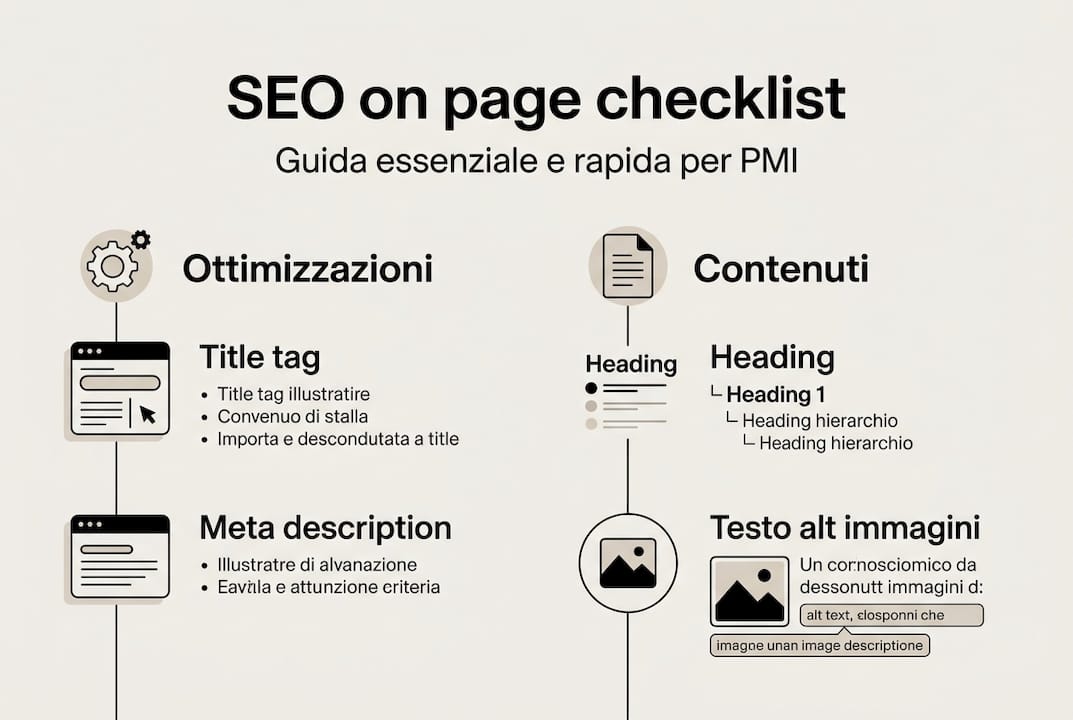
The title tag is the first element that Google and users see in search results. It must contain the main keyword within the first 60 characters and include a clear benefit for the reader. An effective meta description, on the other hand, acts as a micro-advertisement: it summarises the page’s value in 150–160 characters and encourages clicks with a specific call to action.
The structure of the headings creates the semantic hierarchy of the content. The H1 heading identifies the main topic and must be unique per page, whilst H2 and H3 headings organise logical subsections that make the content easier to scan for both users and web crawlers. This information architecture drastically improves readability and helps Google understand the topics covered.
Optimised URLs convey clarity and professionalism. Keep them short, descriptive and free of unnecessary parameters. A URL such as “tuosito.it/servizi-seo-pmi” works better than “tuosito.it/pagina?id=12345” because it gives a preview of the content and includes relevant keywords. The features of a professional website always incorporate this attention to technical detail.
Images require descriptive alt text that explains the visual content in a natural way. As well as improving accessibility, these attributes offer additional opportunities to incorporate contextual keywords in a natural way. Always compress images to speed up loading times, which is a critical factor for the mobile experience.
Internal links create logical pathways between your pages, distribute authority and guide users to related content. Link general pages to specific ones using descriptive anchor text. External links to authoritative sources, on the other hand, boost the credibility of your content. Find out what on-page SEO is to explore these fundamental concepts in greater depth.
Pro tip: Create an on-page optimisation template to standardise the process. Include checklists for titles, meta descriptions, headings, images and links. This systematic approach ensures consistency and reduces errors, especially when managing dozens of pages. The best practices for WordPress websites can guide you through the technical implementation.
Common mistakes and advanced aspects of on-page SEO
Even experienced professionals make mistakes that undermine SEO results. Keyword stuffing – the forced and repetitive insertion of keywords – is an outdated practice that Google actively penalises. Instead, focus on writing naturally to answer users’ questions.
‘Thin’ content – pages with little text or superficial information – seriously damages search rankings. The Helpful Content Update penalises over 28% thin content, whilst it is important to avoid keyword stuffing and content cannibalisation. Each page must offer unique and in-depth value on its specific topic.
Keyword cannibalisation occurs when several pages on your website compete for the same search query. This confuses Google and dilutes authority. Carry out an audit to identify overlaps and either consolidate or clearly differentiate the content. A search engine positioning strategy Good planning prevents these problems.
E-E-A-T (Experience, Expertise, Authoritativeness, Trustworthiness) has become crucial for search rankings, particularly in YMYL sectors. It demonstrates expertise through:
- A detailed biography of the author with verifiable credentials
- References to authoritative sources and sector studies
- Customer reviews and documented case studies
- Professional qualifications and industry memberships
Optimisation for artificial intelligence requires an ‘answer-first’ approach. Structure your content to answer common questions directly, use structured FAQ schema data, and create concise paragraphs that AI systems can easily extract and summarise. The ClickRank’s on-page SEO guide explores these emerging techniques in greater depth.
For local SMEs, organic geo-targeting boosts visibility in location-based searches. Include references to your town or region organically within your content, without spamming. Phrases such as “business services in Milan” or “consultancy for freelancers in Lombardy” work well when integrated naturally into the text.
“By 2026, on-page optimisation will no longer be just about keywords and tags. It will be about creating excellent user experiences that address specific search intentions, underpinned by flawless technical signals and demonstrable authority.”
Google’s post-2025 guidelines emphasise the originality of content and the reduction of manipulative practices. Avoid artificial link schemes, automatically generated content without human supervision, and black-hat tactics that promise quick results but lead to permanent penalties.
Audit and practical application of on-page SEO for SMEs and freelancers
Implementing on-page SEO requires a methodical approach that begins with an analysis of the current situation. For Italian SMEs and freelancers, it is crucial to start with an on-page audit using free tools such as the free version of Semrush and Screaming Frog, prioritising money pages and incorporating the LocalBusiness schema.
Step 1: Comprehensive technical audit
Use Google Search Console to identify crawl errors, unindexed pages and mobile usability issues. Screaming Frog allows you to analyse duplicate titles, missing meta descriptions, poorly structured headings and broken links. Make a note of all the issues in a spreadsheet, prioritising them based on their potential impact on traffic.
Step 2: Identifying strategic pages
Focus your efforts on the pages that generate, or have the potential to generate, revenue. For an e-commerce site, these are the product pages for best-selling items; for a services website, they are the conversion landing pages; and for a professional blog, they are the articles that attract qualified leads. These ‘money pages’ deserve priority optimisation over generic content.
Step 3: Implementation of optimised elements
Rewrite the title and meta description in line with best practice, restructure the content using logical headings, and optimise images and URLs. Add strategic internal links that connect related pages and strengthen the site’s thematic structure. The features of corporate websites Professional services always include this attention to detail.
Step 4: Structured data for local visibility
Implement the LocalBusiness schema to provide Google with accurate information about your location, opening hours, contact details and service area. This improves your visibility in local search results and on maps. You should also add the Organisation schema to strengthen your brand identity.
Step 5: Monitoring and continuous optimisation
In 2026, it is essential to optimise for AI readiness and measure ROI by combining on-page SEO and conversions using tools such as GSC and GA4. Set up custom dashboards that track key metrics such as average rankings, organic clicks, conversion rate and pages per session.
| Stage | Recommended tool | Estimated time | Priorities |
|---|---|---|---|
| Technical audit | Screaming Frog, GSC | 2–3 hours | High |
| Keyword analysis | Semrush, Ubersuggest | 3–4 hours | High |
| Content optimisation | CMS Editor, Yoast | 5–10 hours | Media |
| Schema implementation | Schema.org generator | 2–3 hours | Media |
| Monitoring results | GA4, GSC | 1 hour per week | High |
Pro tip: Create a monthly optimisation schedule. Dedicate the first week to auditing, the second to implementation, the third to content and the fourth to analysing results. This sustainable pace prevents burnout and ensures steady improvements. The website positioning and SEO It requires patience and perseverance, not sudden bursts of effort.
For freelancers and small businesses with limited resources, start by optimising 3–5 key pages rather than trying to overhaul the entire website at once. Measure the results of this test group, refine your approach and then gradually roll it out to other sections. This data-driven method reduces waste and maximises the return on your investment of time.
How Andrea Freelance can help you with on-page SEO
Optimising on-page SEO requires technical expertise, time and keeping up to date with changes to search engine algorithms. If you run an SME or work as a freelancer, you’ll probably prefer to focus on your core business rather than delving into the intricacies of structured data.
Andrea Freelance offers web services for businesses which include website creation, SEO optimisation and ongoing maintenance. With over 20 years’ experience in WordPress, WooCommerce and search engine optimisation strategies, Andrea supports Italian SMEs and professionals in building an effective and measurable digital presence.
Our services include comprehensive SEO audits, technical on-page optimisation, the creation of optimised content, and the implementation of bespoke website ranking and SEO strategies. Our approach combines established best practices with emerging innovations, ensuring websites that perform well today and remain competitive tomorrow.
If you’re looking for a Freelance webmaster specialising in website creation Whether you want to improve the search engine ranking of your existing website, Andrea offers personalised consultancy services that turn SEO theory into tangible results for your business.
FAQs on on-page SEO for SMEs and freelancers
What exactly is on-page SEO?
On-page SEO encompasses all the optimisations you apply directly to the pages of your website to improve search engine rankings. It includes technical elements such as title tags, meta descriptions, headings, URLs and images, as well as content-related aspects such as text quality, keyword research and internal links. Unlike off-page SEO, which focuses on backlinks and external signals, on-page SEO is entirely under your control.
How long does it take to see results after on-page optimisation?
The first signs of improvement may appear within 2–4 weeks for low-competition queries, whilst competitive keywords require 3–6 months of consistent work. Google must first re-crawl the modified pages, then reassess their ranking against the competition. The speed at which results are achieved also depends on the domain’s overall authority and the quality of the optimisation implemented. Monitor metrics weekly using website ranking and SEO tools to track gradual progress.
Which free tools are best for on-page audits?
Google Search Console is an essential tool because it shows exactly how Google sees your website, highlighting crawl errors, indexing issues and search performance. The free version of Screaming Frog analyses up to 500 URLs, identifying duplicate titles, missing meta descriptions and technical issues. Ubersuggest offers limited but useful free keyword analysis for SMEs, whilst PageSpeed Insights measures speed and Core Web Vitals. Combine these tools for a comprehensive overview without any initial investment.
How can you avoid Google penalties with on-page SEO?
Follow Google’s guidelines by avoiding manipulative practices such as keyword stuffing, hidden text, cloaking or duplicate content. Focus on original content that offers real value to users, use keywords naturally and maintain a clean technical structure. Avoid excessive internal linking schemes that appear artificial, and do not publish ‘thin’ content simply to pad out pages. Transparency and authenticity are the best defence against algorithmic or manual penalties.
How can on-page SEO be integrated with content marketing strategies?
On-page SEO enhances the effectiveness of content marketing by optimising each piece of content for maximum visibility and conversions. Before creating content, carry out keyword research to identify topics that your audience is actively searching for. Structure articles and pages with clear headings, use internal linking to create thematic pathways, and optimise technical elements to facilitate indexing. Content marketing generates valuable material; on-page SEO ensures that this material reaches the right audience at the right time via search engines.



