
Having a vulnerable website isn’t just a technical issue: it’s a real risk to your turnover, your reputation and the trust your customers place in you. Italian SMEs account for 43 per cent of the targets cyberattacks, and 60 per cent of those affected cease trading within six months. These figures give pause for thought, especially considering that many small businesses and self-employed professionals believe they are “too small” to be of interest to hackers. The reality is quite the opposite: SMEs are prime targets precisely because they often lack adequate protection. In this article, you’ll discover why web security isn’t a luxury reserved for large companies, but an essential investment for growing with confidence and standing out from the competition.
Contents
- Why website security is essential for SMEs and professionals
- The tangible benefits of a secure website: customer data, reputation, SEO
- Beyond HTTPS: what it really takes to make a website secure
- Security ROI: costs, incentives and return on investment
- Why web security is now the true, unseen ally of SMEs
- Find out how to make your website truly secure
- Frequently Asked Questions about website security
Key Points
| Full stop | Details |
|---|---|
| SMEs in the hackers’ sights | Small and medium-sized enterprises are among the most common targets and the most vulnerable to cyber-attacks. |
| A secure website = greater trust | A secure website boosts customer confidence and enhances a company’s reputation. |
| Security improves SEO | The use of HTTPS and other security measures helps improve search engine rankings. |
| Security: an investment, not a cost | Investing in safety prevents damage, fines and loss of business, whilst also making the most of available incentives. |
Why website security is essential for SMEs and professionals
Let’s start with a fact that should give every business owner or self-employed person pause for thought: 40 per cent of cyber attacks In Italy, it affects SMEs, with an average cost per breach exceeding 95,000 euros and peaks reaching 300,000 euros. These are not just abstract figures: they represent the closure of a business, operations being halted for weeks, and the loss of customers won over through years of hard work.
Who is targeting small businesses, and why?
Hackers do not choose their targets solely on the basis of size. They choose them on the basis of vulnerability. An SME or a professional practice with an out-of-date WordPress site, no regular backups and weak passwords presents a much easier opportunity to exploit than a large company with a dedicated security team.
The main reasons why strikers are drawn to smaller clubs are:
- Access to customer data: credit card numbers, email addresses, personal details. Any e-commerce site or website with a contact form is a potential repository of valuable data.
- Ransomware: the website is blocked and a ransom is demanded to restore it. Many SMEs pay because they do not have backups or do not know what to do.
- Theft of computing resources: the website is being used for illegal activities such as cryptocurrency mining or sending spam, without the owner realising it.
- Targeted reputational damage: In extreme cases, competitors may commission attacks to harm a direct rival.
- Access to the supply chain: an SME that works with large clients can become a point of entry for attacking larger, better-protected organisations.
The figures nobody wants to hear
In 2025, One in four SMEs has suffered at least one cyber attack, with cyber incidents in Italy rising by 53 per cent in the first half of the year compared with the previous year. This surge is no coincidence: the rapid digitalisation following the pandemic has driven many businesses online without equipping them with the necessary security measures.
“Thinking you’re too small to be targeted is the most dangerous vulnerability of all. Hackers look for the open door, not the biggest building.”
Common mistakes that increase the risk include using out-of-date themes and plugins on WordPress, not having two-factor authentication for logging into the control panel, not having an application firewall, and not having automatic daily backups. Each of these factors, taken individually, is enough on its own to compromise your entire online presence.
To understand how protecting your online business To do this effectively, the first step is to recognise that security is not an optional extra: it is the foundation upon which any sound digital strategy must be built.
The operational consequences of an attack
The consequences of a cyberattack are not limited to immediate financial damage. A compromised website is often blacklisted by search engines, which means a loss of organic visibility and a complete drop in traffic. Google may display a warning stating “This site may be dangerous” to visitors, with devastating effects on customer trust. Restoring an online reputation following an attack requires months of work and considerable resources.
The tangible benefits of a secure website: customer data, reputation, SEO
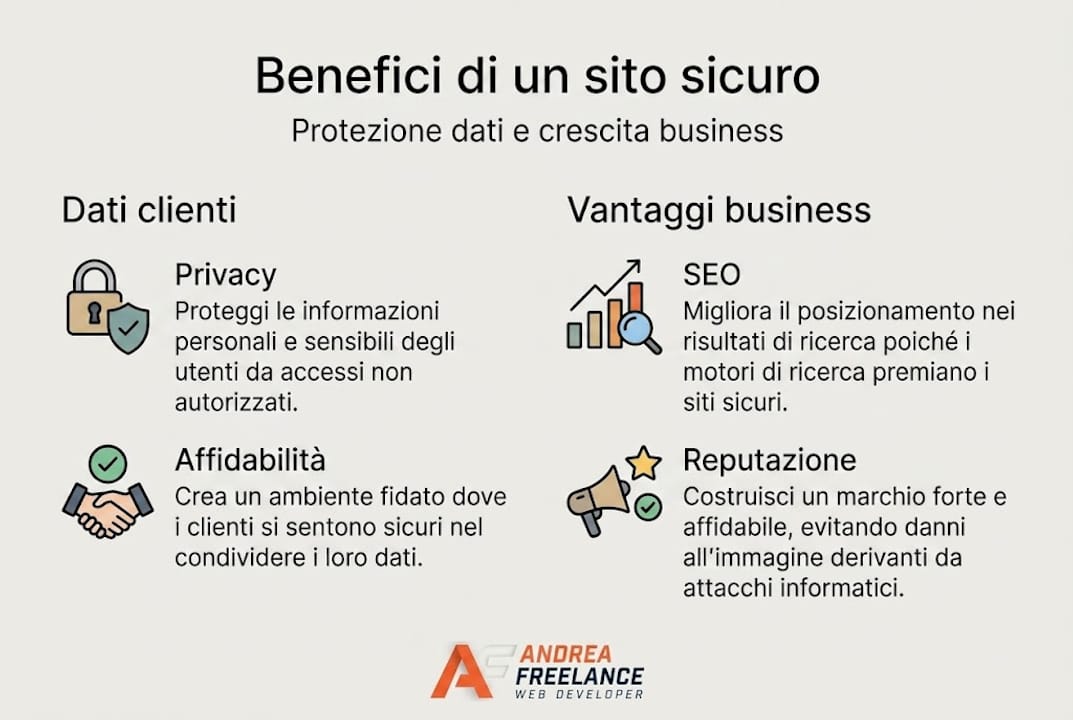
Having analysed the risks, it is now time to look at the other side of the coin: what you actually gain when your website is properly protected. The benefits are not just technical; they are also commercial and reputational.
HTTPS, the GDPR and customer trust
An SSL (Secure Sockets Layer) certificate is the basic level of security that changes your website’s address from http:// a https://, by clicking on the padlock icon visible in the browser bar. This seemingly small symbol has a huge impact on visitors’ perception. A Properly configured HTTPS It improves your Google ranking, boosts customer trust, prevents “not secure” warnings in browsers and helps ensure compliance with GDPR regulations.
From a regulatory perspective, the GDPR (General Data Protection Regulation) requires any website that collects personal data – even if it is just an email address via a contact form – to protect this information using appropriate technical measures. The absence of HTTPS is in itself a potential breach, with fines of up to 4 per cent of global annual turnover.
The tangible difference between a secure website and an insecure one
Here is a direct comparison to help you understand what changes in practice:
| Feature | Insecure website | Secure website |
|---|---|---|
| Protocol | HTTP | HTTPS with a valid SSL certificate |
| Browser | “Not Safe” exhibition” | Show green padlock |
| Google SEO | Penalised in the rankings | Prioritised in indexing |
| GDPR | Potentially non-compliant | Compliant if configured correctly |
| Conversions | Lower due to a lack of confidence | Taller thanks to reassurance |
| Risk of breach | High | Significantly reduced |
| Reputation | At risk in the event of an attack | Protected and controllable |
The figures speak for themselves: on average, a website with HTTPS converts better than one without a certificate, because visitors feel safe providing their details or completing a purchase. This is particularly relevant for e-commerce sites and for professionals who collect online enquiries.
How security supports growth
A secure website is not just a “website that doesn’t break”: it is an asset that works for you even when you’re not there. It actively contributes to the secure sites strategy because Google rewards websites that meet security standards with higher rankings. This means more organic traffic, greater visibility and more business opportunities without increasing your advertising budget.
For improve visibility on Google, security has become an official ranking factor. A website that Google considers trustworthy is displayed ahead of others to potential customers searching for your services or products.
Tangible benefits of a secure website for your business:
- Increased conversion rate thanks to the trust visitors place in the site
- Better organic search engine rankings
- Regulatory compliance with the GDPR and NIS2, avoiding penalties
- Reduced risk of downtime and data loss
- Protecting the brand’s reputation in the event of attempted attacks
- Greater credibility with partners, suppliers and B2B customers
Pro tip: First and foremost, check that your website has an active and correctly configured SSL certificate. You can do this by typing your website’s address into your browser: if the padlock appears, you’re good to go. If “Not secure” appears, you need to take immediate action. Contact an expert to choosing the right developer which can guide you through the next steps.
Beyond HTTPS: what it really takes to make a website secure
Many SMEs make the mistake of thinking that installing a SSL certificate is enough to give you peace of mind. That is not the case. HTTPS is the starting point, not the end goal. True security requires a multi-layered approach that protects the website from multiple angles simultaneously.
As experts confirm, many SMEs underestimate the risks, believing they are “too small” to be a target, but it is precisely these businesses that are the weak link in the supply chain. The recommended approach is a multi-layered one: SSL plus WAF (Web Application Firewall) plus regular updates.
The key measures to be implemented
Here are the practical steps that every SME and self-employed person should take:
- Updated SSL certificate: check that it has not expired and that it covers all the subdomains used by the website.
- Web Application Firewall (WAF): filters out malicious traffic before it reaches the server, blocking common attacks such as SQL injection and cross-site scripting (XSS).
- Regular CMS updates: If you use WordPress, update the core, themes and plugins as soon as new versions become available. Known vulnerabilities are exploited within hours of being disclosed.
- Daily automatic backups: Keep backups of the website and the database in a location outside the main server. In the event of an attack, you’ll be able to restore everything in a matter of minutes.
- Two-factor authentication (2FA): Secure access to the admin panel with a second level of verification, such as an SMS code or an authentication app.
- Continuous monitoring: use tools that alert you immediately in the event of unauthorised changes to the website’s files or suspicious activity.
- Strong passwords and access management: Every CMS user must have unique and strong login details. Remove any unused accounts.
Table of key measures and their effects
| Security measure | Impact on safety | Impact on SEO and business |
|---|---|---|
| SSL/HTTPS Certificate | Encrypts data in transit | Improve your ranking, remove browser warnings |
| WAF (web application firewall) | Block automated attacks | Reduces downtime, protects reputation |
| CMS and plugin updates | Fixes known vulnerabilities | It maintains compatibility and performance |
| Daily backups | Enables quick recovery | Reduces data loss and revenue loss |
| 2FA authentication | Prevents unauthorised access | Protects customer data and complies with the GDPR |
| Continuous monitoring | Early detection of threats | Swift action, minimal damage |
| User and permissions management | Reduces the attack surface | Improve governance and compliance |
To understand all the characteristics of a truly secure website, it is essential to view each level of protection as part of an integrated system, rather than as isolated solutions.
Pro tip: Create a monthly checklist to follow for website maintenance: checking for updates, testing backups, reviewing access logs and scanning for malware. It takes less than an hour a month but can save you weeks of work sorting out the aftermath of an attack. If you don’t have the time or the skills to do this, consider hiring a professional to manage the Steps to a secure website systematically.
One aspect that is often overlooked is hosting security. Not all providers offer the same level of protection. A cheap shared hosting plan can expose your website to the security issues of other websites on the same server. It is worth investing in a high-quality hosting service, preferably one that includes a firewall, a free SSL certificate and automatic backups. As experience with Italian SMEs shows, a structured approach to security – combining SSL with additional measures – protects customer data, boosts conversions, improves SEO and helps avoid GDPR and NIS2 penalties, delivering a very high return on investment relative to the initial outlay.
Security ROI: costs, incentives and return on investment
At this point, you’re probably wondering how much it costs to secure a website and whether it’s really worth it. The answer is yes, and the figures confirm this beyond any doubt.
The cost of a breach versus the cost of prevention
Let’s compare the two scenarios using actual data:
| Scenario | Estimated cost | Operational impact |
|---|---|---|
| Unprotected intercourse | From 95,000 to 300,000 euros | Downtime, loss of customers, GDPR fines |
| Basic Annual Safety Plan | From 500 to 3,000 euros | Continuous protection, compliance, trust |
| Post-attack recovery without a backup | From 5,000 to 50,000 euros | Website restoration, data recovery, PR |
| Annual backup and monitoring | From 200 to 1,000 euros | Restoration within hours, damage minimised |
The maths is simple: investing a few hundred euros a year in security protects you from potential losses that are tens or hundreds of times greater. That’s a return on investment (ROI) that’s hard to ignore.
The digital maturity of Italian SMEs
The The 2025 SME Cyber Index stands at 55 out of 100, with only 16 per cent of small and medium-sized enterprises classified as “mature” in terms of cyber security. This means that 84 per cent of Italian SMEs still have significant room for improvement, and that those who invest in security today gain a real competitive advantage over their rivals.
MIMIT (Ministry of Enterprise and Made in Italy) vouchers offer a tangible opportunity to fund the upgrading of cyber security, including website protection, without having to bear the full cost yourself.
How to access the incentives
Here’s what you need to know to access the available grants:
- MIMIT vouchers for cybersecurity and cloud services: The Ministry for Enterprise is offering grants to SMEs that invest in cyber security and cloud services. The vouchers cover a percentage of the costs incurred.
- Tax credit for digital transition: certain cyber security expenditure is covered by the Industry 4.0 and Transition 5.0 schemes, offering significant tax relief.
- Regional calls for proposals: Many Italian regions offer subsidised loans to support the digitalisation of SMEs, which may include cybersecurity measures.
- Credit guarantee consortia and subsidised loans: Some trade associations offer access to credit on favourable terms for investment in technology.
40 per cent of cyberattacks target SMEs, with average costs exceeding 95,000 euros per breach. An investment in web security, even a modest one, can be worth tens of times its initial cost.
Calculating the ROI of security
To calculate the actual return on investment in security, consider the following factors:
- Potential cost of an attack: Estimate the losses you would incur as a result of downtime, loss of customers, fines and recovery costs.
- Probability of an attack: with one in four SMEs affected each year, the likelihood is by no means negligible.
- Cost of protective measures: A professional security plan for an SME’s website can cost between 500 and 5,000 euros a year, depending on its complexity.
- Indirect benefits: increased conversions through trust, improved SEO rankings, and regulatory compliance to avoid penalties.
Following the security and SEO strategies most effective for SMEs; the result is not just a secure website, but a digital asset that generates measurable value over time.
Why web security is now the true, unseen ally of SMEs
I have worked with dozens of SMEs and professionals over the last few years, and I have noticed a recurring pattern: security is seen as an issue to be dealt with “afterwards” or “when something happens”. This reactive approach is exactly what attackers exploit.
There is, however, a truth that goes beyond figures and statistics: web security is not a technical cost; it is a driver of marketing and growth. A website that always works, that doesn’t display alarming warnings to visitors, that protects customer data and that Google considers trustworthy is not just “secure”: it is a website that sells better, converts more and builds trust over time.
The cost of inaction is invisible until it becomes apparent. You don’t see the customer leaving the site because they saw the “Not secure” warning. You don’t see the rankings lost on Google due to an unresolved technical security issue. You don’t see the leads that don’t come in because your website was offline for a few hours. This damage exists, even if you don’t measure it.
Companies that invest in security today are building something that will become a competitive advantage tomorrow: a reputation for being a reliable partner, a supplier you can count on, and a professional who treats customer data with respect and responsibility. Customers and search engines are rewarding this reliability in an increasingly direct way.
For a more in-depth look at the real risks and direct benefits, my advice is not to wait for something specific to happen before taking action. Web security is like insurance: you don’t think about it until you need it. But unlike insurance, investing in security brings active benefits every day, not just when things go wrong.
Find out how to make your website truly secure
Once you realise just how crucial it is to have a secure website, the next step is to take concrete action, with the support of someone who really knows what they’re doing. With over 20 years’ experience in building and maintaining websites for Italian SMEs and professionals, I can assess the security level of your current website and identify the areas requiring priority attention.
Whether you need a website redesign and security Whether you need a complete overhaul or a targeted review of the technical aspects, I can guide you step by step towards a website that protects your data and that of your customers, converts better and scales with your business. The professional advice on secure websites It is the quickest and most reliable way to turn security from a concern into a real competitive advantage. Contact me for a free assessment of your website.
Frequently Asked Questions about website security
What are the signs that my website isn’t secure?
“Not secure” warnings in the browser, the absence of HTTPS in the address bar, and the collection of data via unencrypted forms are the most obvious and worrying signs that should be checked straight away.
Does a static website really need security measures?
Yes, even a static website that does not collect data can be compromised and become a vehicle for malware or phishing, harming visitors and damaging your online reputation. As highlighted by the security data for SMEs, no website is immune to these risks.
How much does a data breach cost an SME on average?
The average cost per breach exceeds 95,000 euros for Italian SMEs, with some cases reaching 300,000 euros when downtime, recovery costs, fines and loss of customers are taken into account.
Are there any incentives or vouchers available to help secure a website?
Yes, the MIMIT scheme provides cybersecurity and cloud vouchers for Italian SMEs, with grants covering a proportion of the costs associated with cybersecurity and digitalisation.