


Launching a website does not automatically mean that people will find you on Google. Yet this is one of the most widespread misconceptions amongst small and medium-sized Italian businesses: you create the website, you wait, and the customers will come of their own accord. It doesn’t work like that. Search engine optimisation is a precise process, involving technical decisions, targeted content and consistent effort over time. In this guide, you’ll discover what this term really means, how the mechanism behind search results works, what strategies you can adopt straight away, and why ignoring this aspect means losing ground to your competitors every single day.
Contents
- What is search engine optimisation and why is it so important?
- How search engine ranking works: from crawling to the SERP
- SEO and search engine ranking: differences, strategies and tangible results
- What affects search rankings today: the era of generative search
- Practical steps to improve your ranking
- The uncomfortable truth about positioning: the hard work that others don’t talk about
- Resources and support to really boost your search engine ranking
- Frequently Asked Questions about Search Engine Optimisation
Key Points
| Full stop | Details |
|---|---|
| Defined positioning | Ranking refers to the position achieved in search engines’ organic results for targeted keywords. |
| SEO and search engine ranking | SEO is the set of actions that lead to the best possible ranking. |
| New rules for 2026 | Generative research enhances the credibility and clarity of the content. |
| Practical steps | Continuously improving the website, its content and its structure yields tangible results. |
| Patience and adaptability | Truly effective positioning takes time, strategy and flexibility. |
What is search engine optimisation and why is it so important?
Let’s start with the definition. Search engine optimisation (SEO) involves improving a website’s visibility in SERPs (Search Engine Results Pages), with the aim of appearing as high up as possible and with high relevance for a specific query – that is, the word or phrase a user types into the search bar.
This must be clearly distinguished from paid adverts. When you search for something on Google, the top results labelled “Sponsored” are paid adverts. Organic ranking, on the other hand, refers to all unpaid results: those that appear because the search engine considers them relevant and authoritative. Appearing there doesn’t cost per click, but it does require effort and strategy.
“Search engine optimisation involves improving a website’s visibility in the SERPs, with the aim of appearing as high up as possible and with a high level of relevance for a specific query.”
Why should an SME or a self-employed professional be concerned about this? The answer is simple: every day, your potential customers search Google for products and services like yours. If you don’t appear amongst the top results, these people will choose a competitor. Not because the competitor is better, but simply because they find them first.
The tangible benefits of a good a winning strategy for positioning are specific and measurable:
- Increase in enquiries from users who are already interested in your service.
- Greater perceived authority: Appearing at the top of search engine results inspires confidence, as if Google were recommending you.
- Competitive advantage compared with competitors who do not invest in organic visibility.
- Constant, free traffic in the long term, unlike adverts which stop when you stop paying.
- Better targeting: Reach people at the exact moment they’re looking for what you offer – and not by chance.
For an SME with limited resources, this is one of the investments offering the best value for money in the medium term.
How search engine ranking works: from crawling to the SERP
Now that we understand why ranking is so crucial, let’s take a look at how it works behind the scenes. Google and other search engines operate in three main stages, and understanding each one will help you make better decisions for your website.
- Crawling (indexing): Search engines use automated programmes called “spiders” or “bots” that crawl the web by following links from one page to another. These bots read the content of the pages, analyse the site’s structure and gather information. If your website has technical issues such as blocked pages, inaccessible URLs or a confusing structure, the bots may not be able to read your content correctly.
- Indexing: After reading a page, the search engine decides whether to add it to its index – that is, the vast archive of available web pages. A page that hasn’t been indexed cannot appear in the results, however good its content may be. You can check whether your site has been indexed using Google Search Console, a free and essential tool.
- Ranking: This is the stage at which the engine decides in which position to display your page for a specific search. Hundreds of factors are taken into account, including the relevance of the content to the search query, the domain’s authority, page load speed, HTTPS security, the quality of inbound links from other sites, and much more.
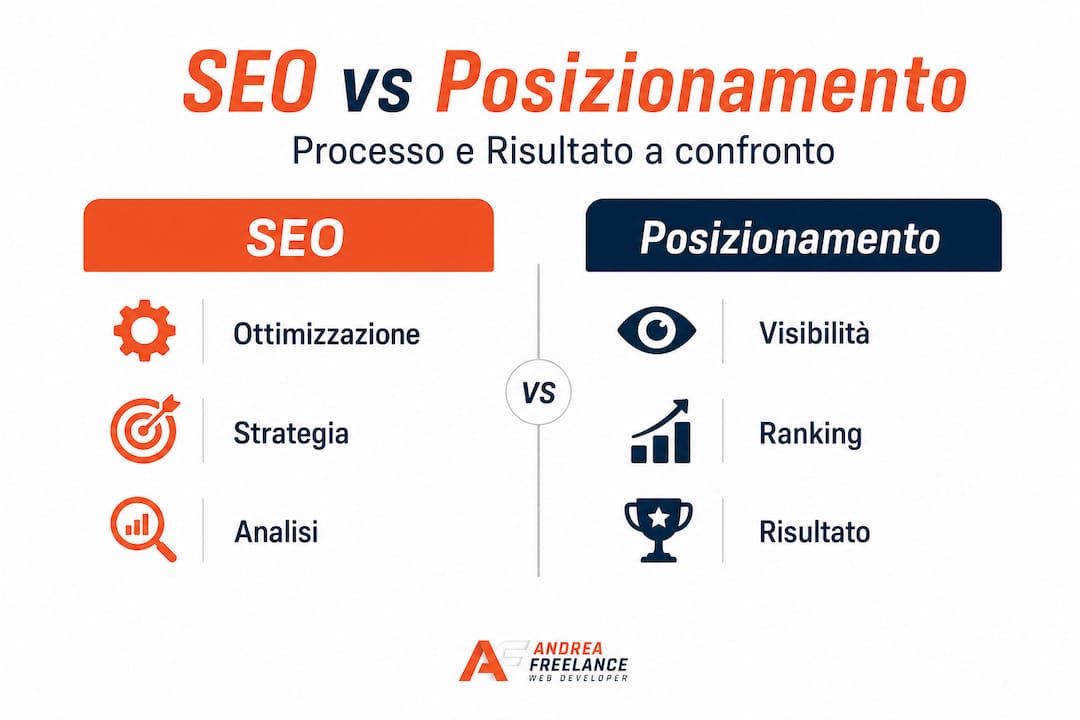
As the standard definition itself points out, “SEO is the process and ranking is the measurable outcome”: what you do technically and strategically is SEO; what you achieve in the results is ranking.
The factors that have the greatest influence on rankings today include:
- Semantic relevance: Does the content actually answer the user’s question?
- E-E-A-T: an acronym for Experience, Expertise, Authoritativeness and Trustworthiness. Google assesses whether the author of the content has genuine experience and certified expertise.
- Core Web Vitals: technical metrics relating to page speed and visual stability.
- Mobile-first: Google indexes the mobile version of the website first.
- Link building: the quantity and quality of the websites that link to yours.
Follow the effective positioning strategies It means taking action on all these levels in a coordinated manner, rather than focusing on just one aspect and hoping that will be enough.
Pro tip: Set up Google Search Console and Google Analytics 4 on your website before you even begin any SEO work. Without data, you cannot know where you’re starting from, nor can you measure your progress over time. These are free and essential tools.
SEO and search engine ranking: differences, strategies and tangible results
At this point, it is important to distinguish between what you can do (SEO) and what you achieve (ranking). SEO (Search Engine Optimisation) is the set of actions you implement. Ranking is the measurement of the result of those actions in the SERP.

This distinction, which is often overlooked, explains why there is no “one-size-fits-all SEO solution”: efforts must be ongoing because search engines update their algorithms, competitors never stop, and user behaviour changes.
The table below provides a practical overview of how SEO actions relate to expected results:
| SEO measures | Expected outcome regarding positioning |
|---|---|
| Keyword research and optimisation | Appear in search results for queries relevant to your sector |
| Creating in-depth and up-to-date content | Greater relevance and perceived authority by the search engine |
| Technical optimisation (speed, HTTPS, sitemap) | Improved crawling and indexing of pages |
| Link building from authoritative websites | Increase in domain authority |
| Optimisation for mobile devices | Better rankings in mobile search – a top priority today |
| Markup schema (structured data) | The opportunity to appear in rich snippets, offering greater visibility |
| Optimisation of meta tags (title, description) | Increase in CTR (Click-Through Rate) in the search results |
I the tangible benefits of SEO The benefits for an SME or a self-employed professional are well documented: an optimised website receives a steady stream of traffic without having to pay for every click, and users arriving via organic search tend, on average, to have higher conversion rates than those arriving via display advertising.
The Technical SEO and visibility They do not just concern keywords in the text. They also include the structure of URLs, loading speed measured in milliseconds (TTFB, or Time To First Byte, which is the time it takes for the server to respond), the presence of an XML sitemap and a valid robots.txt file.
Pro tip: Don’t expect to see significant results until you’ve been working consistently for at least three months. In highly competitive sectors, a realistic timeframe is six months. Anyone who promises you a top spot on Google within a few weeks is almost certainly using unethical techniques that risk getting your website penalised. SEO is a medium-term investment, not a shortcut.
What affects search rankings today: the era of generative search
As SEO evolves, it is no longer just about the technical aspects, but also about how new search systems interpret information. 2025 and 2026 marked a significant turning point: search engines are increasingly incorporating AI-generated answers directly into the SERP, ahead of traditional links.
This represents a profound game-changer. As the latest data shows, “generative research raises the bar for authorship and citability: the aim is not merely to rank highest in search results, but to ensure that the content is easily interpretable and credible for models and response systems”.
In other words, it is no longer enough simply to write a text containing the right keywords. The content must be structured in such a way that an artificial intelligence system can understand it, reference it and use it to answer users’ questions.
| Element | Pre-AI significance | The importance of generative research |
|---|---|---|
| Key words in the text | High | Average (necessary but not sufficient) |
| Authority of the author (E-E-A-T) | Media | Very high |
| A clear layout with FAQs and short paragraphs | Media | Very high |
| Markup schema and structured data | Low | High |
| Quotations and explicit sources | Low | High |
| Website speed | High | High (unchanged) |
The new SEO strategies Those that are successful today focus on the following elements:
- Complete and signed content: clearly states who wrote the content, with an author’s biography that attests to their genuine experience.
- Clear hierarchical structure: Use H1, H2 and H3 headings logically, with short, clearly separated paragraphs.
- FAQ on this page: Questions and answers help AI systems extract precise information.
- Structured data (markup schema): additional code in the HTML that tells search engines what each element on the page represents.
- Links to authoritative sources: Citing credible external sources boosts the credibility of your content in the eyes of ranking systems.
- Regular updating of content: Old, out-of-date pages lose their relevance much more quickly than they used to.
This scenario may seem complex, but it actually offers a great opportunity for SMEs and professionals who invest in high-quality content: websites that focus on substance outperform those that focus solely on volume.
Practical steps to improve your ranking
Having outlined the new challenges, let’s look at how to put them into practice in your own organisation. Here is a step-by-step checklist, designed for SMEs and professionals who want to get off to a methodical start without wasting resources.
- Analyse your existing website. Before you do anything else, use Google Search Console to find out which pages are indexed, which search queries are driving traffic to your site, and where there are technical errors. This is the starting point from which to measure everything.
- Carry out a keyword search. Identify the search terms your potential customers actually use, not the ones you think they use. Tools such as Google Keyword Planner or Ubersuggest can help you find out search volumes and competitive difficulty.
- Optimise the main pages. Every page on your website should answer a specific question. The SEO title (title tag) must be under 60 characters and contain the main keyword. The meta description must be clear and encourage clicks.
- Improve the speed of the website. A slow website affects both the user experience and search rankings. Measure its performance using Google PageSpeed Insights and address issues such as uncompressed images, unnecessary plugins and poor-quality hosting. Creating an effective website It also means building it on a solid technical foundation right from the start.
- Publish useful content on a regular basis. A blog that is regularly updated with articles relevant to your sector signals to search engines that the site is active and authoritative. There’s no need to post every day: two or four high-quality articles a month are worth more than 20 superficial pieces.
- Get links from other websites. Backlinks (links from other websites to yours) are still one of the strongest indicators of authority. You can obtain them by collaborating with partners, listing your site in industry directories, and writing guest posts on relevant blogs.
- Track progress over time. The improving our online presence It doesn’t happen in a linear fashion. Check the rankings of your keywords, organic traffic and the conversion rate of your key pages on a monthly basis.
- Correct technical errors on a regular basis. Broken links, duplicate pages, incorrectly configured redirects: these issues build up over time and quietly erode your search rankings. A technical audit every six months is a good habit to get into.
As the established definition of the sector states, positioning is the measurable outcome of all this work. This means that every action must be tracked and verified; it must not be carried out just once and then forgotten.
Pro tip: The most common mistake I see people making is focusing solely on content whilst ignoring the technical side, or vice versa. A fast, technically flawless website with poor content won’t climb the rankings. A blog full of articles on a slow, poorly structured website wastes all its potential. A balance between the two is needed.
The uncomfortable truth about positioning: the hard work that others don’t talk about
Having provided a practical guide, it is worth taking a moment to reflect on the less visible aspects of SEO and search engine ranking. In over twenty years of working in the web industry, I have seen hundreds of SMEs approach search engine ranking with expectations often shaped by unfulfilled promises.
The market is full of people promising a “guaranteed top spot” or “results in 30 days”. These promises almost always conceal one of two scenarios: either aggressive and unethical techniques are used, which can lead to penalties from Google (with devastating effects that are difficult to rectify), or they involve keywords that are so niche and uncompetitive that they do not generate any real traffic.
The truth is that effective search engine optimisation requires ongoing effort, regular analysis and the ability to adapt when the rules change – and they do change frequently. Google updates its algorithms hundreds of times a year, with some major changes (known as “core updates”) that can significantly shake up the rankings. Those who build their visibility on solid foundations – quality content and honest technical optimisation – weather these updates far better than those who have taken shortcuts.
Experience also teaches us something else: the best results always come from an integrated approach. Technical SEO alone is not enough; content alone is not enough; link building on its own is not enough. You need a holistic view that ties all the elements together. And this view is built through testing, data analysis and iterative adjustments, not through one-off ‘magic formulas’.
The good news is that building a solid organic presence is an asset that grows over time. A paid advert stops driving visitors the moment you stop paying. Well-ranked content continues to drive traffic for months or years. This is the true value of the actual web ranking: not a quick fix, but a long-term asset for your business.
Those who choose to build on solid foundations, accepting that it takes time, end up with a competitive advantage that their rivals cannot easily replicate. This is the sort of positioning that is truly worth pursuing.
Resources and support to really boost your search engine ranking
Understanding how search engine optimisation works is the first step. Putting it into practice consistently and methodically is the second step, and this is often where SMEs and professionals need the most support. If you’ve recognised your website in any of the issues described in this guide, or if you simply want to speed up results without wasting months of trial and error, you can rely on a SEO positioning service designed specifically to meet the needs of Italian SMEs. For those who wish to find out more before making a decision, the following are also available: practical SEO tips applicable straight away, with practical guidance on how to address the most critical issues on your website.
Frequently Asked Questions about Search Engine Optimisation
How long does it take to see results from search engine optimisation?
It depends on the level of competition and the website’s initial status, but it usually takes between 3 and 6 months to see tangible improvements in organic traffic and search rankings.
Is it best to focus solely on Google?
No, it is worth considering other search engines and channels as well, but Google is the priority in Italy in terms of search volume and the availability of advanced tools such as Search Console and Google Analytics.
What is the difference between SEO and search engine ranking?
As clarified by the definition of the sector, SEO is the process of optimisation, whilst search engine ranking is the result achieved for specific keywords: two sides of the same coin, not synonyms.
What will have the greatest influence on search rankings in 2026?
The quality, clarity and authority of content are more important than ever, particularly because, as the GEO 2026 Observatory highlights, generative search is raising the bar in terms of content authorship and citability.



