


You have an active e-commerce site, you’re getting some visitors, but sales aren’t taking off as you’d hoped. You’re not alone. A great many Italian entrepreneurs find themselves in this situation: an online shop built with dedication, but one that struggles to generate real and consistent conversions. The causes are often simpler than they seem. Mistakes in SEO optimisation, a structure that isn’t very user-friendly, incomplete product pages or the lack of targeted digital strategies can quietly stifle growth. In this guide, you’ll find practical methods, suitable for SMEs and freelancers, to transform your e-commerce site into a truly effective sales tool.
Contents
- Initial analysis: what is needed for growth
- SEO optimisation: the foundation for targeted traffic
- Advanced digital strategies to boost sales
- Common mistakes and how to avoid them
- Monitoring results and continuous optimisation
- Our perspective: what really matters when it comes to boosting online sales
- Find out how we can help you grow your e-commerce business
- Frequently Asked Questions
Key Points
| Full stop | Details |
|---|---|
| Analyses the current situation | Find out how your e-commerce site is performing before taking any action, so that you have a solid starting point. |
| SEO first and foremost | Search engine optimisation ensures targeted traffic and greater visibility. |
| Automate and build customer loyalty | Use digital marketing tools to ensure you don’t miss out on any potential customers and to boost customer loyalty. |
| Avoid common mistakes | A good strategy minimises the waste of resources and prevents you from making the mistakes that SMEs often make. |
| Monitor and improve | Only continuous monitoring and testing ensure steady sales growth. |
Initial analysis: what is needed for growth
Before implementing any strategy, you need to know where you’re starting from. Many e-commerce business owners make the mistake of rushing into new tools or advertising investments without having a clear picture of their website’s current state. This leads to a waste of time and money. The first step is always an honest and detailed assessment.
The key metrics to monitor
Start by analysing these three key areas:
- Organic and paid traffic: how many people visit your website each month, where they come from and which pages they visit.
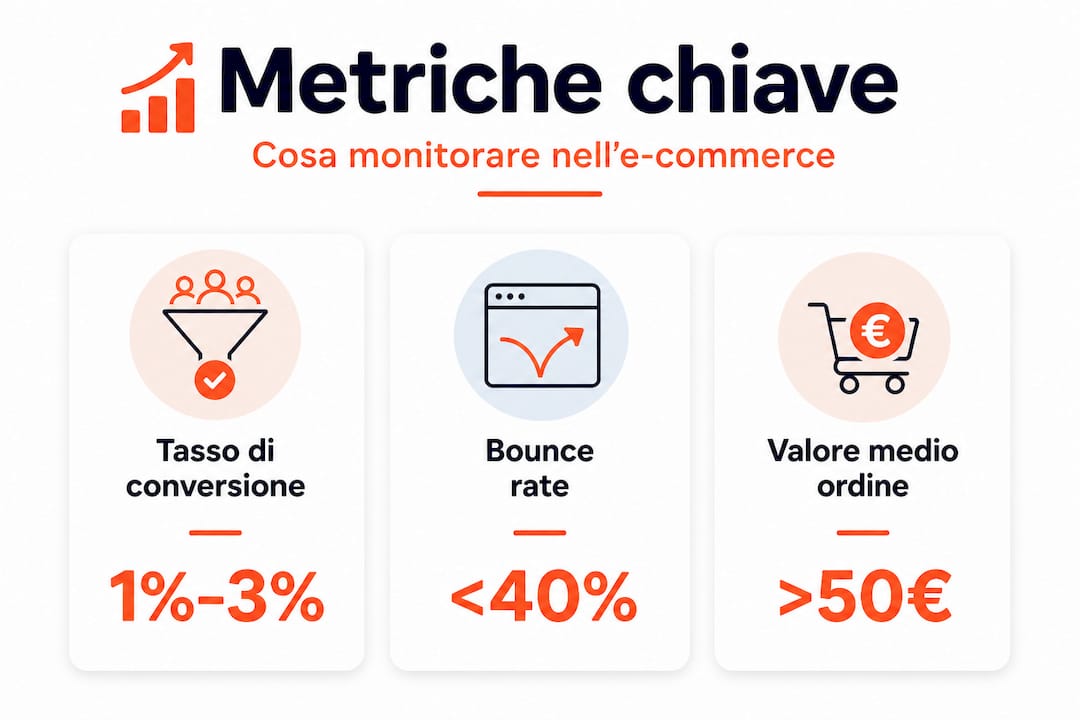
- Conversion rate: the percentage of visitors who complete a purchase. A healthy e-commerce site has an average conversion rate of between 1% and 3%.
- Bounce rate (bounce rate): the proportion of users who leave the site after viewing just one page. A high figure indicates issues with relevance or user experience.
You can find this data directly in Google Analytics 4, the most widely used free tool in the industry. If you haven’t set it up yet, do so straight away: it’s an essential starting point.
| Metric | Ideal value | Warning sign |
|---|---|---|
| Conversion rate | 1% – 3% | Below 0.5% |
| Bounce rate | 30% – 50% | Over 70% |
| Loading speed | Under 2 seconds | More than 4 seconds |
| Shopping basket abandonment rate | Under 60% | Over 80% |
Tools for rapid diagnosis
As well as Google Analytics, there are a number of tools that can help you get an accurate snapshot in no time:
- Google Search Console: it shows you the search queries for which you appear, the impressions and the CTR (click-through rate, i.e. the rate at which users click on your results).
- PageSpeed Insights: analyses the website’s speed on desktop and mobile devices and suggests specific actions to take.
- Hotjar or Microsoft Clarity: heatmap tools that show where users click, where they pause and where they leave the page.
Read our a practical guide to e-commerce It will help you understand which aspects to consider right from the website development stage. Understanding the benefits of corporate websites It also enables you to better prioritise your investments.
Pro tip: Set aside at least two hours a month to analyse your website’s analytics. You don’t need to be an expert in statistics. You simply need to identify the key issues: the pages with the most traffic but few sales, the most viewed products that are never bought, and the stages of the checkout process where users get stuck.
Once you’ve got this overview, you can decide where to take immediate action and what to plan for in the longer term. There’s no need to sort everything out in one go. The right approach is a step-by-step one, starting with the issues that have the greatest impact on conversions.
SEO optimisation: the foundation for targeted traffic
Without targeted traffic, any other strategy proves ineffective. SEO (Search Engine Optimisation) is the foundation upon which to build long-term growth. It is not an investment that yields immediate results, but it is the one that guarantees the most sustainable return over time.
How to optimise product pages
Product pages are the most important pages on your e-commerce site from an SEO and conversion perspective. They are often neglected or filled with generic descriptions copied from suppliers. This is a costly mistake.
Follow these steps to optimise them correctly:
- Choose specific, long-tail keywords: rather than targeting “men’s shoes” (a generic and highly competitive term), focus on phrases such as “men’s brown leather shoes, size 44”. Long-tail searches have lower search volumes, but those who use them are much closer to making a purchase.
- Write an SEO-friendly product title: Include the main keyword in the first 60 characters of the title, so that Google reads it correctly.
- Create original and detailed descriptions: Describe the materials, dimensions, uses, benefits and any other details a customer might want to know before making a purchase. A minimum of 200 words per product page.
- Optimise images: Rename files with descriptive names (e.g. “men’s-brown-leather-shoes.jpg”) and always include the relevant keyword in the alternative text (alt text).
- Add reviews: User-generated content improves SEO and builds trust. Google favours pages that are regularly updated with new content.
Technical SEO: speed and mobile responsiveness
Technical SEO covers all those “invisible” aspects that influence Google rankings. Two factors are key in 2026: page load speed and the mobile user experience.
Google uses Core Web Vitals as a ranking signal. Among these, the LCP (Largest Contentful Paint, i.e. the loading time of the main visible element) must be less than 2.5 seconds. A slow website not only harms search rankings but also drives customers away: according to industry data, a delay of 1 second Slow website response times reduce conversions by 7%.
To find out more about the steps to follow, you can read our practical SEO tips and the SEO strategies for SMEs which we have developed over time.
Category structure and internal links
Good website architecture makes it easier for users to navigate the site and helps Google understand the hierarchy of your content. Each category must have a clear URL, an optimised title and a text description of at least 100 words.
Internal links (i.e. links between pages on your own website) distribute SEO authority and guide users towards making a purchase. Link related product pages, categories to informative blog guides, and landing pages to checkout pages.
Pro tip: Publish at least one blog post a month that answers your customers“ real questions. Phrases such as ”how to choose“, ”the difference between“ and ”which is the best’ attract visitors looking for information, who, over time, become loyal customers.
Advanced digital strategies to boost sales
Attracting traffic is only half the job. The other half involves converting visitors into customers, getting them to return and turning them into brand advocates. This is where digital marketing strategies come into play.

Lead generation, remarketing and automation
Most users do not make a purchase on their first visit. Industry studies show that 97% visitors leaves the site without buying anything. You need tools to win them back.
Here are the main ones:
- Retargeting pixels: Meta Pixel and Google Tag Manager allow you to show personalised adverts to users who have already visited your website or added products to their basket.
- Email marketing automation: Tools such as Mailchimp, Klaviyo or ActiveCampaign allow you to send automated email sequences based on users’ behaviour.
- Lead capture pop-up: Offer a 10% discount or a free guide in exchange for an email address. Building a mailing list is one of the most valuable assets for an e-commerce business.
- Recovery of abandoned trolleys: an email sent within an hour of a customer abandoning their shopping basket has a re-engagement rate of over 45%.
Landing pages optimised for targeted offers
A landing page is a page designed with a single objective: to persuade the visitor to take a specific action. Unlike a homepage or a product page, a landing page eliminates distractions and guides the user towards conversion.
To understand the importance of a landing page It is essential when launching seasonal promotions, advertising campaigns or new products. A generic page does not convert as well as a page designed specifically for that particular offer.
Comparison of acquisition channels
| Channel | Approximate cost | Time to results | Sustainability |
|---|---|---|---|
| Organic SEO | Low (tempo) | 3–6 months | High |
| Google Ads | Mid-to-high | Immediate | Media |
| Email marketing | Bass | 1–4 weeks | Very high |
| Social media adverts | Medium | Immediate | Media |
| Influencer marketing | Variable | 1–2 months | Low to medium |
Incentives and limited-time offers
Promotions work well when they are limited in time and availability. Perceived scarcity (“only 10 items available”, “offer valid until Sunday”) triggers a psychological mechanism that speeds up the decision to buy. Use these tactics sparingly: a website that is “always on sale” loses credibility and profit margins.
To set up your online sales project properly, explore the solutions available in the section e-commerce development to understand what can really make a difference from a technical and strategic point of view.
The most effective ways to encourage purchases include:
- Free delivery on orders over a specific amount
- Bundles of complementary products at a discounted price
- Loyalty schemes with points-based rewards
- Coupons exclusively for newsletter subscribers
- 24–48-hour flash sales with a visible countdown
Common mistakes and how to avoid them
Even with the best of intentions, many Italian e-commerce businesses make the same mistakes time and time again. Knowing what these are in advance allows you to avoid them and not waste valuable resources.
The main obstacles to growth
- Lack of automation: Doing everything manually slows down operations and increases the risk of errors. Automating emails, stock updates and user notifications frees up time and improves the customer experience.
- Inadequate after-sales service: The period immediately following a purchase is crucial for building customer loyalty. A satisfied customer will buy from you again and recommend your shop. A disappointed customer will write a negative review that puts off potential buyers.
- Ignore the reviews: Social proof is one of the most powerful drivers of purchase. 93% of users read reviews before making an online purchase. Not actively collecting them is a huge missed opportunity.
- Complicated checkout process: Every additional field on the checkout form increases the abandonment rate. Offer a guest checkout option, integrate fast payment methods such as PayPal, Apple Pay or Scalapay, and simplify the returns process.
- Does not fit the cabinet: Over 60% of online purchases are made via smartphone. A website that doesn’t work well on mobile devices loses more than half of its potential customers.
Please note: Research by the Baymard Institute indicates that the average shopping basket abandonment rate It stands at 70.19%. The vast majority of these drop-offs can be prevented with minor technical and UX optimisations.
Understanding why it’s worth it setting up an e-commerce business in 2026 It also helps you set the right priorities right from the start, so you don’t end up building on shaky foundations.
If you’d like a comprehensive overview of the solutions available to boost your online presence, take a look at the services for businesses to find the support best suited to your situation.
Monitoring results and continuous optimisation
Implementing a strategy without measuring it is like driving in the dark. Constant monitoring of results is what sets e-commerce businesses that are truly growing apart from those that are stagnating.
Key performance indicators (KPIs) for your e-commerce business
KPIs (Key Performance Indicators) are the figures that tell you, without any ambiguity, whether you’re heading in the right direction. Here are the ones to monitor every week or every month:
| KPIs | What does it measure? | Frequency of checks |
|---|---|---|
| Conversion rate | Percentage of visitors who make a purchase | Weekly |
| Average Order Value (AOV) | Average spend per transaction | Monthly |
| Customer Lifetime Value (CLV) | Total customer value over time | Quarterly |
| Customer acquisition cost (CAC) | How much do you spend on acquiring a customer? | Monthly |
| Customer return rate | How many customers make repeat purchases? | Monthly |
| ROAS (return on advertising spend) | Ad campaign effectiveness | Weekly |
Analytics and heatmap tools
To monitor this data as effectively as possible, use a combination of complementary tools:
- Google Analytics 4: comprehensive analysis of traffic, user behaviour and conversion funnels.
- Google Search Console: organic visibility, indexing errors and query performance.
- Hotjar or Microsoft Clarity: heatmaps, session recording and analysis of where users get stuck.
- Integrated CRM: tracks customer behaviour over time, helping you to segment them and personalise your communications.
To find out more about the process of continuous e-commerce optimisation, we recommend that you read our dedicated guide, which covers all the necessary steps.
A/B testing: small changes, big results
An A/B test involves showing two groups of users two different versions of the same page, to see which one performs better. You can test the colour of the “Buy” button, the headline on a landing page, the position of the reviews or the structure of the checkout process.
The elements to be tested as a priority are:
- Homepage title and subtitle
- Main image of the best-selling products
- Text and colour of the call-to-action
- Order of information on the product page
- Number of steps in the checkout process
There’s no need to test everything at once. Choose one element at a time, collect data on it for at least two weeks, and make decisions based on real data. With this approach, even small improvements add up over time and have a significant impact on sales.
Our perspective: what really matters when it comes to boosting online sales
After years of working with Italian SMEs and professionals, I have noticed a recurring pattern: the companies that really grow online are not those with the biggest budgets. They are the ones that listen to the data and act consistently.
The uncomfortable truth is that many e-commerce businesses fail to grow because their owners chase trends rather than solving real problems. Every month, a new tool emerges, a social network to monitor, or a “revolutionary” technique to apply. The result is a pile-up of half-finished initiatives, with no clear logic behind them.
In my practical experience, I’ve seen online shops undergo a radical transformation through seemingly trivial changes: rewriting product descriptions using relevant keywords, reducing the number of checkout steps from six to three, and displaying reviews prominently. It’s not magic. It’s attention to the details that matter.
The most common mistake made by Italian SMEs is to think that “more is better”. More features, more pages, more campaigns. In reality, a streamlined, fast and focused e-commerce site converts much better than one packed with features that confuse the user. Simplicity is not a shortcut. It is a conscious strategic choice.
Another aspect that is systematically underestimated is the time required. SEO takes months. Customer trust is built up over years of consistency. Those who expect results within a few weeks become discouraged and give up. Those who, on the other hand, keep at it, monitor their progress, make adjustments and persevere, eventually achieve stable and lasting results.
The best advice I can give you is this: before investing in advertising, make sure your website is ready to convert. A slow, confusing or untrustworthy website wastes every euro spent on advertising. Invest in the quality of your digital presence first, then attract visitors.
Find out how we can help you grow your e-commerce business
If you’ve read this guide and want to put theory into practice, we can support you every step of the way. We offer bespoke solutions to boost your e-commerce sales, from building or redesigning your website to advanced configuration of WooCommerce and PrestaShop. Our service e-commerce SEO optimisation It is designed to drive genuinely high-quality traffic – the kind that converts. We can also create optimised landing pages for your campaigns. Contact us for a free assessment of your project: we’ll analyse the current situation together and propose a practical plan.
Frequently Asked Questions
How long does it take to see results after carrying out SEO optimisation on an e-commerce site?
It usually takes between 3 and 6 months to see significant improvements in search rankings and conversions, although the first positive signs may become apparent as early as the first few weeks of consistent work.
What are the essential tools for monitoring sales and traffic on an e-commerce site?
Google Analytics 4, heatmaps such as Hotjar or Microsoft Clarity, and an integrated CRM are the main tools for monitoring performance and making decisions based on real data.
How can I increase my conversion rate without making a large investment?
Focusing on the user experience, simplifying the checkout process by reducing the number of steps, and creating dedicated landing pages for individual offers are the most effective and accessible methods, even on a limited budget.
Does it make sense to invest in advertising if the website isn’t optimised?
A website that isn’t optimised risks wasting its entire advertising budget because it fails to convert the traffic generated by adverts into actual sales. Optimise your website first, then invest in adverts.



