
The development of an e-commerce site in Rome is the technical and strategic process that enables businesses and self-employed professionals to sell online via a high-performing, scalable website that complies with current regulations. A well-structured project built on platforms such as WooCommerce or Shopify, which complies with the GDPR and the AgID Guidelines, can measurably increase sales and digital visibility. This guide covers every stage of the process: from choosing the platform to the technical requirements, from timelines to the actual costs for Roman SMEs, right through to the most common mistakes to avoid.
How to choose the right e-commerce platform for your business in Rome
Choosing the right platform is the most important decision in the entire e-commerce development process. Getting it wrong at this stage means facing costly migrations or technical limitations that are difficult to overcome later on. The two most popular options for SMEs in Rome are WooCommerce and Shopify, and each caters to different needs.
WooCommerce vs Shopify: which one should you choose?
WooCommerce offers greater freedom However, it requires technical expertise to manage, whilst Shopify guarantees operational simplicity and a centralised environment. This means that WooCommerce is the right choice if you have an in-house technical team or a dedicated consultant, whilst Shopify is better suited to those who want to focus on sales without having to worry about the infrastructure. For Roman SMEs aiming for long-term organic growth, WooCommerce offers more substantial SEO benefits.

Integrated SEO is more scalable on WooCommerce, which allows for an advanced content strategy, whilst Shopify focuses on basic SEO for products and categories. This has a direct impact on organic rankings on Google, which for a local business in Rome is often the most profitable channel for customer acquisition. The choice of platform therefore influences not only development costs, but also the return on investment over time.
One factor that is often overlooked is compatibility with in-house skills. The platform must be suited to the capabilities of the team that will manage it on a day-to-day basis, avoiding solutions that are too complex to administer independently. If the business owner has to manage the product catalogue on their own, Shopify significantly reduces the learning curve.
| Feature | WooCommerce | Shopify |
|---|---|---|
| Technical inspection | High | Limited |
| Ease of management | Media | High |
| Advanced SEO | Yes | Partial |
| Fixed monthly costs | Bass (variable hosting) | From €29 per month |
| Scalability | Alta with plugins | Native Alta |
| Ideal for | SMEs with technical support | Those who want independence quickly |
Pro tip: Before choosing a platform, consider who will manage the website after it goes live. If you don’t have an in-house technician, consider Shopify for its simplicity, or hire a local professional to manage WooCommerce. You can explore your options further in the A guide to platforms for SMEs by Andreafreelance.
What technical requirements must an e-commerce website in Rome meet?
An effective e-commerce site does more than simply display products and accept payments. It must comply with technical, regulatory and usability standards which, by 2026, have become mandatory or strongly recommended for operating in the Italian market.
Here are the key requirements that need to be taken into account right from the design stage:
-
Responsive design and intuitive UX. The website must work perfectly on smartphones, tablets and desktop computers. Over 70% of online purchases in Italy are made via mobile devices, so an interface that is slow or difficult to navigate on a mobile phone directly leads to abandoned trolleys.
-
Secure payment systems. Integrating payment gateways such as Stripe, PayPal or Nexi ensures secure transactions and boosts user confidence. PCI DSS certification for the chosen payment gateway is an essential requirement for operating legally.
-
Mandatory digital accessibility. The Legislative Decree No. 82/2022 and the AgID Guidelines They set out digital accessibility standards for e-commerce in Italy, covering the entire user journey from the website to the checkout. This is not merely a legal obligation: incorporating accessibility into the design broadens the potential market and improves the experience for all users, not just those with disabilities.
-
GDPR compliance and cookie banners. I GDPR-compliant cookie banners in 2026 They must block tracking before consent is given and provide four equally visible buttons: accept, decline, customise and close. Failure to comply exposes the business to penalties from the Data Protection Authority, which has stepped up its monitoring of Italian e-commerce sites in recent years.
-
CRM and ERP integration. The integrated CRM and ERP solutions With e-commerce platforms, they can improve inventory management and marketing activities, typically for an additional investment of between 1,000 and 5,000 euros. For a Roman SME managing a catalogue of hundreds of products, this integration prevents stock errors and automates post-purchase communications.
-
Loading speed and technical optimisation. A website that takes more than 3 seconds to load loses a significant proportion of visitors before they even see a product. Techniques such as caching, image compression and high-performance hosting are prerequisites, not optional extras.
Pro tip: It incorporates privacy and accessibility right from the technical design stage. Dealing with these issues from the outset It reduces errors and the risk of non-compliance, thereby avoiding costly subsequent rework. You can also find out more about Italian accessibility regulations in the practical guide to digital accessibility.
What are the stages and timeframes involved in setting up an e-commerce site in Rome?
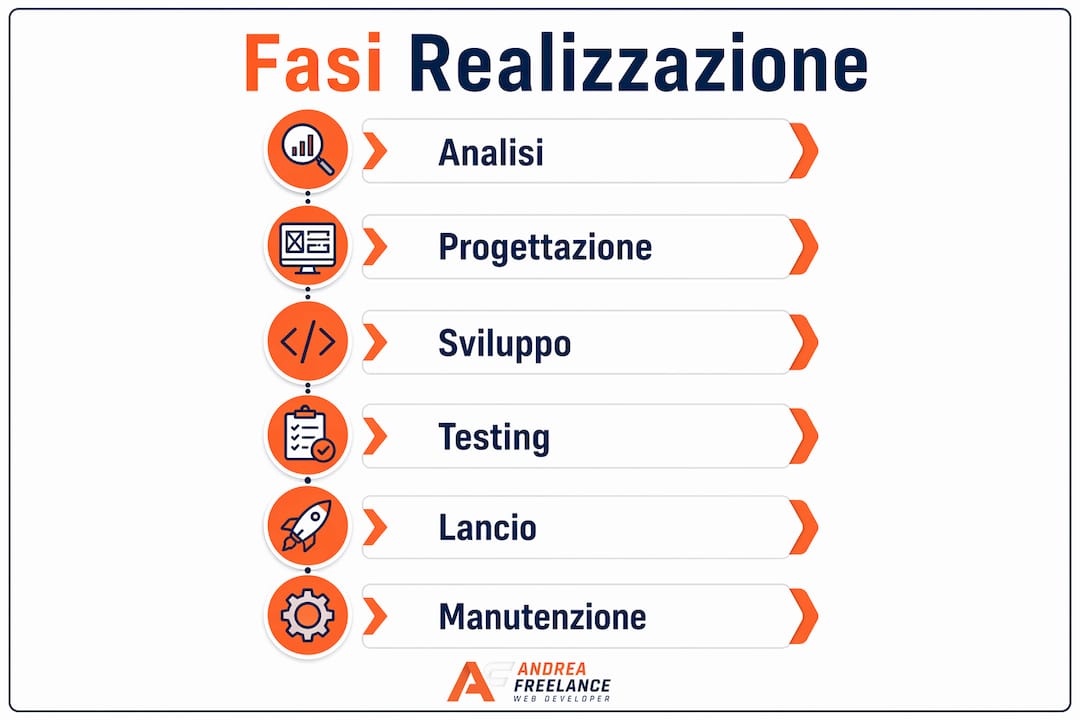
Understanding the development stages and the actual timelines helps to plan the project without any surprises. For an SME in Rome, the typical process is divided into six distinct stages, each with specific objectives.
-
Preliminary analysis and requirements gathering (1–2 weeks). Business objectives, the target audience, the product catalogue, necessary integrations and the available budget are defined. This stage determines the quality of everything that follows: an incomplete brief leads to costly revisions later on.
-
Graphic design and UX architecture (2–3 weeks). Wireframes and mock-ups of the main pages are created, the navigation structure is defined, and the purchase journey is designed. A well-thought-out UX architecture reduces the shopping basket abandonment rate, which in Italy averages over 70%.
-
Technical development and platform configuration (3–4 weeks). We install and configure CMSs, plugins, payment gateways, delivery systems and integrations with CRM or ERP systems. This is the longest phase and the one in which the developer’s technical expertise makes the difference between a stable website and one that causes constant problems.
-
Content creation and basic SEO (1–2 weeks). You upload products, optimised descriptions and images, and configure the SEO metadata. The SEO techniques specific to e-commerce These include URL structure, structured data for products and the optimisation of category pages.
-
Testing, review and launch (1–2 weeks). All purchase flows, payment processes, cross-browser compatibility and loading speeds are tested. The website only goes live once it has passed this stage.
-
Post-launch management and (ongoing) maintenance. Security updates, performance monitoring, ongoing SEO optimisation and technical support are monthly tasks that ensure the website’s operational continuity.
| Stage | Average duration | Approximate cost |
|---|---|---|
| Analysis and requirements | 1–2 weeks | Included in the project |
| UX/UI Design | 2–3 weeks | 800-1.500€ |
| Technical development | 3–4 weeks | 3.000-6.000€ |
| Content and Basic SEO | 1–2 weeks | 500-1.500€ |
| Testing and launch | 1–2 weeks | Included in the project |
| Project total | 8–12 weeks | 6.000-12.000€ |
The average cost of setting up an e-commerce site for SMEs in 2026 is between 6,000 and 12,000 euros, with a standard development time of 8–12 weeks. These costs often exclude professional photography, videos and advanced integrations, which can add between 20% and 40% to the initial budget. Planning for these items from the outset prevents you from running out of resources once the project is well underway.
How to avoid the most common mistakes when running an e-commerce business
Mistakes made when setting up an online shop in Rome are not limited to the code or the design. Many problems stem from poor strategic decisions taken in the early stages of the project, and rectifying them later costs far more than preventing them in the first place.
The most common mistakes that Andreafreelance comes across in e-commerce projects in Rome are:
-
Choosing the wrong platform for your skills. Opting for WooCommerce without ongoing technical support leads to websites that are out of date, vulnerable and slow. Conversely, choosing Shopify when you need advanced customisation results in high monthly costs and frustrating limitations.
-
Neglecting SEO right from the start. Many e-commerce sites are launched without a basic SEO structure: unoptimised URLs, duplicate product descriptions, and a lack of structured data. Correcting these errors after launch takes weeks of work and can result in temporary penalties on Google.
-
Ignoring privacy and accessibility regulations. As previously mentioned, incorporating privacy and accessibility from the design stage avoids costly reworks and legal risks. A non-compliant cookie banner or an inaccessible website are not merely ethical issues: they pose a real risk of penalties.
-
Underestimating the quality of images and content. An e-commerce site with low-quality photos or generic product descriptions converts far less effectively than one with carefully curated content. Professional images are not a luxury: they are a direct sales tool.
-
Do not plan any post-launch maintenance. An e-commerce website is not a project that you simply complete and then forget about. Out-of-date plugins, expired SSL certificates and performance that deteriorates over time are common problems that can be prevented with a monthly maintenance plan.
-
Relying on cheap hosting services that are unsuitable for e-commerce. Shared hosting costing just a few euros a month may be suitable for a blog, but not for an e-commerce site handling active transactions. The server’s response time (TTFB) directly affects Google rankings and the shopping experience.
Preventing these mistakes starts with choosing the right technical partner. A professional with specific experience in the Roman market understands the needs of local SMEs and can guide you through the most critical decisions even before writing a single line of code. You can find out more about the benefits of launching an e-commerce business in 2026 in the guide for SMEs by Andreafreelance.
Key points
Setting up an e-commerce site in Rome requires a combination of a platform suited to your skills, technical specifications that comply with the 2026 regulations, and realistic planning in terms of time and costs.
| Full stop | Details |
|---|---|
| Choice of platform | WooCommerce for those looking to optimise their SEO; Shopify for those who want simple, self-managed control. |
| Regulatory requirements for 2026 | Digital accessibility (AgID) and the GDPR, including a four-button cookie banner, are mandatory for operating legally. |
| Budget and timelines | An e-commerce site for SMEs costs between 6,000 and 12,000 euros and takes 8–12 weeks to develop. |
| Mistakes to avoid | Neglecting SEO, privacy and post-launch maintenance are the three most costly mistakes to rectify later on. |
| The value of planning | Building accessibility and privacy into the design from the outset reduces legal risks and lowers the total project costs. |
What I’ve learnt after 20 years in e-commerce in Rome
After more than twenty years of working on web projects and creating dozens of e-commerce sites for businesses and professionals in Rome, I have come to a conclusion that goes against conventional wisdom: the main problem is almost never a technical one.
Most projects that fail or fall short of expectations do so for strategic reasons. The client did not have a clear understanding of their target audience. The platform was chosen on the basis of price, not actual needs. The budget was focused entirely on development, leaving no resources for SEO and post-launch marketing. I’ve seen technically flawless e-commerce sites that didn’t sell a thing because nobody could find them on Google.
Rome is a unique market. Roman SMEs often have a strong local identity and a loyal offline customer base, but they struggle to translate this advantage into the digital sphere. My most practical advice is this: before investing in an e-commerce site, define precisely who will buy from you online and why they should choose you over a marketplace such as Amazon. If you don’t have a clear answer to this question, no platform or technology will save you.
Another aspect that almost everyone underestimates is maintenance. An e-commerce site is a living system: it needs updates, monitoring and continuous optimisation. I’ve seen websites launched with great enthusiasm only to be abandoned six months later because the client hadn’t set aside either the time or the budget to manage them. Plan for maintenance before you even start development, not afterwards.
Finally, on the subject of regulations: by 2026, you can no longer afford to ignore accessibility and the GDPR. This isn’t bureaucracy for its own sake. It’s a matter of respecting your users and protecting your business. Relying on a local professional who is familiar with these regulations is not an additional cost: it is an investment that will save you from far more costly problems down the line.
— Andrea
Set up your e-commerce site in Rome with Andreafreelance
If you’re thinking about launching or improving your online presence, Andreafreelance offers a comprehensive service for professional e-commerce development for businesses and freelancers in Rome. From graphic design to technical development on WooCommerce and PrestaShop, from SEO optimisation to GDPR compliance and AgID accessibility, every project is tailor-made to meet the client’s specific needs. With over 20 years’ experience in web development and first-hand knowledge of the Roman market, Andreafreelance oversees the project at every stage, from the initial brief to post-launch maintenance. Discover the services available and request a personalised consultation by visiting the page dedicated to e-commerce services for Rome.
FAQ
How much will it cost to set up an e-commerce site in Rome in 2026?
The average cost for an SME is between 6,000 and 12,000 euros, with a development time of 8–12 weeks. The budget may increase if professional photographs, CRM/ERP integrations or advanced features are included.
Which platform is best for an e-commerce business in Rome: WooCommerce or Shopify?
WooCommerce is the better choice for those focusing on advanced SEO and who have technical support available; Shopify is better suited to those who want to manage their website independently with a shorter learning curve. The choice depends on in-house expertise and long-term objectives.
Does an e-commerce site have to comply with digital accessibility standards?
Yes. Legislative Decree 82/2022 and the AgID 2026 Guidelines set out mandatory accessibility standards for Italian e-commerce sites, covering the entire user journey from the website to checkout. Failure to comply exposes the business to legal risks and penalties.
How long does it take to launch an e-commerce website in Rome?
A standard project takes between 8 and 12 weeks from the initial analysis to launch. Urgent requests or requests to speed up the process may increase costs by up to 30–50% compared with the basic quote.
Does the GDPR apply to all Italian e-commerce businesses?
Yes. All e-commerce sites that collect data from European users must comply with the GDPR. By 2026, cookie banners must block tracking until consent is given and offer users four clear and equally visible options.