

You’re getting traffic to your website, but sales aren’t taking off. This is one of the most common problems that small and medium-sized Italian businesses face every day. The traffic is coming in, but visitors aren’t taking the action you want them to: filling in a form, giving you a call, or making a purchase. Many SMEs are struggling to convert traffic into customers without a dedicated landing page. A landing page – that is, a page designed with a single objective in mind – is the tool that can turn your online presence around. In this guide, you’ll find everything you need: from the initial set-up to the practical steps, from mistakes to avoid right through to checking the results. By following this guide, you’ll finally be able to turn visitors into actual customers.
Contents
- What it takes to create an effective landing page
- The step-by-step guide to creating a high-impact landing page
- Common mistakes when creating landing pages and how to avoid them
- Optimisation and evaluation of results: how to improve after publication
- The truth about landing pages that nobody tells SMEs
- Take your online presence to the next level with an expert
- Frequently asked questions about creating landing pages
Key Points
| Full stop | Details |
|---|---|
| A winning strategy | Define your objective, materials and tools before you start creating the landing page. |
| Step-by-step guide | Follow a clear process from concept to publication to avoid mistakes. |
| Continuous optimisation | Monitor and optimise your landing page using traditional tools and AI. |
| A human-centred approach | Strategy and human decision-making are irreplaceable when it comes to pure automation. |
What it takes to create an effective landing page
Once you’ve grasped the value of a landing page, the next step is to understand what it really takes to create a successful one. It’s not enough simply to open an editor and start writing. You need a structured approach that covers content, tools and technical requirements.
Firstly, you need to be clear about three key elements: the images, the text (known as copy) and the offer. The images must be professional and consistent with your brand. The copy must clearly communicate the main benefit you offer. The offer must be unique, clear and irresistible to your target audience.
When it comes to digital tools, the solutions most commonly used by Italian SMEs are WordPress combined with Elementor, which allows you to build pages visually without writing code. To track results, Google Analytics is the industry standard, but you can integrate it with tools such as Hotjar for heatmaps – which show where users click and pause.
Market and competitor analysis is essential for creating an effective landing page. Before you start building anything, find out what your competitors are doing and what your potential customers expect. This stage is often skipped, and it is one of the most costly mistakes you can make.

Two technical requirements are essential in 2026: the design mobile first and compliance with the GDPR. ‘Mobile first’ means designing for smartphones first and then adapting the design for desktop, not the other way round. The GDPR means that every contact form must obtain the user’s explicit consent before collecting data.
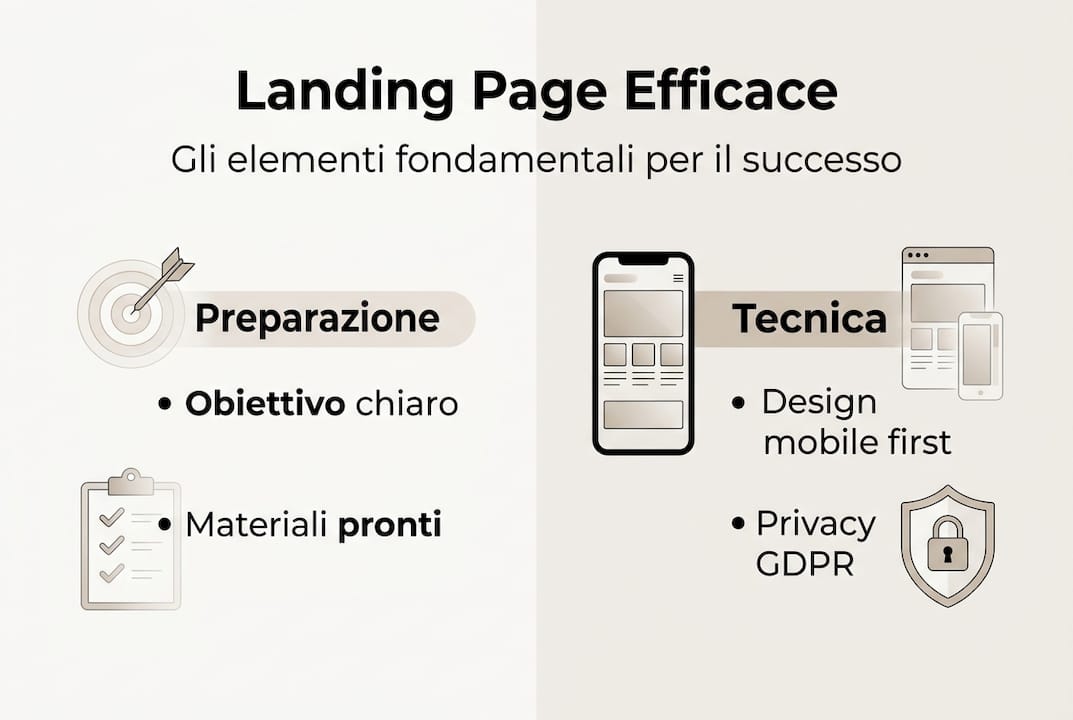
Understanding the’the importance of a landing page It helps you make better use of your time and resources right from the start.
Summary table: what it is and what it is used for
| Element | Main function |
|---|---|
| Professional images | Building visual trust and brand consistency |
| Persuasive copy | Communicating the benefits and encouraging action |
| A clear offer | Standing out and driving conversions |
| WordPress + Elementor | Building the page without code |
| Google Analytics | Tracking traffic and user behaviour |
| Hotjar or similar tools | Analysing heatmaps and session recordings |
| Mobile-first design | Ensuring an optimal experience on smartphones |
| GDPR compliance | Collecting data in a lawful and transparent manner |
Pre-launch checklist:
- Have you set a single conversion goal for the page?
- Are the images optimised for the web (small file size, high quality)?
- Does the copy answer the question “Why should I choose you”?
- Have you installed Google Analytics and verified that tracking is working?
- Does the contact form have GDPR consent?
- Has the page been tested on smartphones and tablets?
- Have you analysed at least three direct competitors?
The step-by-step guide to creating a high-impact landing page
Once you’ve prepared your tools and materials, it’s time to get down to the actual work. Following a logical sequence saves you time and ensures a solid result right from the first attempt.
- Define the single objective. Every landing page should have just one purpose: to collect contact details, sell a product or book a consultation. If you try to do everything, you won’t do anything properly.
- Write the main headline. It’s the first thing a visitor reads. It must immediately convey the main benefit, not your name or the company’s name.
- Structure the page from top to bottom. Start with the customer’s problem, then present the solution, followed by social proof (testimonials, figures, logos), and finally the call to action (CTA) – that is, the button or form that prompts the customer to take action.
- Write the CTA in a direct manner. Avoid generic phrases such as “Click here”. Use specific phrases such as “Request your free quote” or “Book a consultation now”.
- Eliminate any distractions. No navigation menu, no external links, no content unrelated to the objective. A simple approach is more effective than a complex strategy.
- Optimise for mobile first. Test the page on at least three different devices before publishing it. Mobile conversions can increase by up to 400% with an optimisation correct.
- Publish and start collecting data. Don’t wait for perfection. Publish, measure, improve.
Key figures: Double the conversion rate It can double turnover whilst traffic remains the same. This means that improving the landing page is often more effective than increasing the advertising budget.
Pro tip: Work on the page layout first (a wireframe on paper or using a simple digital tool) and only then move on to the graphic details and the final copy. Many business owners make the opposite mistake and waste hours on details that end up changing completely.
To find out more about the most advanced landing page conversion strategies, you can find specific resources designed for the Italian market. If, on the other hand, you’d prefer to outsource this stage, the landing page design services Professional tools allow you to get started on a solid, tried-and-tested foundation.
Common mistakes when creating landing pages and how to avoid them
Once the correct operating procedure has been followed, it is essential not to undermine it by making common mistakes. These mistakes are very common amongst Italian SMEs, often because they copy generic templates without adapting them to their own audience.
The most common mistakes that reduce conversion rates:
- Navigation menu available. A menu or too many links can be distracting and reduce conversion rates. A landing page is not your website: it should have only one way out, which is your CTA.
- Incorrect length. A page that’s too short isn’t convincing, whilst one that’s too long is tedious. The right length depends on the complexity of what you’re offering and your audience’s level of awareness.
- Not optimised for mobile. If your page doesn’t display properly on a smartphone, you’ll lose most of your potential customers before they’ve even read the headline.
- CTA is not very visible or is too generic. The call-to-action button should be large, colourful and feature specific text. If the user has to search for it, you’ve already lost them.
- Lack of social evidence. Testimonials, reviews and figures on satisfied customers: these elements build trust and reduce hesitation to take action.
- Unclear or non-existent privacy policy. A form without a privacy policy is not only illegal in Italy, but it also puts off the more cautious users.
- Slow loading speed. Every extra second of waiting time reduces conversions. Optimise your images and use a fast hosting service.
“A landing page without a clear focus is like a salesperson who talks about everything except the product you want to buy.”
To avoid these problems, I’d advise you to always test the page with real users before the official launch. Ask three or four people from your target audience to browse the page and tell you what they understand about the offer in under ten seconds. Their answers will tell you more than any technical analysis.
Pro tip: Use a free tool such as Google PageSpeed Insights to check the speed of your landing page. A score below 70 on mobile is a sign that you need to take immediate action. Even the website positioning strategies depend partly on the speed and technical quality of the page.
Optimisation and evaluation of results: how to improve after publication
Once the landing page is live, the real work has only just begun. Optimisation and monitoring are key to growing over time and not stopping at the first result.
The main tools you should use are:
- Google Analytics 4: to track traffic, sources and conversion rates.
- Google Search Console: to monitor the page’s SEO performance.
- Hotjar or Microsoft Clarity: for heatmaps and user session recordings.
- Google Optimize or VWO: for A/B tests, i.e. tests that compare two versions of a page to see which one converts better.
Comparison table: traditional methods vs. AI solutions
| Appearance | Traditional method | AI-based solution |
|---|---|---|
| A/B testing | Manual, time-consuming and involves a lot of traffic | Automated, faster results |
| Copy analysis | Human review | Data-driven AI recommendations |
| Heatmap | Manual interpretation | Automatic pattern recognition |
| Customisation | Manual segmentation | Dynamic content by user |
| Cost | Bass (free tools) | Mid-to-high (premium tool) |
Artificial intelligence is useful during the optimisation phase, but human strategic input remains crucial. AI tools can speed up data analysis, but they cannot replace a deep understanding of your customers and your market.
Steps for monitoring and optimising conversions:
- Set a measurable conversion goal in Google Analytics (e.g. form submission, button click).
- Collect data for at least two weeks before drawing any conclusions.
- Identify the point on the page where users leave (heatmaps and screen recordings).
- Suggest a possible improvement (e.g. “I’ll change the text of the CTA”).
- Carry out an A/B test with the original version and the modified version.
- Analyse the results and roll out the winning version.
- Repeat the cycle every month.
Knowing when to seek professional help is just as important. If, after two months of optimisation, the conversion rate hasn’t improved, it might be time to choosing the right professional for a comprehensive review. An expert can identify structural issues that automated tools miss. You can also check whether your page complies with the company website features which make all the difference in terms of credibility and conversion.
The truth about landing pages that nobody tells SMEs
Having looked at how to create and optimise a landing page, it is essential to consider a few little-known truths. These are truths that, in over 20 years of working with Italian companies, I have learnt the hard way – both for myself and for my clients.
The first truth is that there is no one-size-fits-all formula. Every SME has a different audience, a different offering and a different competitive landscape. Copying a competitor’s landing page – even if it seems to work well – is almost always a losing strategy. You need to find your own mix, test it and adapt it continuously.
The second truth concerns technology. Many entrepreneurs think the problem lies with the tool: “If I used that platform, conversions would go up.” That’s not the case. Technology is a means to an end, not the solution. I’ve seen landing pages built with very simple tools convert far better than technically flawless pages that lack a clear strategy.
Human judgement remains superior to pure automation when it comes to designing an effective landing page. AI can help you optimise, but it cannot understand the relationship you have with your customers, the language they use, or the objections they have before making a purchase. Only you know these things.
The third truth is that Italian SMEs often underestimate the value of the create a professional website as a solid foundation on which to build landing pages. A landing page that links to a slow, untrustworthy or poorly structured website loses much of its effectiveness. Invest in the foundations first, then in your campaigns.
Testing, adapting and building genuine relationships with customers is worth more than any conversion trick.
Take your online presence to the next level with an expert
If you’ve followed this guide this far, you already have a clear idea of what it takes to create a landing page that really converts. But knowing what to do and doing it well are two different things. Relying on a professional with practical experience saves you time, helps you avoid costly mistakes and gets you results faster.
With Andrea Freelance’s landing page services, you get a page tailor-made for your audience, optimised for mobile and designed to convert. Not a generic template, but a solution designed specifically for your SME. You can explore all the web services for businesses available to help you find the support that best suits your needs. If you want to understand why relying on an expert makes all the difference, read how the PM’s online success It often depends on the quality of the technical partner you choose. The next step is simple: get in touch with Andrea and start turning your traffic into real customers.
Frequently asked questions about creating landing pages
How much does it cost to create a professional landing page?
The cost can range from 300 to 1,000 euros, depending on the complexity and the level of customisation required. There is no fixed price: it depends on your objectives and the features you wish to include.
Meglio una landing lunga o breve?
La lunghezza non è fissa e va scelta in base all’utente e all’obiettivo. Spesso una struttura pensata per l’esperienza utente supera qualsiasi regola rigida sulla lunghezza.
Qual è il tasso di conversione medio di una landing ben fatta?
Il tasso può variare dall’1% al 5%, ma ottimizzando si può arrivare al doppio o al triplo. Un CR che passa da 1% a 2% raddoppia il fatturato a parità di traffico.
L’AI può sostituire il lavoro umano nella creazione di landing page?
L’AI è utile per accelerare l’ottimizzazione e l’analisi dei dati, ma la strategia umana resta insostituibile per capire il cliente e definire un’offerta davvero efficace.