


Small and medium-sized Italian businesses often underestimate the power of a corporate blog, viewing it as outdated. Yet the figures tell a different story: Companies with an active blog get +55% more traffic and +434% more indexed pages compared to those without. These figures show that a corporate blog not only works, but is a strategic tool for growing your online presence, generating qualified leads and building authority within your sector. In this guide, you’ll discover how to make the most of this resource for your SME.
Contents
- How a corporate blog can help your business grow
- Strategies for improving SEO and visibility with a corporate blog
- Demonstrating expertise and authority through the company blog
- How to start and maintain an effective corporate blog for your SME
- Discover the web services to help grow your corporate blog
- Why is setting up a corporate blog important for SMEs?
Key points
| Full stop | Details |
|---|---|
| Traffic and visibility | A corporate blog generates +55% of organic traffic and +434% of indexed pages, boosting the company’s online presence. |
| Lead generation | Companies with an active blog receive 67% more qualified leads than those without one. |
| Affordable costs | Content marketing costs 62% less than traditional advertising, making it ideal for SMEs. |
| Authority | High-quality content positions the company as an industry leader and reduces repetitive enquiries. |
| Measurable results | With an SEO strategy and regular content publishing, results are seen within 9–12 months. |
How a corporate blog can help your business grow
The figures speak for themselves when it comes to assessing the real impact of a corporate blog. Companies with blogs generate 55% more organic traffic and have 434% more indexed pages than their competitors who do not have one. This increase translates into greater visibility on search engines, more opportunities to be found by potential customers and a significantly stronger digital presence.
But traffic is just the start. The real value becomes apparent when we look at lead generation: Companies with blogs receive +67% leads compared to those without. Every published article becomes a gateway to new potential customers seeking solutions to their problems. This constant flow of qualified leads represents a tangible competitive advantage, especially for SMEs operating in saturated markets.
For small and medium-sized Italian businesses, these benefits translate into sustainable growth. A well-managed blog does not require a huge advertising budget, but delivers long-lasting results. Consider these measurable benefits:
- A steady increase in organic traffic without any recurring advertising costs
- Ranking for hundreds of long-tail keywords specific to your sector
- Building a library of content that’s always available and works for you 24/7
- Reducing reliance on paid channels such as Google Ads or Facebook Ads
A corporate blog transforms your website from a simple, static showcase into an active and measurable customer acquisition tool.
I benefits of corporate websites These benefits multiply when you implement a structured content marketing strategy. You’re not just publishing content; you’re building a digital asset that increases in value over time. Every optimised article contributes to your online authority and your ability to capture searches specific to your target audience. The difference between a company website with and without a blog is clear: the former grows organically, whilst the latter remains invisible.

Strategies for improving SEO and visibility with a corporate blog
Regular publishing is the cornerstone of any effective blogging strategy. For SMEs, consistency is crucial: it is better to publish 1–2 high-quality articles a month than to post sporadically or produce superficial content. Consistency signals to search engines that your site is active and relevant, whilst allowing you to gradually build a solid online presence without overburdening your internal resources.
The pillar-cluster strategy revolutionises the approach to content. You create in-depth pillar articles on the main topics in your sector, then support them with cluster content that explores specific aspects. This model organises information in a logical way for both users and search engines, increasing the chances of ranking for competitive queries. Keyword research becomes essential for targeting long-tail searches: specific phrases with less competition but a high purchase intent.
Here’s how to put together an effective SEO strategy for your corporate blog:
- Identify 3–5 key topics relevant to your business and create in-depth content (2,000+ words)
- Develop 5–10 cluster articles for each pillar, focusing on specific long-tail keywords
- Optimise each article with logical H1, H2 and H3 headings and engaging meta descriptions
- Implement a markup schema to increase the likelihood of rich snippets appearing in search results
- Strategically link to related articles to improve navigation and distribute link equity
Pro tip: Use free tools such as Google Search Console and Answer The Public to find out exactly what your target audience is searching for. These real-life questions become content opportunities with a high likelihood of conversion.
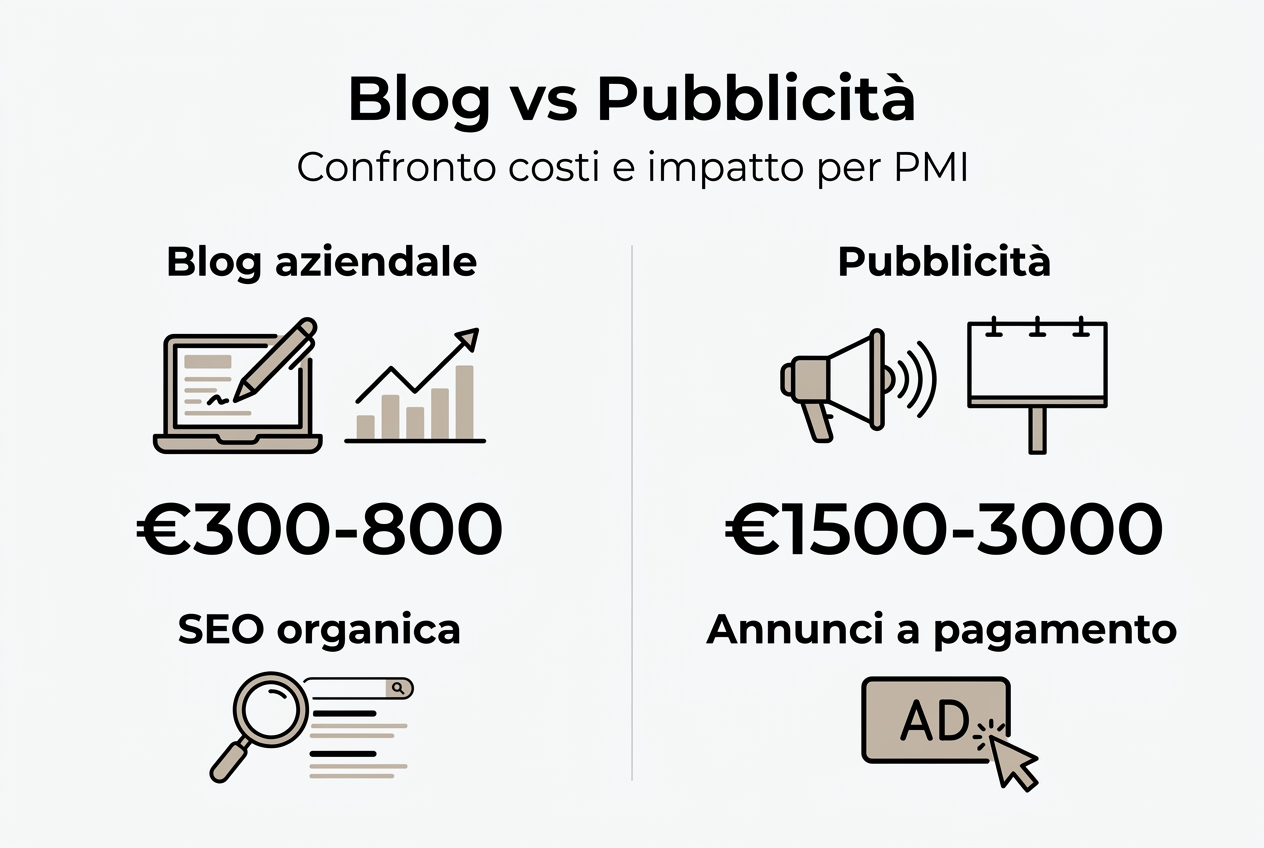
The financial benefit is significant: Content marketing costs 62% less traditional advertising. This difference is crucial for SMEs with limited budgets. Whilst adverts stop working as soon as you stop paying for them, SEO content continues to generate traffic and leads for months or even years after publication.
| Metric | Company blog | Traditional advertising |
|---|---|---|
| Average monthly cost | €300-800 | €1500-3000 |
| Duration of results | Permanent | Subject to the budget |
| ROI over time | Growing | Constant or decreasing |
| Content review | Total | Restricted by platforms |
Integration with website positioning and SEO amplifies these results. A blog does not operate in isolation: every post strengthens the domain’s overall authority, improves the internal linking structure and provides opportunities for natural backlinks. When create a company website With a blog strategy integrated from the outset, you can lay solid foundations for sustainable organic growth.
Demonstrating expertise and authority through the company blog
High-quality content transforms how your company is perceived. Blogs featuring case studies and guides position your business as an authoritative leader in the sector. When you share real-life experiences, measurable results and practical solutions, you demonstrate your expertise in a tangible way. Prospective customers no longer have to rely solely on your word: they see concrete evidence of your ability to solve problems similar to theirs.
Case studies are the most powerful format for building credibility. They tell stories of transformation: a client with problem X, solution Y implemented, and measurable result Z. This narrative structure engages the reader emotionally whilst simultaneously providing rational evidence. In-depth guides, on the other hand, demonstrate technical expertise and a willingness to share knowledge unreservedly, building trust even before the first commercial contact.
This content delivers tangible operational benefits:
- They drastically reduce repetitive enquiries from customers and prospects, freeing up time for value-adding activities
- They feed social media channels with high-quality native content, boosting engagement and organic shares
- They create newsletter content that keeps the relationship with leads and existing customers alive
- They provide resources that the sales team can share during the sales process
Pro tip: Turn every successfully completed project into a mini case study. There’s no need for elaborate documents: 500 words outlining the initial problem, the approach taken and the results achieved are enough to demonstrate genuine expertise.
Authority is also built through thematic consistency. When you publish regularly on specific topics within your sector, you become the go-to source for that niche. Google rewards this specialisation with better search rankings, whilst readers recognise you as a reliable expert. The combination of demonstrated expertise and organic visibility creates a virtuous circle that is difficult for competitors to replicate.
A professional website This effect is amplified when blogs and strategic content are integrated. The professionalism of the design combines with the substance of the content, creating an overall impression of reliability and expertise. Visitors do not just see a beautiful website: they experience a company that knows what it is doing and demonstrates this in practice.
How to start and maintain an effective business blog for your SME
The publication frequency must be sustainable in the long term. 1–2 posts a month This is the ideal frequency for SMEs with limited resources. This schedule allows you to maintain high quality, devote sufficient time to research and optimisation, and ensure continuity without overburdening the team. Consistency matters more than quantity: it is better to publish consistently every two weeks than to produce five articles in one month and then go quiet for three.
On-page optimisation transforms good content into content that performs well. Every article needs a clear hierarchical structure, with H1 for the main heading, H2 for primary sections and H3 for subsections. This structure helps readers and search engines to quickly understand the topic and layout. Schema markup adds semantic context, which increases the chances of appearing as a rich snippet, taking up more space in search results and attracting more clicks.
Follow this process for each new item:
- Search for long-tail keywords with sufficient search volume and low competition for your sector
- Create a detailed outline with H2 and H3 headings that address specific questions from users
- Write original content of 1,500–2,500 words, including concrete examples and verifiable data
- Optimise meta titles and descriptions to maximise CTR from search results
- Add internal links to related content and external links to authoritative sources
- Implement the appropriate markup schema for the type of content
- Promote via newsletters and social media channels to speed up indexing and generate initial traffic
Pro tip: Create a quarterly editorial calendar that balances evergreen content with seasonal topics relevant to your business. This planning helps prevent writer’s block and ensures comprehensive coverage of key topics.
Integration with newsletters and social media multiplies the impact of each article. A blog post becomes an email for subscribers, content for LinkedIn and a topic for discussion on social media. This multi-channel distribution increases visibility, generates traffic from various sources and reinforces the message through multiple touchpoints. Consistent communication across channels builds brand recognition and trust.
| Stage | Action | Timeline |
|---|---|---|
| Initial setup | Content strategy and keyword research | Months 1–2 |
| Publication | 1–2 optimised articles per month | Continuous |
| Optimisation | Monitoring metrics and making adjustments | Monthly |
| Visible results | Traffic and leads on the rise | Months 9–12 |
Results are achieved within 9–12 months with the right SEO strategy and consistent publishing. This timeline requires patience, but the benefits accumulated over time far outweigh the initial investment. After the first year, you’ll have a library of content that continues to generate traffic and leads with minimal maintenance, whilst new articles further boost the already positive results.
I web services for businesses Professionals speed up this process by providing strategy, implementation and technical optimisation. The creation of corporate websites Having a blog integrated from the outset lays a solid foundation for organic growth, avoiding costly restructuring later on.
Discover the web services to help grow your corporate blog
You’ve realised the potential of a business blog for your SME. Now you need to turn this knowledge into tangible results. Andrea Freelance’s web services for businesses offer comprehensive support to develop and manage a blog that generates traffic, leads and authority. With over 20 years’ experience in WordPress, WooCommerce and SEO optimisation, you’ll receive bespoke solutions tailored to your business’s specific needs.
From website positioning and SEO to content strategy, every element is carefully crafted to maximise measurable results. The development of corporate websites with integrated blogs ensures an optimal technical structure right from the start, preventing future problems and accelerating the achievement of online visibility objectives.
Why is setting up a company blog important for SMEs?
How much does it cost to keep a company blog active?
Costs vary depending on the frequency and quality of the content. For SMEs, a monthly investment of 300–800 euros covers 1–2 professionally optimised articles, including keyword research and SEO optimisation. This represents a saving of 62% compared to traditional advertising campaigns, with results that last over time. Creating a company website with an integrated blog further optimises the investment.
What is the most effective content for a corporate blog?
Case studies with measurable results, practical guides that solve specific problems, and content optimised for long-tail keywords generate greater value. These formats demonstrate real expertise, attract qualified traffic and convert visitors into leads. Always align your content with the real problems faced by your target audience to maximise relevance and engagement.
How long does it take to see results from a corporate blog?
With the right SEO strategy and the consistent publication of 1–2 articles a month, significant results become apparent after 9–12 months. Organic traffic grows gradually as Google indexes and ranks the content. Patience is essential: the benefits accumulate over time, creating an increasingly valuable digital asset for the business.
How can you integrate your blog with other digital channels?
Every article becomes a multi-channel resource: content for newsletters, posts for LinkedIn and Facebook, and material for the sales team. This synergy boosts visibility, drives traffic from various sources and reinforces messages across multiple touchpoints. Maintain consistency in your messaging across channels to build brand recognition and trust amongst your target audience.



