


Nowadays, having an effective online presence is essential, as lawyers’ websites must do more than simply exist; they must help people in need to understand who you are, what you do and how to contact you quickly. A well-structured website becomes the first point of contact for those seeking qualified legal assistance.
Many professionals still operate with websites that have remained unchanged for years, are slow or are invisible to search engines. For a law firm, this failure to keep the website up to date translates into a real problem: few enquiries are received and, often, those few do not match the desired target audience.
I websites for solicitors They really do work when they combine credibility, clarity, confidence and a local strategy tailored to the practice’s specific needs.
Key points
- An effective legal website showcases specialisms, professionals and contact details in a matter of seconds.
- Each area of practice deserves its own dedicated page, which is useful for both the client and Google.
- Mobility, speed and secure modules have a direct impact on trust and on requests for legal advice.
- Local SEO boosts visibility in searches relating to the city, the neighbourhood and the legal issue.
- The conversion rate must be measured to determine whether the website generates leads or simply wastes traffic.
Why a law firm needs a well-designed website
Prospective clients searching for a solicitor online are rarely browsing out of curiosity. They usually have a specific problem: a separation, redundancy, debt recovery, a property matter or criminal proceedings.
The person opens Google, compares a few options and looks for reassuring signs. They want to find out whether the law firm handles that type of case, where it is based, how they can book an appointment and whether there are actual professionals behind the website.
A generic website isn’t enough. The standard homepage featuring “expertise, reliability and professionalism” doesn’t answer any questions. These are words that could appear on any firm’s website.
An effective website makes it clear straight away:
- what subjects the firm specialises in;
- who the solicitors are and what experience they have;
- in which cities it operates;
- how to request legal assistance and book an appointment;
- what to expect after the initial contact.
Trust is not built on visual appeal. It is built on accurate information, professional photographs and clear text. Legal language is used when necessary. But those seeking assistance should not feel excluded by the front page.
A legitimate website should allay any doubts before even asking for contact details.
A common mistake is to treat the website as a digital brochure. It is published, then forgotten. However, the website is often the first point of contact between the firm and a potential client. If that first impression is unclear, the client won’t get in touch.
That is why the creation of professional WordPress websites It must start with the objectives of the project, not with a hastily chosen design theme. A high-quality project, based on sound website development, is the essential starting point for turning visitors into actual customers.
The right structure for law firm websites
Intuitive navigation is the cornerstone of any successful digital project. Menus with too many items, duplicate pages and vague sections confuse visitors, who should never feel lost or wonder where to click.
For a small or medium-sized law firm, a solid foundation includes a clear homepage, an ‘About Us’ page, details of the firm’s practice areas, profiles of the lawyers, contact details, a blog and a privacy policy. If the firm operates by appointment only, it is essential to state opening hours, the physical address and provide clear directions to the office.
Homepage: an immediate response to a need
The homepage should explain in a matter of seconds who you help and in which areas. There’s no need to tell the firm’s entire story on the first screen.
A practical and effective slogan could be: “Legal advice on family law, employment law and inheritance law in Rome”. This is a far more useful choice than a grand-sounding phrase that lacks substance.
Immediately afterwards, include a clear call to action. “Book an appointment”, “Speak to the practice” or “Send a confidential enquiry” yield better results than a generic “Find out more”.
The telephone number must always be clearly visible. Integrating WhatsApp can also be useful, but it must be handled with the utmost care. Customers must not be encouraged to send confidential documents or overly sensitive details via a chat that is not adequately secured.
One page for each area of activity
Civil law, family law, employment law, criminal law, company law, debt recovery. If the firm offers advice in several areas, each service should have its own dedicated page.
This approach enables users to quickly work out whether you are the right professionals for their needs. Furthermore, it helps Google link each page to relevant searches. In these sections, it is essential to provide high-quality content that explains the type of support offered, the most common scenarios, the initial documents required and how to get in touch. These texts are not a substitute for legal advice, but they guide the reader towards making an informed enquiry.
The guide to Wix on creating a website for solicitors It highlights a key point: user experience, useful content and professional images must always work in synergy.
Professional profiles make all the difference
The “About Us” page should not be limited to a group photo and a few lines of text. Every lawyer deserves their own individual profile featuring a professional photograph, their educational background, membership of the Bar, areas of expertise, publications and languages spoken, where relevant.
Avoid exaggerating your CVs. Clear, verifiable facts are worth far more than vague promises.
These pages enhance the firm’s credibility and enable potential clients to understand who they will be dealing with. In the legal sector, building this relationship of trust right from the very first digital contact is of the utmost importance.
Professional design: understated, clear, fast
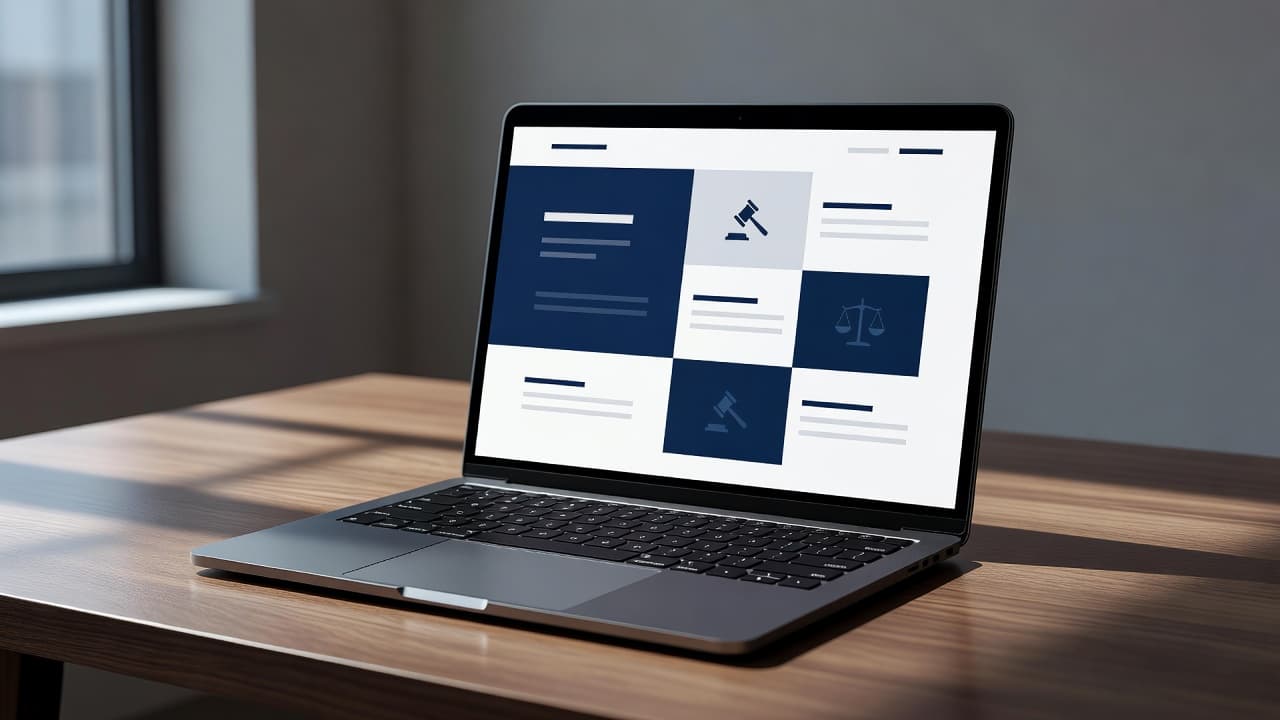
A website for solicitors should not look like the portal of an investment bank, nor should it be a page full of gavel symbols, legal codes and Doric columns. These are images we’ve seen a thousand times over, and they rarely enhance the perception of the practice.
It’s best to opt for a clean design, with consistent colours, white space and a clear visual hierarchy. Blue, grey, white and neutral shades are popular choices because they convey order and reliability. But colour alone cannot fix a disorganised website.
The text must be easy to read. Fonts that are too small, endless lines and low contrast make it difficult to read. This is particularly true on smartphones.
Mobile-first is not just a minor detail
Many enquiries come via telephone. Someone might search for “employment lawyer near me” during a break, whilst travelling or after receiving an urgent message. A responsive design is essential to ensure that the website adapts perfectly to every device.
If the website loads slowly, the menu doesn’t open properly or the form takes too long to load, the visitor will leave. There’s no point in having expensive graphics if the user experience is let down by forms that are impossible to use with a thumb.
Check the following:
- large buttons spaced well apart;
- clickable telephone number;
- forms with few fields;
- text that can be read without zooming;
- compressed and properly proportioned images;
- No pop-ups that cover the content.
Google also takes the quality of the mobile experience into account when crawling pages. A slow website may lose organic traffic and enquiries.
Core Web Vitals help identify real issues. LCP measures how long it takes for the main content to appear. INP monitors responsiveness to interactions. CLS detects sudden shifts in elements whilst the page is loading. Optimising these metrics isn’t just for show; it’s a key factor in improving search engine rankings. If a CTA shifts just as a visitor is about to click on it, that’s a genuine problem that needs to be resolved.
The call to action must explain what happens next
Every page needs a main objective. If a page is about employment law, the most logical call to action is to ask for an appointment for a consultation. Don’t suggest five different actions on the same page.
“Contact us” is clear, but not very specific. “Book a consultation” gives a better idea of what happens after you click.
Position matters too. A prominent CTA at the top of the page is useful for those who have already made up their minds. A second CTA at the bottom of the page can capture the attention of those who have read all the information before taking action.
Privacy, security and proper communication
A legal website often collects sensitive data. A user may provide details about a legal case, a family relationship, a dismissal or a dispute. It is not just any old form.
Security is the starting point: the website must use a valid SSL certificate, receive regular updates and have secure administrative access. WordPress is a reliable platform, but it should never be left without ongoing maintenance.
The contact form should only ask for the necessary information. Name, contact details, the subject of the enquiry and a brief message are often sufficient for an initial contact. Avoid unsolicited attachments and fields that encourage the user to reveal too much detail at this stage.
Consent for the processing of data submitted via forms must be separate from the cookie banner. The GDPR privacy notice, the cookie policy and tracking tools must be configured with the utmost care. It is essential not to copy text found online, as every practice deals with different data, tools and purposes.
Professional communication, too, requires a sense of proportion. A solicitor may highlight their expertise, publications, services and verifiable results, whilst always fully complying with the code of conduct for the legal profession. It is not appropriate to promise certain outcomes, use misleading phrases or turn a sensitive legal matter into an advertising slogan.
The Lawyers’ online presence in the digital landscape It therefore requires visibility, but also constant attention to one’s reputation and strict adherence to the rules of the profession.
Local SEO for law firms: getting noticed in your own town
A well-designed website that hasn’t been optimised using SEO strategies for solicitors yields few tangible results. For a professional practice, investing in local SEO is often the top priority for attracting potential clients in the local area.
Users“ searches are almost never generic; instead, they focus on specific intentions such as ”divorce solicitor Rome“, ”debt recovery solicitor Milan“ or ”employment law firm Turin’. Behind these search queries there is almost always an immediate need for assistance.
The first step is to create useful pages for specific areas of activity and for the geographical area actually served. There is no point in creating dozens of pages for every Italian city if the practice operates from a single physical location. Google and users can easily spot content created solely to take up space, and they penalise this approach.
Google Business Profile and consistent data
Optimising your Google Business Profile is essential for appearing in local searches and on Google Maps. Your practice name, address, telephone number, opening hours and website link must be consistent across all digital channels to improve your online visibility.
An incorrect number or an out-of-date opening time can instantly undermine trust. These are small details, but they have a significant impact on the likelihood of being contacted.
Reviews should be requested politely, without being pushy. Always respond professionally and do not discuss the details of cases in public. Even a brief reply shows that you care about the customer.
Information on Seven common mistakes on lawyers’ websites They show just how common problems such as generic text, confusing navigation and hard-to-find contact details are.
A legal blog attracts traffic if it answers real questions
A legal blog should not publish incomprehensible legal commentary simply to pad out the site. Instead, it should answer the questions that clients actually ask the firm during consultations.
“How does a mutual separation work?”, “What should I do after being made redundant?” or “How long do I have to contest a fine?” are topics that are much closer to the way people actually speak.
Every article must be up to date, signed where appropriate, and written using reliable sources. When it comes to legal matters, accuracy takes precedence over quantity.
Publishing two pieces of content a month can be more useful than writing ten in a week and then stopping updating the website. Consistency is key, as is keeping the content up to date whenever the regulations change.
For a more comprehensive project, the guide on websites for freelancers It helps you understand how to link structure, content and contact enquiries effectively.
Measuring contacts, not just visits
Having a thousand visits a month isn’t enough. The key question is: how many people ring, fill in a form or book a consultation?
The conversion rate is calculated as follows:
(number of conversions / visitors or sessions) × 100
The unit chosen must remain the same. If you use sessions, always use sessions. If you use users, stick with users. Otherwise, the comparison becomes unreliable.
With Google Analytics 4, you can track the use of contact forms, clicks on the phone icon, clicks on WhatsApp and bookings. Google Search Console, on the other hand, shows the search queries that drive traffic, the pages viewed in the results and the CTR.
Don’t get too hung up on the 2% or 3% benchmarks. Every agency has different services, clients and traffic sources. The most useful comparison is with your own historical data.
An overall rate of 2% may mask a specific situation: 4% for desktop and 0.7% for mobile. In that case, there is no need to increase the advertising budget straight away. First, we need to understand why the mobile site is causing users to drop off and preventing potential customers from being converted into actual leads.
When conversions drop, the first thing to check is the website, not the adverts.
Look at the pages that are getting traffic but no enquiries. Check the form, the loading speed, the clarity of the CTA and whether the search results match the content. Small tweaks can solve a problem that’s much bigger than it seems.
How much does a website for solicitors cost, and what should you look out for?
The final cost depends on the structure, content, functionality and the SEO work required. Requesting a quote for a website requires careful assessment, as a basic site with about-us pages, service areas, a blog and contact details involves a different investment to a complex portal that incorporates restricted-access areas, management functions and listings for multiple locations. Branding for solicitors also affects the price, as a bespoke design that conveys authority requires more in-depth planning.
Be wary of excessively low prices that promise to include everything. Often, such offers do not include strategic analysis, copywriting, mobile optimisation, technical training, security, ongoing maintenance or local search engine optimisation.
Before choosing who will build the website, ask:
- who will be responsible for updates and security after publication;
- whether the website will actually be owned by you;
- how contacts and enquiries will be recorded;
- whether the project includes a local SEO strategy;
- What are the expected timelines for content, development and review?.
The WordPress CMS is a sound choice for many agencies because it allows you to update pages and articles without having to rely on a developer every time. However, a well-organised technical foundation is essential. Haphazard plugins, resource-intensive themes and a lack of maintenance will soon turn an investment into a problem. If your current platform is slow or not working properly, consider that a website redesign might be the best solution to start generating qualified leads again.
A good professional doesn’t start by asking which colour you prefer. They first analyse your areas of business, your ideal customer profile, the geographical area you serve, your growth objectives and the content you already have. Design, in fact, always comes after strategy.
A legal website should make it easy to take the first step
An effective website for solicitors does not promise simple solutions, but conveys expertise, answers the key questions of potential clients and makes it easy to get in touch.
A clear structure, dedicated pages, mobile optimisation, compliance with privacy regulations, local SEO and constant monitoring all work in synergy. If even one of these elements is missing, the website risks attracting traffic without generating conversions.
The point is not simply to have an online presence, but to build online credibility that makes the firm come across as reliable, accessible and knowledgeable from the very first click. Investing in your professional authority means transforming your website into a strategic asset, as any truly effective marketing plan for solicitors always starts with a solid, well-designed website capable of converting visitors into qualified leads.
FAQs on websites for solicitors
Which pages are essential for a law firm’s website?
To build effective websites for solicitors, they must include a homepage, a page presenting the practice, profiles of the professionals, practice areas, contact details and sections dedicated to privacy and cookie policies. A professional blog is also essential for capturing informational searches and consolidating the brand’s authority over time.
If the practice operates from several locations, each location must have accurate and verifiable information. It is not advisable to create fictitious local pages for the sole purpose of appearing in multiple cities, as this undermines the website’s credibility.
Can a solicitor use reviews on their website?
Reviews can certainly boost users’ confidence, but they must be handled with the utmost care. They must always comply with the rules on confidentiality, professional conduct and the guidelines on the provision of information that every law firm is required to observe.
Ideally, you should use genuine, verified reviews and avoid any misleading alterations. Even when the firm responds to reviews, the tone must remain measured and professional, without ever revealing confidential details of the relationship between the solicitor and the client.
How long does it take for a legal website to rank on Google?
The time required depends on local competition, the technical quality of the website, the relevance of the published content and the starting point. A new portal rarely reaches the top positions in a very short space of time.
An SEO strategy for solicitors requires consistent effort over the medium and long term. Optimised web pages, a well-maintained Google Business Profile, useful content for potential clients and accurate technical data lead to far more robust results than any shortcuts or promises of immediate rankings.



