Many Italian SMEs invest in SEO every year without seeing any tangible results. They pay someone, wait for months, and ultimately end up with reports full of incomprehensible data and no new customers. The problem isn’t SEO itself, but how it’s implemented. This SEO guide for businesses is designed to offer a fresh perspective: not a list of technical tricks, but an integrated system that links visibility, content and actual conversions. If you run a small or medium-sized business and want to finally understand how to turn your website into a customer acquisition tool, you’ve come to the right place.
Contents
- Laying the foundations: what you need to know before starting SEO
- How to structure a website technically for effective SEO
- Creating content with commercial intent and authority
- Continuous monitoring and optimisation with Google Search Console
- Why many SEO strategies for SMEs fail and how to avoid this
- Professional SEO solutions for your business
- Frequently Asked Questions about the SEO Guide for Businesses
Key Points
| Full stop | Details |
|---|---|
| Integrated SEO | Effective SEO combines technical aspects, content and conversion goals into a coherent system. |
| Technical priority | Focusing on Core Web Vitals, clean architecture and internal linking yields the greatest benefits. |
| Content with intent | Creating content tailored to business needs increases qualified traffic and leads. |
| Continuous monitoring | Google Search Console is essential for diagnosing issues and optimising SEO on an iterative basis. |
| A people-centred approach | Making content more human builds trust and improves the company’s online reputation. |
Laying the foundations: what you need to know before starting SEO
Before you even start working on the website, the code or the keywords, there’s one essential thing you need: clarity on what you want to achieve. All too often, SEO for businesses starts with technical optimisation without having a clear answer to the question: “Which customers do I want to attract, and what do I want them to do on my website?”. Without this answer, you’re building on sand.
As those working in the field with SMEs point out, SEO isn’t just a checklist It’s not just a technical approach, but a system linked to conversions and real-world impact metrics. This changes everything: you’re not optimising for Google, you’re optimising for your ideal customer.
Understanding search intent before keywords
Search intent is the reason why someone types something into Google. It’s not enough to find keywords with a high search volume: you need to understand whether the person searching for that term is ready to buy, is comparing options, or is simply gathering information. An SME selling solar panels, for example, needs to target people searching for “solar panel quote for businesses” far more than those searching for “how a solar panel works”.
To find out which keywords Types of SEO strategies for SMEs to help you identify which ones are best suited to your situation, sort them into three categories:
- Informational keywords: “What is local SEO?”, “How does search engine ranking work?”
- Comparison keywords: “best SEO agency in Milan”, “website optimisation prices”
- Commercial/transactional keywords: “SEO quote”, “SEO consultant for businesses”
The former drive traffic. The latter bring in customers. A good SEO strategy for businesses uses both, but knows where to focus its efforts.
Set objectives and KPIs before you start
KPIs (Key Performance Indicators) must be chosen beforehand, not afterwards. Set at least three specific objectives for the next 90 days:
- Organic traffic: How many visits do you want to receive from organic search each month?
- Conversions: How many enquiries, phone calls or sign-ups do you want to generate?
- Position: which keywords do you want to rank highly for
Essential tools for monitoring SEO
| Instrument | Main function | Cost |
|---|---|---|
| Google Search Console | Position monitoring, technical faults | Free |
| Google Analytics 4 | Traffic and conversion analysis | Free |
| Screaming Frog | Technical site scan | Free (basic version) |
| Ubersuggest / Semrush | Keyword research and competitor analysis | Subject to a fee |
Pro tip: Don’t wait until you have all the perfect tools to get started. Start with Google Search Console and Analytics 4, which are free and already give you 80% of the information you need. Adding advanced tools only makes sense once you know how to interpret the basic data.
How to structure a website technically for effective SEO
Now that the groundwork is complete, let’s move on to how to make changes to the technical structure to achieve tangible results. The technical side of things daunts many business owners, but in reality there are only a few, clearly identifiable priorities. You don’t need a perfect website: you need a website that doesn’t block Google and that loads quickly on mobile devices.
As the latest analyses show, stable Core Web Vitals, a clear site architecture and well-thought-out internal linking are key elements for SEO that really works. Let’s see what this means in practice for an SME.
Core Web Vitals: the speed metrics that matter
Core Web Vitals are three metrics that Google uses to measure the user experience on your website:
- LCP (Largest Contentful Paint): How long does it take for the main content to load? (It must be under 2.5 seconds)
- INP (Interaction to Next Paint): how quickly the website responds to user clicks (under 200 milliseconds)
- CLS (Cumulative Layout Shift): how much the page elements “move” whilst the page is loading (this should be close to zero)
A slow mobile site loses rankings. You can check your metrics directly in Google Search Console under the “Page Experience” section.
Site architecture and clean URLs
The structure of your website must be logical and predictable. Google needs to be able to understand what you do, who you do it for, and where to find the key information in just a few clicks. Here are the practical guidelines:
- Every page on the website must be accessible via maximum 3 clicks from the home page
- URLs should be short and descriptive (e.g. "/services/corporate-seo/")
instead of/page?id=34`) - Use H1, H2 and H3 tags in a hierarchical order, without any logical gaps
- Each page must have a subheading and one meta description unique
Internal linking: how to distribute authority
Internal linking involves strategically linking the pages on your website to one another. If you write an article on “how to choose an SEO consultant”, include a link to your SEO services page. This helps Google understand which pages are most important and transfers authority between pieces of content.
To find out more about how this technique translates into tangible visibility, the guide to Technical SEO benefits provides a clear overview of the priority measures for SMEs.
Pro tip: Avoid technical perfectionism. Fixing the 10 most serious errors on your website is far more valuable than correcting 100 minor, secondary details. Use Screaming Frog to identify the real issues: 404 errors, pages without meta titles, duplicate content.
Creating content with commercial intent and authority
Now that we understand the importance of technique, let’s look at how to produce content that converts and builds trust. Content is what makes the difference between a website that attracts traffic and one that attracts customers. It’s not about writing a lot, but about writing right.
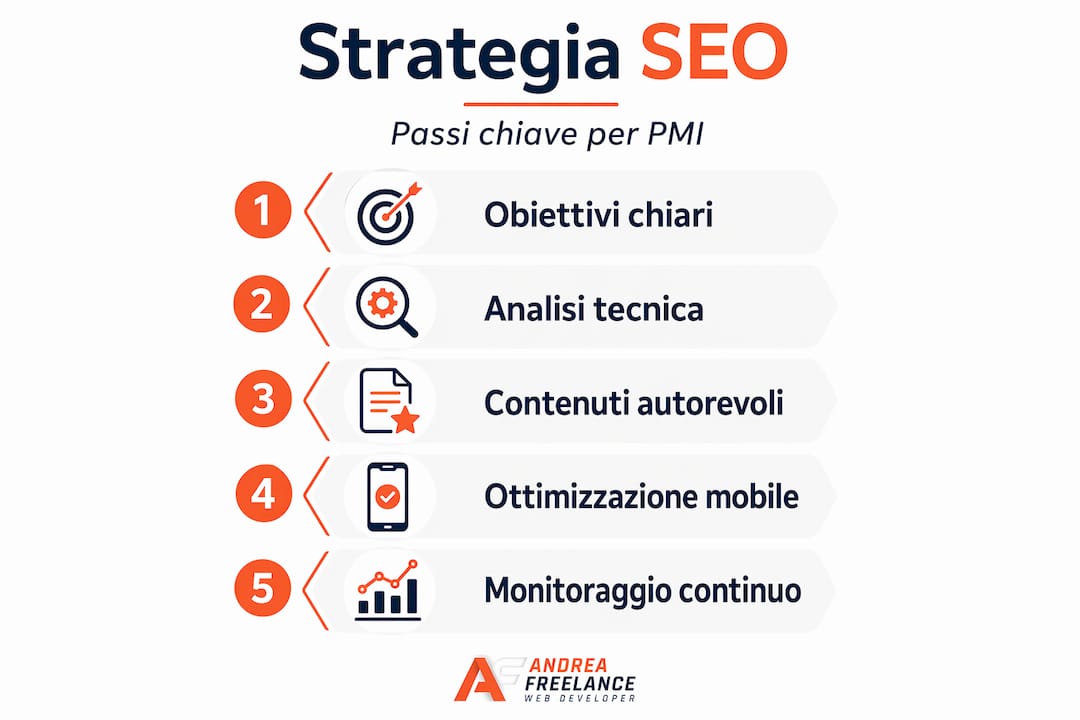
As demonstrated by the experience of those who have turned SEO into a lead generation assets, combining technical SEO, commercial content and digital PR is the key to achieving lasting results in 2026.
How to identify keywords with commercial intent
Not all keywords are the same. To attract customers who are ready to take action, follow these steps:
- Look for the terms your best customers use. Ask your existing customers directly how they found you and what they searched for on Google.
- Analysise your competitors’ pages that generate traffic. Tools such as Ubersuggest show which keywords they rank for.
- Take a look at the “People Also Ask” section on Google. Related questions reveal what those close to making a purchase want to know.
- Prioritise long-tail keywords. Long-tail keywords such as “SEO consultant for manufacturing companies in Bergamo” have lower search volume but a much higher purchase intent.
Content that offers real value
A common mistake is to write generic content that could apply to any business. The customer reading it needs to feel that you are speaking directly to them of his specific problem. For the website positioning strategies for SMEs For them to work, the content must answer specific questions:
- What objections does the customer have before making a purchase?
- What are the typical mistakes made by those new to your sector?
- Why choose you rather than an alternative?
Digital PR and link building to build authority
Inbound links (known as backlinks) from authoritative websites boost your website’s credibility in Google’s eyes. For an SME, the most effective strategies are:
- Press releases in local newspapers for events, awards or company news
- Guest post on an industry blog where you share your experience and knowledge
- Registration with directories and trade associations verified and relevant
- Collaborations with suppliers or partners which mention your website in their content
Digital PR isn’t just about link building: it’s about building a credible online presence that Google recognises as a sign of trust.
Monitoring AI responses for future visibility
By 2026, an increasing proportion of searches will be answered directly by artificial intelligence search engines such as Google SGE or Bing Copilot, without the user clicking on any website. To remain visible in this scenario, your content must be structured in such a way that AI systems can cite it as an authoritative source. Answer frequently asked questions in your sector directly and precisely, use clear language and include verifiable data.
Continuous monitoring and optimisation with Google Search Console
Now that we’ve created the content and structure, let’s learn how to monitor and optimise on an ongoing basis. Without monitoring, SEO becomes a shot in the dark. The problem is that many SMEs set up Google Analytics, check it once a month and then make decisions based on gut feeling. It doesn’t work like that.
Google Search Console (GSC) is a essential operational tool to diagnose and improve SEO on an ongoing and precise basis.
How to set up an effective monitoring routine
- Every week: Check in GSC to see if any new technical errors have appeared (excluded pages, coverage issues, 404 errors)
- Every week: Check the queries that have generated impressions and clicks over the past week, comparing them with the previous week
- Every month: analyse pages with a high number of impressions but a low CTR (Click-Through Rate, i.e. the ratio of views to clicks) and optimise the meta title
- Every month: Check the average position of your main keywords and assess whether they are improving or getting worse
Key metrics to monitor in Google Search Console
| Metric | What does it measure? | How to use it |
|---|---|---|
| Impression | How often does your website appear in the results? | Measure potential reach |
| Click | How often do users click on your website? | Measure actual organic traffic |
| CTR (%) | Click-through rate | A low CTR indicates that some headlines need improving |
| Average position | Average position in the SERPs for each query | Priority: to improve rankings for queries between positions 5 and 15 |
How to use data to make decisions
The real value of monitoring lies in linking SEO data to business results. If a page has lots of impressions but zero conversions, the problem isn’t SEO: it’s the page itself. If a keyword drives traffic but people leave straight away, the content is probably not matching their search intent.
To link SEO and business results in a structured way, the section dedicated to SEO website optimisation provides a clear overview of how to measure the actual impact of the work carried out.
Pro tip: Create a shared Google Sheet where you record the top 5 keywords each month, along with their average ranking, clicks and CTR. In 6 months, you’ll have a clear picture of what’s performing well and what needs attention. Your own historical data is worth more than any external benchmark.
Why many SEO strategies for SMEs fail and how to avoid this
After more than 20 years working in the digital sector, I have seen hundreds of Italian SMEs approach SEO with sky-high expectations, only to be disappointed after just a few months. The reason is rarely technical. The real problem is structural.
As more in-depth analyses of Italian SMEs reveal, there is often a lack of a clear editorial strategy that brings together technique, content and conversion. Without this consistency, a great deal of work is done that yields little in the way of results.
For many companies, SEO is treated as a separate activity: one consultant optimises the website, another writes a few articles, and the owner updates the prices on the homepage. Nobody ensures that these elements work together. And so, whilst the website may well climb the Google rankings, it fails to generate enquiries because the landing page isn’t compelling, or it generates enquiries but from the wrong customers because the chosen keywords don’t match their actual intent.
Another mistake I often see people making is chasing vanity metrics, that is, figures that make you feel good but don’t tell you anything useful. Having 10,000 visits a month on a blog featuring industry trivia is worth nothing if those visits don’t turn into leads. Better to have 500 qualified visits than 10,000 that are all over the place.
The human factor is often underestimated. Content written with real-world experience and first-hand knowledge of the customer performs better than texts that have been coldly optimised with keywords inserted mechanically. By 2026, Google will be increasingly able to recognise the quality of information, not just its structure. A text that genuinely answers the searcher’s question, written by someone with hands-on experience in the sector, ranks higher than a technical but anonymous text.
The most practical advice I can give you is this: build a sustainable SEO process. Not a massive two-month effort followed by nothing, but a steady rhythm: one article a month, a quarterly technical review, a monthly data analysis. SEO rewards consistency far more than intensity.
To understand how improve our online presence As it can deliver tangible results even for small businesses, it is worth reading about real-life examples of companies that have transformed a static website into an active tool for customer acquisition.
Professional SEO solutions for your business
If you want to turn this guide into tangible results, find out how our services can help you, step by step. Understanding the principles of SEO is the first step, but putting them into practice requires time, tools and technical expertise that SMEs often lack in-house.
With the web services for businesses available at andreafreelance.com, you can count on comprehensive support: from technical optimisation prioritised according to the actual issues affecting your website, to the creation of content with a commercial focus, right through to monthly monitoring with clear data and concrete actions. If your website needs to be revamped before any SEO work can begin, the workflow for the redesign It is designed to ensure that the work already done is not wasted. And for those who want to get started straight away with search engine optimisation, the section dedicated to website positioning and SEO explains exactly how the process is structured. Over 20 years’ experience in the web industry, tailored to the real needs of Italian SMEs.
Frequently Asked Questions about the SEO Guide for Businesses
How long does it take to see results from SEO?
Tangible SEO results for an SME generally start to become apparent after 3–6 months, though this depends on the technical situation and the existing content. A realistic 90-day plan can already remove the main technical obstacles and kick-start the optimisations that will have the greatest impact.
What does ‘content with commercial intent’ mean?
These are texts designed to engage users at the decision-making or purchasing stage, responding directly to their needs with clear calls to action. Bliss Agency has demonstrated that focusing on commercial keywords leads to a direct increase in leads and qualified conversions.
Which SEO metrics are most useful for a small business?
It is best to focus on metrics such as CTR, the volume of relevant impressions and conversions generated to gauge the true effectiveness of SEO. According to industry analysis, a few useful KPIs – such as clicks, CTR, and micro and macro conversions – help you make better decisions without getting lost in the numbers.
How can I make the most of local SEO for my business?
Local SEO relies on specific optimisation techniques such as managing Google My Business listings and ensuring visibility on maps and in geolocated searches. As explained by Mailchimp on local SEO, is a specific feature that helps businesses stand out in local search results.
Should SEO take artificial intelligence into account?
Yes, modern SEO strategies incorporate a presence in AI-generated answers and prioritise signals of quality and reliability in order to remain competitive. Managing AI-generated answers is now an integral part of effective SEO in 2026.