TL;DR:
- SEO is essential for boosting the visibility and sales of Italian SME e-commerce businesses.
- Effective SEO strategies include on-page and off-page optimisation, viral content and ongoing monitoring.
- SEO requires consistency and a long-term perspective to achieve lasting results.
Many Italian e-commerce sites list products, invest in design and wait for customers who never turn up. In most cases, the problem is neither the product range nor the price: it is the lack of a structured SEO strategy. SEO, or search engine optimisation, determines whether your online shop appears when a potential customer searches for exactly what you’re selling. Without it, your website exists but is invisible. In this article, you’ll discover why SEO is essential for Italian SMEs, what the key elements to optimise are, which strategies to implement straight away, and how to measure progress over time.
Contents
- Why SEO is crucial for Italian e-commerce
- Key elements of SEO for online shops
- Practical SEO strategies to boost sales and visibility
- How to monitor results and optimise them over time
- The truth that few people talk about: e-commerce SEO requires a long-term vision
- Choose professional solutions to ensure your e-commerce site’s SEO success
- Frequently Asked Questions about SEO for e-commerce
Key Points
| Full stop | Details |
|---|---|
| SEO boosts visibility | Optimising your e-commerce site enables you to reach more customers and boost sales. |
| Focused on the user experience | A clear structure and targeted content improve not only search engine rankings but also visitor satisfaction. |
| Constant monitoring | Regularly analysing SEO data and KPIs helps you adapt your strategy and maximise results over time. |
| Invest in training | Only those who continually update their SEO skills are able to stay one step ahead of developments in the digital market. |
Why SEO is crucial for Italian e-commerce
Let’s analyse why SEO is essential for the success of Italian e-commerce businesses. The Italian digital market has grown significantly in recent years, but many small and medium-sized enterprises still struggle to stand out from the online competition. Having a well-designed website isn’t enough: Google and other search engines need to find it, understand it and show it to the right users at the very moment they’re searching for your products.
Visibility as the key driver
When a user searches for “handcrafted leather shoes” or “industrial office lamps”, Google returns a list of results. The websites that appear at the top of the rankings receive the vast majority of clicks: the first organic result receives, on average, over 25% of all clicks, whilst those outside the first page receive very little attention. For an Italian SME, this means that e-commerce development for SMEs Having the right SEO structure is already a huge competitive advantage over local rivals.
“Most Italian SMEs struggle to increase their visibility and sales without SEO strategies for SMEs effective.”
Qualified traffic versus general traffic
One aspect that is often underestimated is the quality of traffic. SEO doesn’t attract just any visitors: it brings in users who are actively looking for what you offer. This translates into a much higher conversion rate than, for example, social media adverts. A user who clicks on an organic search result has already demonstrated an intention to buy or search; your job is simply not to let them down.
The main benefits of qualified SEO traffic include:
- Higher conversion rate: Organic users convert on average three times more than traffic from social media.
- Cost per acquisition reduced over time: once you’ve achieved that ranking, you don’t pay for each visit, as you do with paid advertising.
- Cumulative effect: Optimised content continues to attract visitors for months or years after it is published.
- Greater consumer confidence: Users tend to trust organic results more than paid adverts.
SEO versus paid advertising
Google Ads or Meta Ads campaigns deliver immediate results, but as soon as you stop paying, the traffic drops to zero. SEO, on the other hand, is an investment with long-lasting effects. An SME with limited resources should focus on building a digital asset that works for it over time, rather than constantly paying for every visit.
For large companies with huge budgets, paid advertising can be viable. For an Italian SME, focusing on SEO means building a solid online presence that does not depend on a constant flow of expenditure. It is a slower strategy but one that is far more efficient in the medium and long term.
The gap between optimised and non-optimised websites
The difference in visibility between an optimised e-commerce site and one that isn’t is enormous. A website with good SEO can receive thousands of free visits each month, whilst one without optimisation remains invisible even if it offers excellent products. This is even more true in niche markets, where Italian SMEs often have a real competitive advantage but fail to capitalise on it because they lack online visibility.
Key elements of SEO for online shops
Now that we have understood the importance of SEO, let’s look at its key components and how they directly impact the performance of an online shop. SEO is not a single action: it is a set of coordinated measures that fall into three main areas.
On-page SEO: the foundation of it all
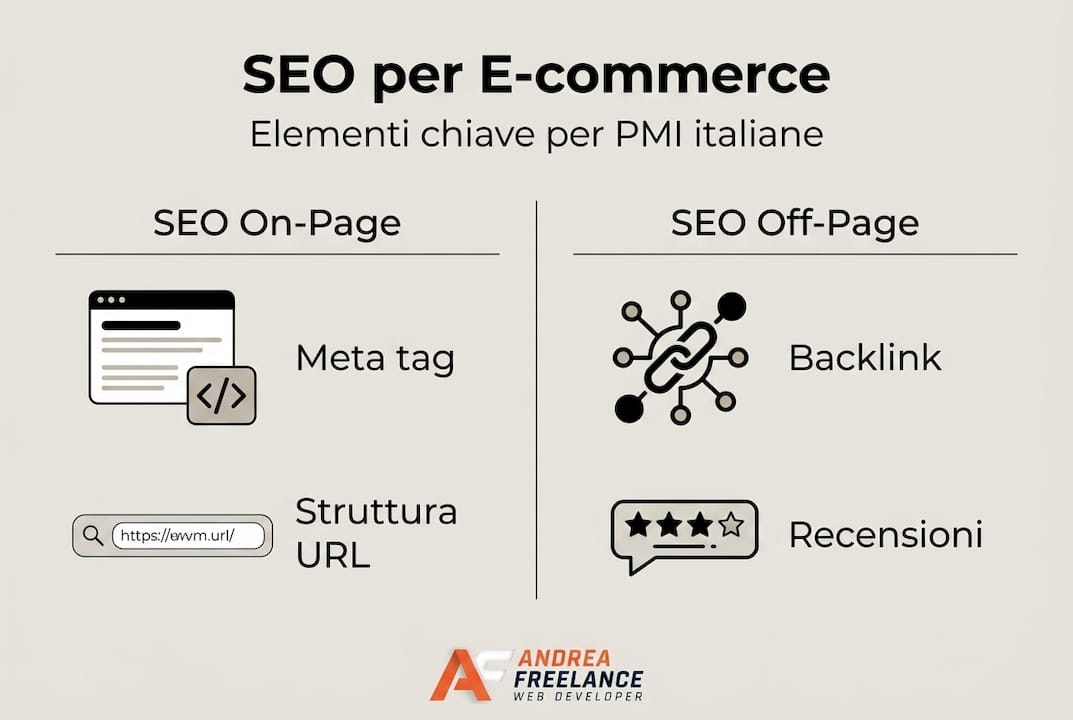
On-page SEO covers everything you can directly control within your website. It includes URL structure, meta tags (the title and description that appear in search results), heading tags (H1, H2, H3), product page descriptions and images with their alt attributes. A website with features of professional websites Well-structured ones already have a head start.
The most important on-page elements for an e-commerce site are:
- Readable and descriptive URLs: use “/category/product-name”
instead of/p?id=123`. - Unique meta titles and meta descriptions for each page: Avoid duplication, particularly for product variants.
- Original content in the product descriptions: Do not copy the supplier’s descriptions; rewrite everything using relevant keywords.
- Internal link structure: Link categories to related products and vice versa to help Google understand the site’s structure.
Off-page SEO: authority and reputation
Off-page SEO covers everything that happens outside your website. The main factor is link building: obtaining links from other authoritative websites to yours. Google interprets these links as votes of confidence. An e-commerce site with high-quality backlinks from industry blogs, online newspapers or specialist directories climbs the rankings more easily than a site without external links.
Performance, mobile and user experience
This is the area most often overlooked by Italian SMEs. Google actively assesses page load speed, the mobile experience and the website’s overall ease of use. The features of corporate websites Modern websites always include mobile optimisation and speed as basic requirements.
| Element | SEO impact | Common mistake |
|---|---|---|
| Loading speed | High | Uncompressed images |
| Mobile optimisation | High | Non-responsive layout |
| Meta tags | Medium | Duplicate titles |
| URL structure | Medium | Generic or numeric URLs |
| Link building | High | A complete lack of backlinks |
| Product sheet contents | High | Copied descriptions |
Pro tip: Use Google PageSpeed Insights to analyse your website for free. Often, simply compressing images and enabling browser caching is enough to gain valuable points in your performance score, which has a direct impact on your search rankings.
A professional website with an optimised structure measurably improves an e-commerce site’s search ranking and performance. It’s not just about aesthetics: it’s about how the site actually works – something that Google rewards and that users appreciate.
Practical SEO strategies to boost sales and visibility
Once the basic elements of SEO have been identified, it is useful to move on to practical strategies that deliver tangible results for SMEs and small online shops. Practical SEO strategies boost sales and visibility, particularly through optimising product listings and targeted content.
Strategies to implement straight away
- Optimise each product page with specific keywords. Do not use generic titles such as “Shoe model A”. Instead, use “Handcrafted brown leather men’s shoe, size 43”, as this reflects what users actually search for. Include the main keyword in the title, the first sentence of the description and the alt attribute of the main image.
- Set up a company blog with informative content. Many SMEs are unaware of this incredibly powerful tool. An article such as “How to choose the right lamp for your office” will attract users who are actively searching for information, who will then discover your products. Content marketing is one of the most effective SEO techniques in the medium term.
- Work on the website’s technical SEO. Create and submit an XML sitemap to Google Search Console, configure the robots.txt file correctly, remove duplicate pages and resolve 404 errors. These technical measures often lead to noticeable improvements within a few weeks.
- Make the most of Local SEO if you also have a physical premises. Optimise your Google Business Profile with opening hours, your address, up-to-date photos and replies to reviews. For a locally based SME, appearing in local searches (“furniture shop in Bologna”) can attract customers both online and in-store.
- Use rich snippets to stand out in the search results. Rich snippets are enhanced visual elements that appear in search results: review ratings, product prices and stock availability. By implementing the markup schema.org On the product pages, your listing becomes much more visible and clickable than those of your competitors.
The value of customer reviews
Reviews are user-generated content that Google considers highly relevant. An e-commerce site with dozens of genuine reviews on its product pages ranks more easily for competitive keywords. Encourage satisfied customers to leave a review immediately after their purchase, perhaps via an automated post-purchase email.
Pro tip: Implement the markup schema.org for product reviews and prices, either directly in the HTML code or via SEO plugins such as Yoast or Rank Math on WordPress. In just a few hours, your organic search results could display star ratings and prices, boosting your CTR (click-through rate) by as much as 30%.
Important information: E-commerce sites that implement a structured SEO strategy see an average increase in organic traffic of 40–60% within the first 12 months, with even higher peaks in niche sectors where online competition is still limited.
How to monitor results and optimise them over time
Once you have put these strategies into practice, it is essential to understand how to monitor the results and optimise them over time to ensure continuous growth. Without measurement, you don’t know what works and what doesn’t. And without that insight, every action is a gamble.
The key SEO KPIs to keep an eye on
KPIs (Key Performance Indicators) are the metrics that measure the effectiveness of your SEO strategy. The most relevant ones for an e-commerce business are:
- Organic traffic: the number of visitors coming from search engines. This should increase over time.
- Average keyword position: monitor where your website ranks for key keywords.
- CTR (Click-Through Rate): the percentage of users who click on your result compared to those who see it.
- Organic conversion rate: how many organic visitors complete a purchase.
- Rebound frequency: if it is high, the page does not meet the user’s expectations.
- Home pages: which pages attract the most organic traffic and deserve more attention.
Essential tools for monitoring
| Instrument | Main function | Cost |
|---|---|---|
| Google Search Console | Positions, clicks, technical errors | Free |
| Google Analytics 4 | Traffic, behaviour, conversions | Free |
| Semrush or Ahrefs | Keyword and backlink analysis | Subject to a fee |
| Screaming Frog | Technical audit of the site | Freemium |
| PageSpeed Insights | Speed and performance | Free |
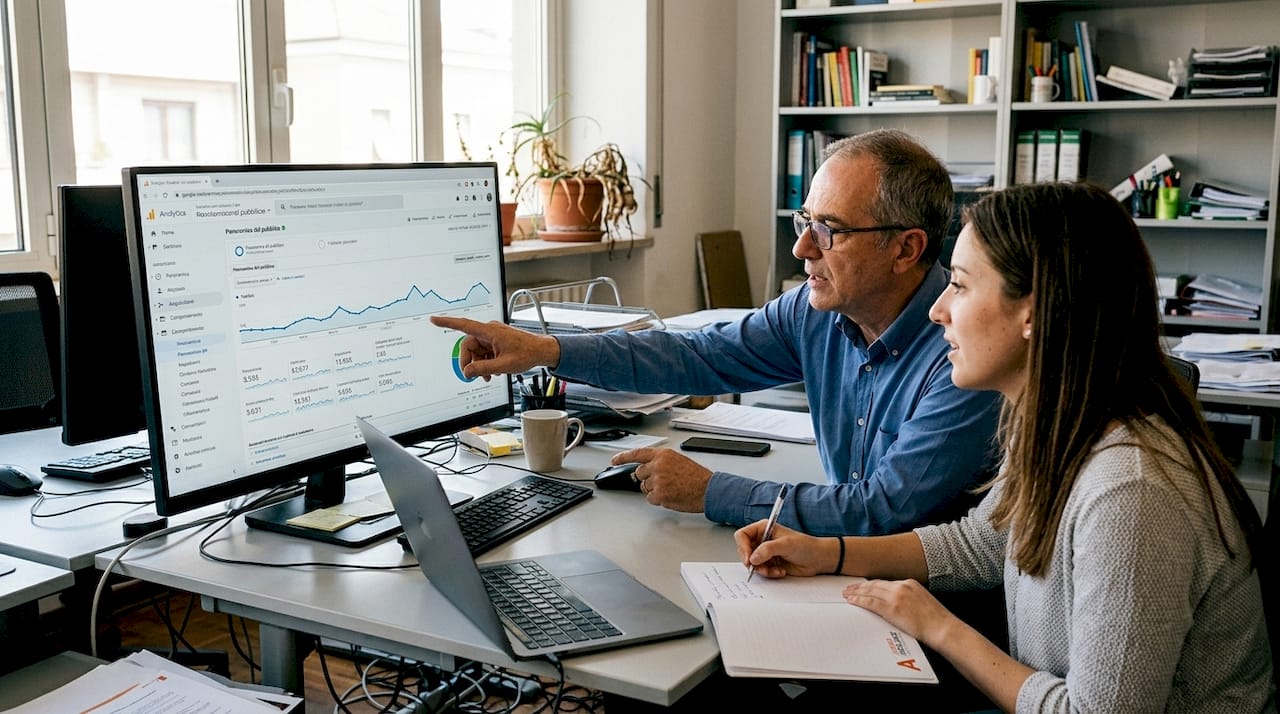
Google Search Console is an essential starting point. It shows you exactly which search queries your website appears for, how many impressions it receives and how many clicks it gets. It is a free tool that is often overlooked by Italian SMEs, yet it contains valuable information that no other tool can provide.
The SEO ranking monitoring It must become a monthly routine, not a one-off activity.
How to interpret the data and take action
Having the data is only the first step. The most common mistake is gathering information without turning it into concrete action. If you notice that a product category has a lot of impressions but few clicks, it means the meta title isn’t compelling enough: rewrite it. If a page has a high bounce rate, it probably isn’t answering the user’s question: improve the content.
“The ongoing monitoring ”It enables you to improve your SEO strategy and adapt to changes in the market."
Checklist for regular optimisation
Every three months, carry out this check on your e-commerce site:
- Check for any new errors in Google Search Console.
- Update the content on the most important product pages.
- Analyse the keywords for which you’re close to the first page (positions 8–15) and focus your efforts specifically on them.
- Check your website’s speed after CMS updates or installing new plugins.
- Analyse the backlinks you’ve acquired and identify new opportunities.
A website redesign and SEO optimisation, if carried out correctly whilst maintaining redirects and the URL structure, should not adversely affect search engine rankings. In fact, it can improve them if accompanied by a comprehensive technical review.
The truth that few people talk about: e-commerce SEO requires a long-term vision
Now that we’ve looked at how to monitor and optimise, it’s time to reflect on the mindset that delivers real and lasting results. There’s a widespread myth I want to dispel: SEO isn’t a magic bullet. There’s no “shortcut” that will get your website onto the first page in a week, and anyone who promises you that is lying.
The uncomfortable truth is that many Italian SMEs approach SEO with unrealistic expectations and then give up after two months when they see no visible results. It’s like expecting to run a marathon without training. SEO rewards consistency, not speed.
What sets growing e-commerce businesses apart from those that stagnate is neither the initial budget nor the most sophisticated tool. It is consistency. SMEs that achieve lasting results are those that commit to constant, small improvements: they update content, optimise new product listings and correct technical errors month after month.
Another misconception that needs to be dispelled is that large companies have an insurmountable advantage. In reality, SMEs with the right real-world experience with e-commerce They often dominate their niches because they know their customers better and can create much more specific and relevant content. Specialisation is a tangible SEO advantage.
It’s better to carry out ten targeted improvements spread out over the course of a year than to undertake one major overhaul and then leave it at that. SEO never lets you down if you nurture it regularly: every small improvement adds to the others, building up an authority that becomes increasingly difficult for competitors to undermine.
Choose professional solutions to ensure your e-commerce site’s SEO success
If you’ve read this far, you’ll already have realised that SEO for e-commerce isn’t something you can just wing. It requires technical skills, an understanding of algorithms, the ability to analyse data and a content strategy that remains consistent over time. For many Italian SMEs, the challenge isn’t a lack of willingness, but rather the time and expertise needed to manage everything in-house.
With over 20 years’ experience in web development and SEO, Andrea Freelance’s SEO service is designed precisely for this purpose: to support Italian SMEs at every stage, from the SEO design of the website right through to the ongoing monitoring of performance. If you’re considering developing your own e-commerce site or already have an online shop that isn’t delivering the results you’d hoped for, contact Andrea for a tailored consultation. Together, you’ll build a solid, measurable SEO strategy tailored to the specific needs of your business.
Frequently Asked Questions about SEO for e-commerce
How long does it take to see tangible results from SEO in an e-commerce business?
On average, it takes at least 3–6 months of continuous optimisation before you start to see noticeable increases in traffic and sales. The ongoing monitoring It helps to speed up the process by quickly identifying what works.
What are the most common SEO mistakes made by Italian SMEs?
Among the most common mistakes are duplicate content, an unclear URL structure and a lack of regular performance monitoring. A website with an optimised structure avoids these problems right from the start.
Do you need a large budget to carry out effective SEO for e-commerce?
No, a targeted strategy can yield results even with a modest initial investment; consistency is more important than the budget. As the experiences of many Italian SMEs confirm, consistency always trumps a one-off expenditure.
What is the difference between technical SEO and content SEO?
Technical SEO relates to the functioning and structure of the website, such as loading speed and URLs, whilst content-based SEO focuses on text, keywords and content quality. The most effective practical SEO strategies combine both aspects in a coordinated manner.