


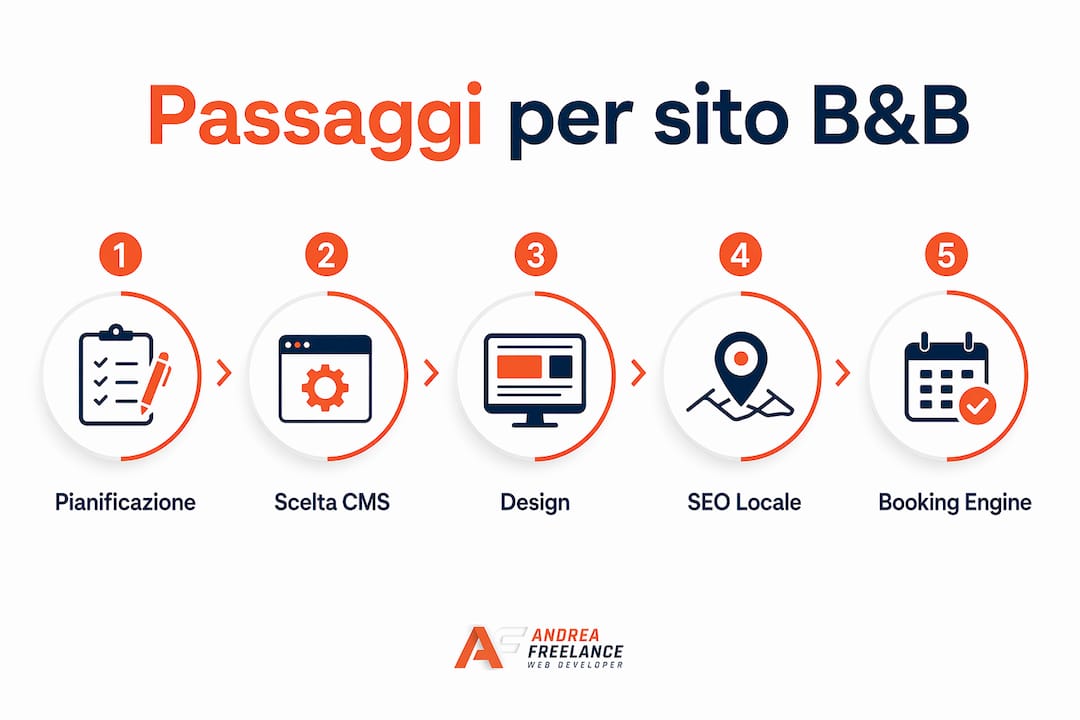
Creating a website for a B&B involves designing and developing a bespoke site that incorporates direct booking functionality, content optimised for local SEO, and a design aimed at converting visitors into paying guests. Your website is the only online space which you have complete control over, unlike Booking.com or Airbnb, where the rules are dictated by others. Without an effective website, you’re handing over your profit margins and brand identity to OTAs every single day. Tools such as WordPress, integrated booking engines and Google Business Profile are the technical building blocks on which to build an independent and profitable digital presence. This guide shows you exactly how to do it, step by step.
What features should an effective B&B website have?
An effective bed and breakfast website can be recognised by one key feature: it converts. It is not enough simply to be online; you need to turn every visit into a booking or a qualified lead. To achieve this, the website must meet clearly defined technical and content standards.
Responsive design and loading speed They are an essential starting point. Over 60% of accommodation searches are carried out on smartphones, and a slow website or one that isn’t optimised for mobile loses these bookings in a matter of seconds. Google penalises slow websites in organic search rankings, so technical performance is also a matter of visibility.
The sections that are a must in a B&B website The following are effective:
- Rooms and Rates page: detailed descriptions, up-to-date availability and clear prices. Guests should not have to look elsewhere for this information.
- Integrated booking system: a direct, visible and user-friendly booking engine, positioned at the top of the page, not hidden at the bottom.
- “Where we are and what to do” section”: information about the location, nearby attractions, recommended restaurants. This section boosts local SEO and answers the questions guests ask themselves before booking.
- Reviews and Testimonials Page: Feedback from previous guests builds trust. Embedding Google or TripAdvisor reviews directly into your website boosts your perceived credibility.
- Contact details and map: telephone number, email address and embedded Google Maps. Simple, but often overlooked.
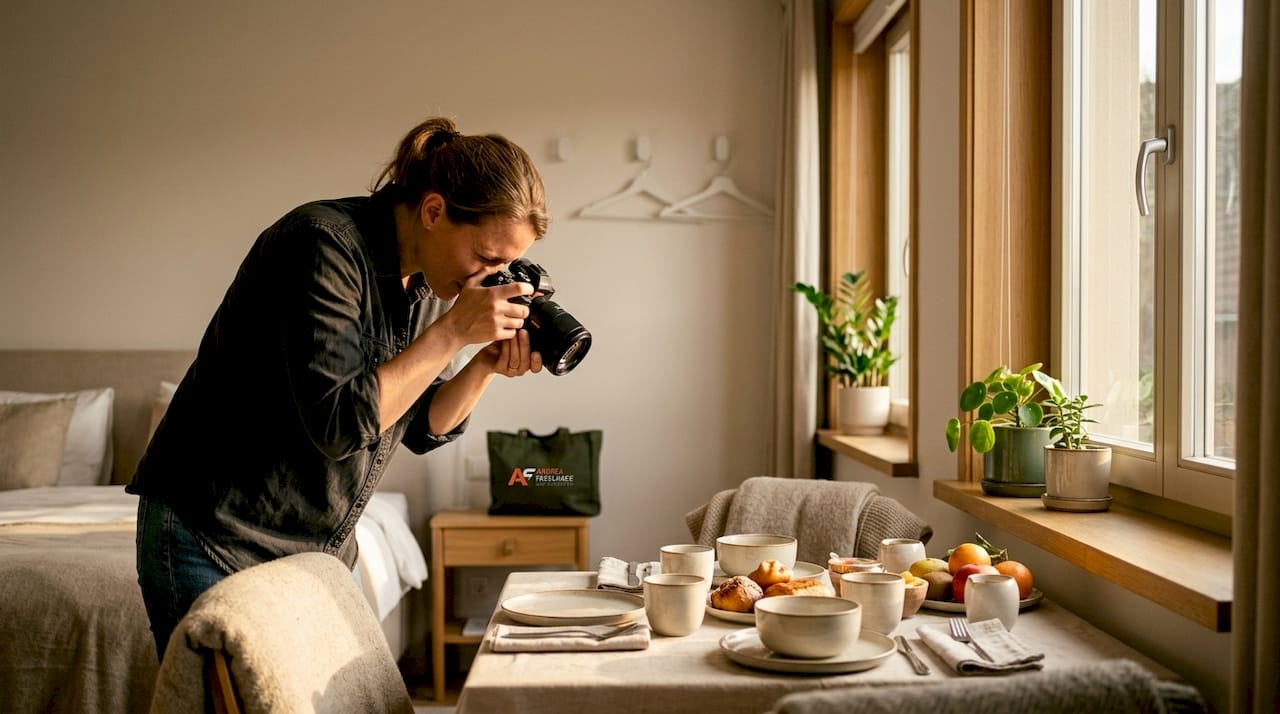
Professional photos are an investment that pays for itself quickly. Well-lit rooms, a laid breakfast table, the communal areas and the distinctive features of your B&B convey an experience even before the guest reads a single word. A professional photographer for a half-day session costs between 200 and 500 euros, but can make the difference between a website that converts and one that is abandoned after three seconds.
Pro tip: Add a direct booking widget to the homepage, visible without having to scroll down the page. Every click saved on the way to booking increases the conversion rate.
How important are local SEO and Google Business Profile for a B&B?
Local SEO is the factor that determines whether your B&B appears when someone searches for “bed and breakfast in central Florence” or “B&B with breakfast near the Colosseum”. Appearing in Google’s so-called “local pack” – the three results with a map that appear at the top of the page – generates a volume of clicks and bookings that no paid advertising campaign can match with the same cost-benefit ratio.
The starting point is the Google Business Profile. The incomplete GBP form It significantly reduces the local visibility of your B&B. This means that having an incomplete listing is worse than not having an optimised one: Google actively penalises it in local search rankings.
Here are the practical steps to optimise your Google Business Profile:
- Select the correct main category. Select “Bed and Breakfast” rather than “Hotel” or “Accommodation”. Change the primary category Switching from “Hotel” to “Bed and Breakfast” can increase impressions by 23% in 60 days. Many owners underestimate this detail and lose visibility every day.
- Upload updated photos every month. Google rewards active listings. Photos of seasonal breakfasts, refurbished rooms or nearby local events show that the establishment is up and running and well-maintained.
- Write a comprehensive description using local keywords. Include the name of the neighbourhood, the main nearby attractions and the unique features of your B&B.
- Reply to all reviews, both positive and negative. Responding to reviews improves the perception of the business and signals to Google that the listing is actively managed.
- Update timetables, services and special offers using the “Post” feature on Google Business. These updates boost engagement on the listing.
Local SEO integrated with Google Business Profile is often overlooked, but it is the key to appearing in “ready-to-book” searches – those where the user has already decided to stay in a specific area and is simply choosing where.
Integration between the website and the Google Business Profile is equally important. The website must contain the business name, address and telephone number exactly as they appear on the Google Business Profile, with no variations. This consistency, known as NAP consistency (Name, Address, Phone), is a sign of trust for local search algorithms. You can find out more about the strategies for local SEO positioning to understand how to integrate these elements in a technical and structured way.
What are the best technical options for creating a website for a B&B?
The choice of technology used to build your B&B’s website has practical implications for costs, autonomy and long-term results. There is no single, universally best solution: the choice depends on your budget, your willingness to manage the website and your growth objectives.
WordPress remains the most flexible CMS for building websites for accommodation providers, but it requires technical expertise to be set up correctly. With WordPress, you can integrate booking plugins such as Checkfront or WP Hotel Booking, optimise SEO with Yoast SEO or Rank Math, and customise every aspect of the design. The downside is that updates, security and performance require constant attention or the support of a professional.
| Solution | Initial cost | Flexibility | Management autonomy | SEO optimisation |
|---|---|---|---|---|
| WordPress with a developer | 1,500 to 4,000 euros | High | Media (with training) | Excellent |
| Website builders (Wix, Webnode) | 200 to 600 euros per year | Low | High | Limited |
| Web agency | 3,000 to 10,000 euros | High | Low (addiction) | Good |
| Specialist freelancer | 1,000 to 3,500 euros | High | Media | Excellent |
Website builders such as Wix or Webnode offer a quick start and low costs, but have serious structural limitations. Technical SEO is difficult to optimise thoroughly, integrations with advanced booking engines are often lacking or expensive, and the website remains “hosted” on the provider’s platform. If you stop paying, the website disappears.
Working with a freelancer specialising in web development for B&Bs offers the best balance between customisation, cost and ongoing support. A professional with experience in the hospitality sector is already familiar with the necessary integrations, local SEO best practices and the specific needs of those running a small or medium-sized establishment.
Pro tip: Before choosing the technology, ask your developer whether you’ll be able to update text, photos and prices yourself without having to request paid technical support every time. The ability to manage content independently is a requirement, not an optional extra.
How can you increase direct bookings and reduce OTA commissions?
OTAs such as Booking.com Airbnb and similar platforms are essential tools for raising your profile, particularly for attracting international guests who are not yet familiar with your B&B. The problem is the cost. OTA commissions These include taxes and can amount to an effective cost of 18 and 19 per cent of the sale price. On a room costing 100 euros a night, you’re giving up nearly 20 euros on every booking made through an intermediary.
The right strategy is not to abandon OTAs, but to gradually reduce dependence on them by increasing the volume of direct bookings via the website. Here’s how to do it in practice:
- Set up a direct booking engine on the website. Tools such as Lodgify, Beds24 and Smoobu allow you to manage direct bookings with online payment, without any intermediary fees. The monthly cost of these tools is more than recouped with just one or two direct bookings a month.
- Synchronise your calendar with a channel manager. A channel manager automatically updates availability across all OTAs and on your website, eliminating the risk of double bookings. Solutions such as Cloudbeds or iCal enable this real-time synchronisation.
- Offer an incentive for booking directly. A complimentary breakfast, free early check-in or a 5 per cent discount on the OTA price are tangible incentives for guests. Make this clear on your website and in follow-up emails after their stay.
- Calculate the correct BAR. The Best Available Rate must take into account discounts and commissions to ensure the desired net profit. Carrying out spot checks against the selling price, the invoiced commission and the net amount received helps to avoid hidden financial losses that many owners only discover at the end of the year.
- Collect guests’ email addresses and build a mailing list. Every guest who stays with us is a potential direct customer for the future. A seasonal newsletter featuring exclusive offers for those who book directly builds loyalty and reduces customer acquisition costs over time.
The Strategies for combining OTA and direct bookings They enable you to increase margins and reduce reliance on high commission fees. A realistic target for a B&B with a strong online presence is to increase direct bookings to between 30 and 40 per cent of the total within 12 months of optimising the website.
Key points
A professional website for B&Bs, optimised for local SEO and featuring a direct booking engine, is the most effective way to increase bookings and reduce reliance on OTAs.
| Full stop | Details |
|---|---|
| Design and speed | The website must be responsive and fast: over 60% of searches are carried out on mobile devices. |
| Google Business Profile | Select the “Bed and Breakfast” category and update your photos and content every month to maximise your local visibility. |
| Technological choice | WordPress, when used with a specialist freelancer, offers the best balance between flexibility, cost and SEO. |
| Direct bookings | An integrated booking engine eliminates OTA commissions and improves profit margins right from the very first booking. |
| Constant updates | Monitor and update the website It consistently maintains its visibility on search engines and ensures guest satisfaction. |
My perspective after 20 years of web design for accommodation providers
After more than twenty years working in web development, I’ve seen hundreds of B&B owners make the same mistake: investing in a website that looks great but is useless. Pages with elaborate animations, stylish fonts and coordinated colours. And yet, zero direct bookings, because there was no booking engine, local SEO hadn’t been addressed and the photos were taken on the owner’s smartphone.
The most common problem isn’t a lack of budget. It’s a lack of clear priorities. Many business owners think that simply having a website automatically means they’ll gain visibility. It doesn’t work like that. A website without local SEO is like a road sign in the middle of the desert: perfect, but nobody sees it.
Another mistake I often see is relying on DIY solutions to save money, only to discover later that the website doesn’t rank well, doesn’t load properly on mobile devices and doesn’t integrate with any booking system. The initial saving turns into a hidden cost in terms of lost bookings.
The advice I always give to B&B owners is this: treat your website as you would your establishment. Keep it up to date, look after it and improve it over time. Constantly updating and monitoring your website isn’t a one-off task; it’s routine maintenance. Seasonal offers need to be published, photos need to be updated, and reviews need to be managed. A website left to its own devices loses its ranking in search engines and credibility in the eyes of guests.
The good news is that a B&B with a well-designed website, an optimised Google listing and an active booking engine can compete on equal terms with much larger establishments, even without a substantial advertising budget. Local SEO is a field where quality trumps quantity, and a small, well-run B&B often stands a better chance than a large, impersonal hotel.
— Andrea
Create or revamp your B&B website with Andreafreelance
If you’re considering creating a new website for your bed and breakfast or revamping your existing one, Andreafreelance offers a specialised service with over 20 years’ experience in web development for accommodation providers. Every project begins with an analysis of the property’s specific requirements, with a focus on local SEO, booking engine integration and ease of self-management of content. You can find out about the full website redesign process or assess the website design services tailored to your B&B. Contact Andreafreelance for a free consultation and find out just how much of a difference it can make to have a website that really works for you.
FAQ
How much does it cost to build a website for a B&B?
The cost ranges from 1,000 to 4,000 euros for a professional WordPress website with an integrated booking engine, depending on its complexity and the number of pages. Website builders are cheaper initially but offer less flexibility in terms of SEO and integration.
Can I manage my B&B’s website myself once it’s been set up?
With WordPress and some basic training, you can update text, photos, prices and special offers yourself. A good developer will hand over the website to you along with a practical guide and will remain available for any ad hoc technical support.
How long does it take to rank on Google using local SEO?
The first results from local SEO become visible within 60 to 90 days for less competitive searches, but achieving a stable ranking in Google’s local pack requires between 4 and 6 months of consistent work on content, the Google Business Profile and local link building.
Do I need a direct booking engine if I’m already on Booking.com?
Yes. The direct booking engine eliminates OTA commissions, which can be as high as 18 or 19 per cent of the sale price. Even with just a few direct bookings a month, the savings quickly cover the cost of the tool.
Which WordPress plugins are most useful for a B&B website?
The most commonly used plugins for bed and breakfast websites are Yoast SEO or Rank Math for search engine optimisation, Lodgify or Beds24 for the booking engine, and WP Rocket or LiteSpeed Cache for page loading speed.



