


Google’s ranking strategies for 2026 are defined as the coordinated set of SEO techniques, digital architecture and technical optimisation required to appear in search results and in AI-generated responses. The most significant change compared with previous years concerns the role of Google’s generative systems, which select sources based on the structure, authority and clarity of the content. The E-E-A-T signals (Experience, Expertise, Authoritativeness, Trustworthiness) are no longer a competitive advantage: they are the minimum requirement. Those who fail to build a consistent digital identity, with structured data and verifiable content, simply will not be featured. This guide shows how to apply 2026 SEO techniques in a practical way, from website architecture right through to continuous performance monitoring.
Google Ranking Strategies for 2026: How to Build a Solid Digital Architecture
The website’s digital architecture is the first factor that Google and AI systems assess when deciding whether a source deserves visibility. Digital identity and structured data They enable generative AI models to recognise the brand, associate it with a specific sector and include it in AI responses as a reliable reference. Without this foundation, even the best content risks remaining unseen.
How Google’s RAG system works
Google uses an approach called RAG (Retrieval-Augmented Generation) to generate AI responses. The system retrieves snippets of content from indexed sources, combines them and generates a summarised response. To be selected, your website must present information that is clear, well-organised and easily extractable by crawlers. A website with a confusing structure, ambiguous headings and overlapping content will not be retrieved, regardless of the quality of the text.
Structured data in the format Schema.org They are the main way of telling Google who you are, what you do and who you do it for. Implementing markup for Organisation, Service, FAQPage and BreadcrumbList is not an optional technical detail: it is how your site communicates directly with automated systems. A coherent digital architecture that links identity, services and expertise significantly increases the likelihood of appearing as a source in AI Overviews.
Internal linking: distributing authority systematically
The’Internal linking distributes authority across the site’s pages and guides search engine bots through the content hierarchy. This means that every important page must receive links from other related pages, with descriptive anchor text that is consistent with the topic covered. A website with 50 isolated pages is worth less, in terms of distributed authority, than a website with 20 pages that are well interconnected.
An effective structure should include:
- Pillar pages (pillar pages) which cover a topic in depth and receive links from all related pages
- Satellite pages which explore specific sub-topics in greater depth and link back to the main page
- Varied but semantically consistent anchor text, avoiding the mechanical repetition of the same phrase
- Contextual links included in the main body of the text, not just in the sidebar or footer
- Clear hierarchy which reflects the site’s structure in the navigation and breadcrumbs
To gain a deeper understanding of internal linking techniques, internal linking strategies provide a useful methodological framework for service and consultancy websites.
A tip: Before adding new content, map out your existing internal links using a tool such as Screaming Frog or Sitebulb. Identify orphaned pages – those with no inbound links – and link them to the most relevant pillar pages. This improves your crawl budget and distributes link equity where it’s needed.
How to improve a website’s technical performance in 2026
Technical optimisation is the foundation on which all other strategies are built. Core Web Vitals and site speed are direct ranking factors, linked to user experience and bounce rate. A slow website loses rankings not because Google penalises it arbitrarily, but because users leave it before reading the content.
The three Core Web Vitals to monitor
| Metric | What does it measure? | Optimal threshold |
|---|---|---|
| LCP (Largest Contentful Paint) | Loading time of the main element | Under 2.5 seconds |
| INP (Interaction to Next Paint) | Responsiveness to user interactions | Less than 200 milliseconds |
| CLS (Cumulative Layout Shift) | Visual stability whilst loading | Less than 0.1 |
These three metrics measure different aspects of the user experience. A high LCP indicates that the main content takes too long to appear. A high INP suggests that the site responds slowly to clicks. A CLS value outside the threshold means that elements shift position whilst the page is loading, causing accidental clicks and frustration.
Practical techniques for improving performance
The use of modern image formats such as WebP reduces file sizes by 25–35% compared to JPEG, without any visible loss of quality. Combining WebP with predictive lazy loading means that off-screen images are not loaded until the user scrolls to that section. The result is a lower LCP and reduced bandwidth usage.
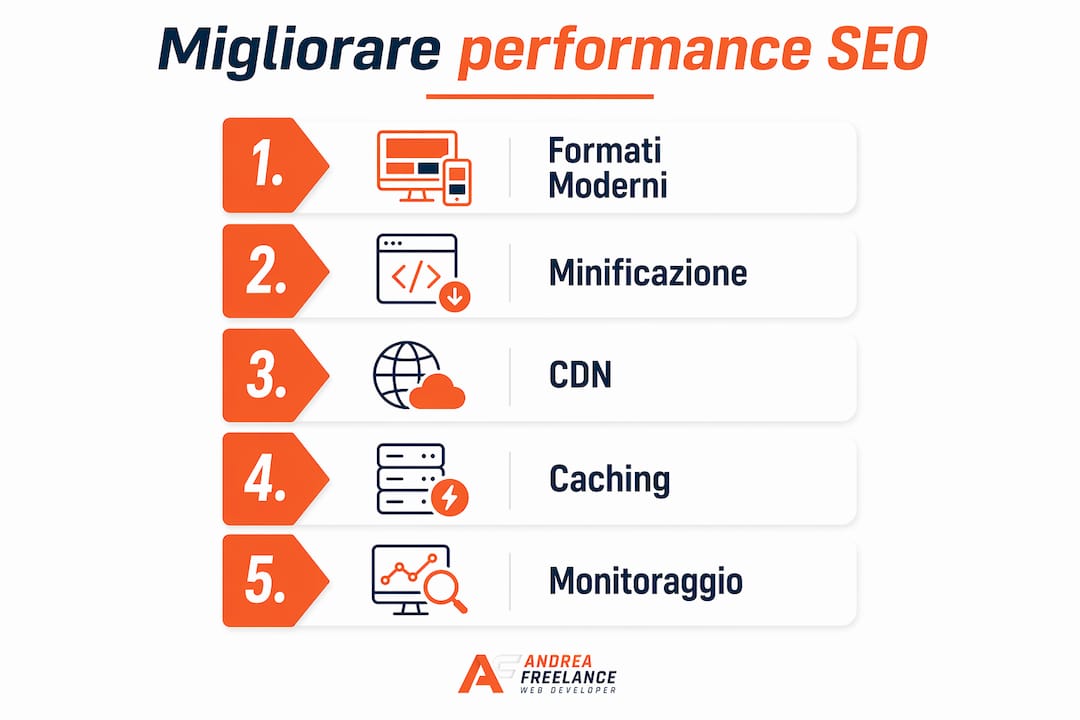
Minifying CSS, JavaScript and HTML removes spaces, comments and redundant characters from the code. A CDN (Content Delivery Network) distributes static files across servers geographically close to the user, reducing latency. Progressive Web Apps and predictive lazy loading complete the technical picture, measurably improving perceived interactivity and Core Web Vitals scores.
For those who manage WordPress sites, plugins such as WP Rocket or LiteSpeed Cache handle caching, minification and preloading centrally. For bespoke sites, configuring the server with HTTP/2 or HTTP/3 and Brotli compression are measures that have an immediate impact on TTFB (Time to First Byte).
A tip: Use Google PageSpeed Insights and the Core Web Vitals report in Google Search Console together. PageSpeed Insights provides lab data that is useful for debugging. Search Console provides real-world data collected from users, which is the data that Google actually uses for ranking.
How to structure content for AI responses and search queries
Effective SEO in 2026 is based on subject-matter authority with clear answers in the first paragraph, favouring tables and precise definitions to summarise the AI’s responses. This is not a stylistic tip: it is the way in which Google’s generative systems select the sources to cite. Content that answers the main question within the first three lines is far more likely to be extracted and displayed in AI Overviews.
The E-E-A-T principles applied to content
E-E-A-T is not an algorithm with a numerical score. It is a set of qualitative signals that Google uses to assess the reliability of a source. Applying them in practice means:
- Experience (first-hand experience): Include real-life examples, case studies and data from fieldwork. An article written by someone who has managed SEO campaigns for years conveys experience in a different way to one written simply by compiling sources.
- Expertise: Attribute content to identifiable authors, with verifiable biographies and linked professional profiles. Google assesses who writes the content, not just what is written.
- Authoritativeness: Build backlinks from sources relevant to the sector, not from generic directories. A link from an industry publication is worth more than a hundred links from unrelated sites.
- Trustworthiness: ‘About’ pages, a Privacy Policy, verifiable contact details, HTTPS enabled and genuine reviews. Trust is built on concrete evidence, not just statements.
Structuring content for snippets and AI Overviews
Optimising for generative AI requires high-quality content, a robust technical structure and verifiable authority. Google has made it clear that special files or artificial divisions of content are not necessary. The official 2026 guide confirms that SEO for AI is traditional SEO with a greater focus on quality and structure.
In practical terms, structuring content for AI responses means:
- Begin each section with a direct answer to the question implied in the title
- Use tables for comparisons, lists for sequential processes, and definitions for technical terms
- Keep paragraphs short (3–5 sentences) with one main idea per paragraph
- Update existing content with the latest information rather than publishing new articles on the same topics
- Link each article to a thematic pillar page to strengthen the cluster’s authority
To find out more about how to structure the types of web content To help professionals in the sector optimise their SEO effectively for 2026, Andreafreelance has published a guide specifically for them.
How to monitor and adapt SEO strategies over time
Regular monitoring and optimisation via Google Search Console is the practice that distinguishes those who maintain their rankings over time from those who lose them after the first algorithm update. Search Console data shows which queries drive traffic, which pages are losing impressions, and where the CTR is low compared to the average position. Taken together, these three indicators guide optimisation decisions far more precisely than any intuition.
Tools to use every week
- Google Search Console: Track impressions, clicks, CTR and average position by query and page. Check the Core Web Vitals report and the Coverage report to identify indexing errors.
- Google Analytics 4: It tracks user behaviour once they have landed on the site. The engagement rate, scroll depth and conversions round off the picture provided by Search Console.
- Rank tracking: Tools designed to monitor rankings for specific keywords allow you to see the impact of algorithmic updates in real time.
- Analysis of server logs: The logs show which pages are actually crawled by Googlebot, how often, and whether there are any errors that aren’t visible in Search Console.
Common mistakes to avoid
SEO techniques in 2026 incorporate artificial intelligence, machine learning and behavioural analysis to deliver a data-driven approach. This renders certain still-common practices obsolete: publishing new content without updating existing content, ignoring long-tail queries because they have low search volume, and failing to track conversions attributable to organic traffic.
A particularly costly mistake is investing in techniques that are not officially supported. Google’s guide to generative AI optimisation makes it clear that files such as llms.txt or special mark-up are not necessary. Time spent on these solutions is time taken away from genuinely improving content and technical structure.
A tip: Set up a regular monthly report featuring three metrics: change in total impressions, change in average CTR, and the number of pages with indexing errors. When compared month on month, these three figures reveal the site’s true trajectory before any issues become serious.
Key points
Effective Google positioning strategies for 2026 require a coherent digital architecture, measurable technical optimisation and content structured for generative systems, all of which must be continuously monitored.
| Full stop | Details |
|---|---|
| Digital architecture | Implement Schema.org and a clear internal linking structure so that it can be recognised by AI systems. |
| Core Web Vitals | Keep LCP below 2.5 seconds, INP below 200 ms and CLS below 0.1 to meet Google’s 2026 standards. |
| E-E-A-T Content | Attribute content to verifiable authors and answer the main question within the first three lines of each section. |
| Active monitoring | Check Search Console, Analytics 4 and your server logs every week to spot any issues before they affect your rankings. |
| Avoid taking shortcuts | Do not invest in unofficial techniques: the 2026 Google guide confirms that quality and technical structure are the only factors that matter. |
SEO in 2026 as seen by those who work in the field every day
With over 20 years« experience working on corporate websites, I have seen many cycles of algorithmic updates. Each time, a section of the market reacts by looking for the latest shortcut, the trick that »beats’ the system. In 2026, this trend became even more pronounced with the arrival of generative AI systems: I’ve seen professionals waste weeks implementing llms.txt files or experimental markup, convinced they had an edge. They didn’t.
The uncomfortable truth is that Google hasn’t changed in substance: it still rewards those who build something useful, well-structured and reliable. What has changed is the speed at which quality signals are assessed and the level of detail with which AI systems distinguish authoritative sources from generic ones. A website with a clear digital identity, attributed content and Core Web Vitals within the green threshold is selected. The others are not.
The advice I give my clients is always the same: before adding new content, consolidate what you already have. Update existing articles with the latest data, link pages together logically, and check that structured data is implemented correctly. This consolidation work yields more stable results than any aggressive link-building campaign.
Continuous adaptation is not an option: it is essential to remain visible. Algorithms change, search habits change, and AI systems evolve. Those who monitor the data every week and adjust their strategy in real time maintain their ranking. Those who wait to see a drop before taking action are already behind the game.
For those who run SMEs or work as digital marketing professionals, the SEO best practice 2026 by Andreafreelance provide a practical and up-to-date starting point.
— Andrea
Andreafreelance: SEO and websites for 2026
Andreafreelance offers services in website positioning and SEO built using techniques updated to 2026: digital architecture with structured data, Core Web Vitals optimisation, E-E-A-T content and continuous performance monitoring. With over 20 years’ experience in WordPress, WooCommerce and Prestashop, Andrea supports SMEs and professionals from the analysis phase right through to tangible results in terms of visibility and conversions. If your website needs a structured overhaul, the rebranding workflow by Andreafreelance starts with a comprehensive technical analysis and leads to a measurable action plan, with no vague promises.
Frequently Asked Questions
What is E-E-A-T and why will it matter in 2026?
E-E-A-T (Experience, Expertise, Authoritativeness, Trustworthiness) is the framework Google uses to assess the reliability of a source. By 2026, with generative AI systems selecting which sources to cite, having strong E-E-A-T signals will be the minimum requirement for appearing in AI-generated answers.
Do Core Web Vitals really affect rankings?
Yes. Core Web Vitals are direct ranking factors linked to user experience. LCP, INP and CLS values that exceed the thresholds reduce a website’s visibility in search results, regardless of the quality of its content.
Will an llms.txt file be needed for AI SEO in 2026?
No. The official Google 2026 guide makes it clear that special files such as llms.txt are not required for generative AI optimisation. Content quality, technical structure and verifiable authority are the only factors that matter.
How often should existing content be updated?
Update existing content whenever relevant data changes or when Search Console shows a drop in impressions for that page. Publishing new articles on the same topics without updating the existing ones leads to keyword cannibalisation.
What tools should you use to monitor your search rankings in 2026?
Google Search Console and Google Analytics 4 form the foundation. Combine them with a rank-tracking tool for your main keywords and an analysis of your server logs to understand how Googlebot crawls your site. This combination provides a comprehensive overview of your site’s actual performance.



