A professional blog is a business tool that generates visibility, credibility and qualified leads over time. It is neither a personal diary nor a random collection of articles: it is a business asset which addresses the specific challenges faced by the ideal client. For entrepreneurs and freelancers, building a professional blog step by step means following a precise method, from choosing a niche right through to promoting content. This guide covers every stage with practical advice, updated for 2026, for those who want real and lasting results.
How to choose a niche and content format for your professional blog
Choosing your niche is the most important decision you’ll make before writing your first article. The 74% in the new blogs fails within the first six months due to a lack of vertical focus. Those who focus on a specific area grow three times faster than those who try to cover everything.
An effective niche has three characteristics: it is narrow enough to allow you to become a recognisable authority, broad enough to ensure a steady audience, and aligned with the services or products you wish to sell. A financial adviser who writes exclusively about «pension planning for self-employed professionals under 40» builds authority much more quickly than one who covers personal finance in general terms.

Curator or Primary Creator: which model will you choose?
There are two main models for content production. The model Curator is based on short articles, industry updates and a selection of relevant news items. The model Primary Creator It produces original, in-depth content based on first-hand research or personal experience.
The Primary Creator model builds long-term authority and is the preferred choice for professionals who want to position themselves as experts. Long, in-depth articles attract more backlinks, are shared more widely and rank higher in search engines. The Curator model only works if you already have an active community and publish content at a very high frequency.
- Choose a vertical niche, not a general topic
- Define your ideal customer before choosing your themes
- Consider whether you have sufficient skills to produce original content
- Check that the niche has real monetisation potential
- Plan at least 10 pillar articles before launch
A tip: Before registering your domain, write down five article titles that you could publish straight away. If you’re struggling to come up with five, the niche is too narrow or isn’t the right one for you.
How to set up a secure, professional blog from a technical perspective
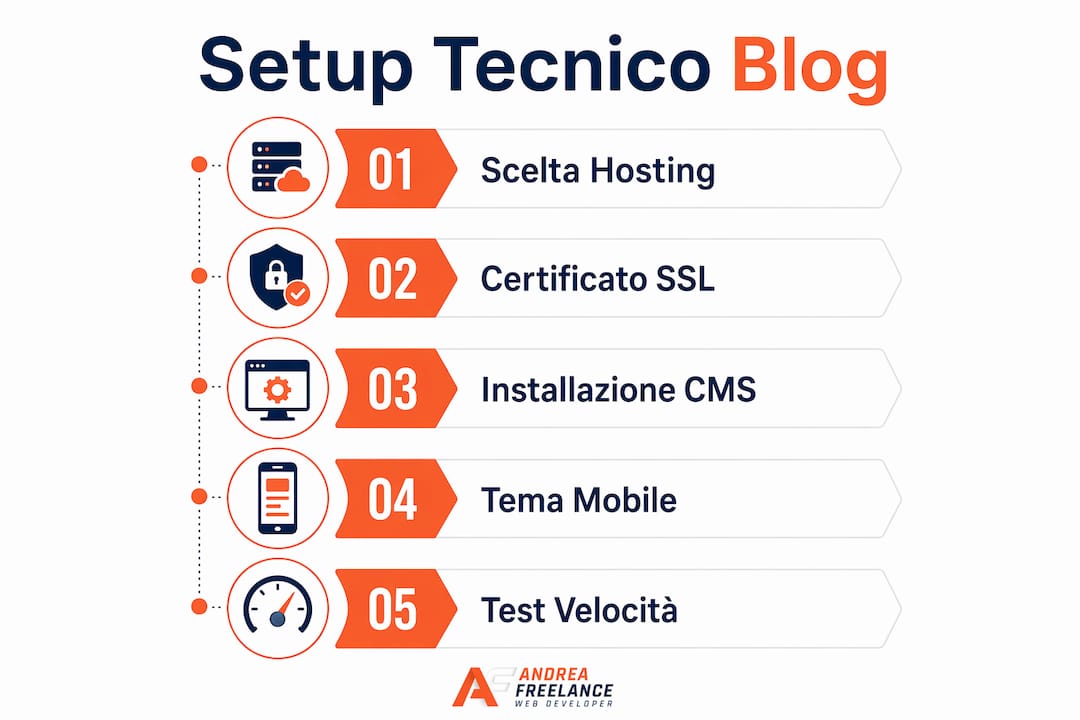
Setting up a blog takes less than 20 minutes. The business results, however, they arrive after 9–12 months of regular publications. This means that the technical foundation must be solid from the outset, because changing it part-way through is costly and risky.
WordPress.org It is the recommended platform for a professional blog. It offers complete control over the code, thousands of verified plugins and an active community of developers. The distinction between WordPress.org (stand-alone installation) and WordPress.com (hosted service) is essential: only the former gives you full ownership of the website and the freedom to customise it.
Steps for the technical setup
- Choose a domain with your name or your brand name. Would you prefer the .it domain extension for the Italian market or .com for an international audience?.
- Choose a reliable hosting provider with servers in Italy or Europe, responsive technical support and daily automatic backups.
- Install WordPress.org via the hosting control panel – a process that takes just a few clicks.
- Set up the essential plugins: an SEO plugin such as Yoast SEO or Rank Math, a security plugin such as Wordfence, a backup plugin such as UpdraftPlus, and a caching plugin to improve speed.
- Create the essential static pages: About Us, Contact, Privacy Policy and, if you offer services, a dedicated page. These pages ensure the blog’s legal and functional reliability.
| Element | Priorities | Reason |
|---|---|---|
| SSL Certificate | High | Data security and Google rankings |
| Two-factor authentication | High | Administrator access protection |
| Automatic daily backup | High | Quick recovery in the event of problems |
| Caching and image compression | Media | Loading speed and user experience |
| Updated Privacy Policy | High | GDPR legal obligation |
The design must follow the ‘mobile-first’ principle: over 60% of web traffic comes from mobile devices. A clean theme, with clear navigation and loading times of under 3 seconds, reduces the bounce rate and improves search engine rankings. Avoid themes with dozens of unnecessary features: technical simplicity is a competitive advantage.
A tip: Test your website’s speed using Google PageSpeed Insights immediately after installation, before publishing any content. It’s much easier to fix performance issues when the site is empty than when you already have 50 articles online.
To find out more about choosing a platform, see the Andreafreelance guide on WordPress for professional websites provides a detailed comparison of the available options.
How to plan content and SEO to boost visibility
Content planning is the difference between a blog that grows and one that fizzles out after three months. Semantic architecture An SEO strategy based on topic clusters and pillar pages is the most effective approach in 2026. A pillar page covers a main topic in broad terms, whilst cluster articles explore specific sub-topics in depth and link back to the main page via internal links.
A practical example: if you’re an employment consultant, your pillar page could be «A comprehensive guide to employment contracts for SMEs». The cluster articles cover topics such as «Fixed-term contracts: when they’re worthwhile», «Differences between self-employment and employment», and «How to handle voluntary resignations». Each cluster article reinforces the authority of the pillar page, and vice versa.
Publication frequency and keyword research
Publishing one in-depth article every 1–2 weeks is the recommended sustainable frequency for 2026. This schedule allows you to maintain high quality without burning yourself out. One long, well-structured article every two weeks is worth far more than three superficial articles a week.
The process of selecting keywords follows a specific logic:
- Identify the questions your ideal customer asks on Google
- Use tools such as Google Search Console, Google Trends or Ubersuggest to find variations with actual search volume
- Prioritise long-tail keywords, which are more specific and less competitive
- Include the main keyword in the H1 heading, the first paragraph, at least one H2 heading and the meta description
- Create internal links between related articles to distribute SEO authority
| On-page SEO element | Where to put it | Frequency |
|---|---|---|
| Main keyword | H1, first paragraph, meta description | Every article |
| Related keywords | H2, H3, main text | Every article |
| Internal links | Main text | 2–4 per item |
| Image alt text | Alt text for each image | Each image |
| Human-readable URL | Article slug | Every article |
The E-E-A-T concept (Experience, Expertise, Authoritativeness, Trustworthiness) guides Google’s algorithm in evaluating content. For a freelancer, this means signing every article with their own name, citing verifiable sources, including examples drawn from direct experience, and updating published content at least once a year. You can find out more about the types of web content the most effective ones for professionals, as set out in Andreafreelance’s dedicated guide.
How to promote your blog and build sustainable growth
Publishing an article without promoting it is like opening a shop without a sign. Content distribution requires a selective strategy: it is better to maintain a consistent presence on two or three channels than to have a superficial presence everywhere.
«The growth of a professional blog does not depend on the quantity of content published, but on the consistency with which you publish it and the quality of the relationships you build around it.»
The most effective distribution channels for a professional blog are:
- Email newsletter: the channel with the highest conversion rate. Every new article is sent out as an email to the mailing list. Start gathering subscribers from day one, even with a small list.
- LinkedIn: the social network best suited to professionals and entrepreneurs. Share an extract from the article with a link to the blog, not the full text.
- Guest blogging: Write articles for influential blogs in your sector. Gain high-quality backlinks and visibility amongst an already established audience.
- Online and offline communities: Take part in industry groups, specialist forums, events and conferences. Your network of personal contacts helps spread the word more quickly.
Monitoring traffic and conversion data on a daily basis helps you understand which topics are performing well and where action is needed. This doesn’t mean obsessing over the figures every day, but rather regularly checking metrics such as the most visited pages, traffic sources, bounce rate and search queries that drive traffic. Google Search Console and Google Analytics 4 are the go-to free tools.
A tip: Create a shared file where you record the five articles with the most traffic each week. After three months, you’ll have a clear picture of which topics your audience really values, and you’ll be able to plan future content based on that data.
Sustainable growth is achieved by striking a balance between quality and quantity. A blog with 30 excellent, well-ranked articles is worth more than one with 200 mediocre ones. Consistency over time, not initial speed, determines long-term success. For those who run a blog as part of a wider digital presence, Andreafreelance’s guide to online freelancers in 2026 provides practical guidance on how to integrate the blog into the overall strategy.
Key points
A professional blog will only grow if it combines a specialised niche, original and in-depth content, a solid technical foundation and consistent publishing over time.
| Full stop | Details |
|---|---|
| Vertical niche | Choose a specific topic to build authority more quickly and attract your ideal customer. |
| Primary Creator Model | Produce original, in-depth content: it builds more authority than mere curation. |
| Solid technical setup | WordPress.org SEO, security and backup plugins are the bare essentials for a professional blog. |
| Editorial plan with clusters | Organise your content into pillar pages and cluster articles to improve your SEO ranking. |
| Selective distribution | Focus consistently on two or three channels rather than spreading your energy too thinly across all social media platforms. |
What I’ve learnt after 20 years of web projects
I’ve been working with websites for over twenty years and have seen hundreds of professional blogs start up, grow and, often, come to a standstill. The most common mistake isn’t a technical one: it’s a lack of patience. Anyone expecting results within three months almost always gives up before the blog really starts to take off.
The second mistake is to confuse publication with promotion. I have seen professionals write excellent articles that nobody has ever read, simply because they had no distribution strategy. An article without promotion is an invisible article, regardless of its quality.
The thing that has surprised me most, over time, is just how much authenticity matters. The blogs that grow the most aren’t the ones with the best-looking design or the most technical SEO: they’re the ones where you can hear the voice of a real person, with first-hand experience and clear opinions. Google increasingly rewards content written by recognisable experts, and readers keep coming back to sites where they find someone they trust.
My practical advice is this: start with less than you think you need to. One article every two weeks, on a specific niche, accompanied by a small but well-curated newsletter. After a year, you’ll have a solid foundation. After two years, you’ll have an asset that works for you even when you’re not publishing.
— Andrea
Andreafreelance: professional support for your blog
Setting up a professional blog requires technical, editorial and marketing skills that are rarely all found in one person. Andreafreelance offers bespoke WordPress set-up services, SEO optimisation and website redesign For freelancers and entrepreneurs who want a solid, well-designed digital presence. With over 20 years’ experience in WordPress, WooCommerce and Prestashop, Andreafreelance manages every project from initial set-up to ongoing maintenance. Whether you want to get off to a flying start or improve an existing blog, you can rely on a experienced web developer which understands the specific needs of Italian professionals.
Frequently Asked Questions
How long does it take to see results from a professional blog?
Significant business results are achieved after 9–12 months of regular publishing. The technical set-up is quick, but organic growth requires consistency over time.
Which platform should you choose to create a professional blog?
WordPress.org It is the recommended choice for professionals and business owners. It offers total control, SEO and security plugins, and full ownership of the website.
How often should you publish blog posts?
Publishing an in-depth article every 1–2 weeks is a sustainable frequency that ensures growth without compromising the quality of the content.
What is a pillar page and why is it useful for a blog?
A pillar page is a comprehensive article on a main topic, linked to more specific articles. This structure improves SEO rankings and organises the content in a logical way for the reader.
Is a Privacy Policy compulsory for a professional blog?
Yes, the Privacy Policy is a legal requirement under the GDPR for any website that collects user data, including analytics cookies.