The’87% clients review the portfolio even before contacting a professional. Not your CV, not your LinkedIn profile: your portfolio. This completely overturns the idea that a list of work experience is enough to convince a potential client. If you’re an Italian entrepreneur or freelancer, your digital portfolio is now your most powerful sales tool. In this article, you’ll discover how to structure it, which platform to choose, how to tailor it to your sector and how to promote it to achieve tangible results.
Contents
- Why an online portfolio is essential for success
- How to put together an effective online portfolio
- Customisation and platforms: which to choose
- Online portfolios for various professions: real-life examples and edge cases
- Optimisation and promotion of the digital portfolio
- Build your portfolio with someone who has 20 years’ experience
- Frequently Asked Questions
Key Points
| Full stop | Details |
|---|---|
| A portfolio is better than a CV | Showing real results through a digital portfolio is more effective than sending a traditional CV. |
| A simple and focused structure | Choose between 3 and 10 high-value projects and organise the information in a clear and accessible way. |
| Suitable for any profession | Even those who do not work in creative sectors can make the most of results, testimonials and case studies. |
| Strategic promotion | SEO, social media and freelance platforms are essential tools for getting noticed and attracting new clients. |
| Constant updates | Improve and update your portfolio regularly to remain competitive in the digital market. |
Why an online portfolio is essential for success
The freelance labour market in Italy has grown significantly in recent years. It is estimated that between 4.3 and 5 million people now work as freelancers in our country, with the gig economy having grown by more than 123% over five years. In this competitive environment, standing out is no longer a choice: it is a necessity.
A traditional CV lists what you’ve done. A portfolio shows as You did it and, above all, what results you have achieved. This difference is crucial. As those who study the sector point out, the An online portfolio is an essential showcase compared to a CV, because it allows you to demonstrate your actual skills through concrete evidence rather than mere statements.
“A well-put-together portfolio doesn’t tell people who you are: it shows what you can do. And for a client, that’s the only thing that really matters.”
That is why over 80% of customers assess the portfolio before making any decision. The main benefits are clear:
- Instant personal branding: Your portfolio conveys your style, your specialism and your approach to work in a matter of seconds.
- Tangible social proof: Real projects replace promises with action.
- Differentiation from the competition: In a crowded market, a well-curated portfolio sets you apart from the crowd.
- Conversion tool: a visitor browsing your portfolio is already halfway through the buying process.
How to put together an effective online portfolio
Now that we’ve clarified the value of a portfolio, let’s look at how to build one that really works. Its structure is not a minor detail: it is the backbone of the entire user experience.
The recommended structure involves between 3 and 10 carefully selected projects. It doesn’t matter how many projects you’ve completed: what matters is which ones you choose to showcase. Quality always comes before quantity.
The key sections of an effective portfolio are:
- Home: an immediate introduction to who you are and what you do, with a clear value proposition.
- About me: professional background, values, approach to work and key skills.
- Projects: your detailed case studies, including background, process and measurable results.
- Contact Us: a simple form, a visible email address, and possibly a link to LinkedIn or other channels.
Every project profile should answer three questions: what was the client’s problem, how did you solve it, and what tangible results did they achieve? This narrative format transforms a simple example of your work into a compelling story.

| Element | Freelancer | Agency |
|---|---|---|
| Number of recommended projects | 3-6 | 8-15 |
| Main focus | Individual skills | Team capacity |
| Testimonials | Fundamentals | Very useful |
| Detailed case studies | Yes, always | Selected |
| Team section | Not required | Recommended |
For your website’s homepage, you can find out more about how best to set it up by following the professional homepage guide by Andrea, which offers practical and up-to-date advice.
Pro tip: Always include a measurable figure in your case studies. “I increased the client’s sales by 40% in three months” is infinitely more convincing than “I improved the website’s performance”.
Customisation and platforms: which to choose
Now that the structure has been designed, let’s find out which platform best suits your needs. The choice of platform affects not only the visual appearance, but also your visibility on search engines and the control you have over your digital space.
The differences between free platforms and bespoke solutions are significant, and it is worth considering them carefully before you begin.
| Platform | Customisation | SEO | Cost | Ideal for |
|---|---|---|---|---|
| WordPress + Elementor | High | Excellent | Medium | Professionals and SMEs |
| Behance | Low | Limited | Free | Designers and creative professionals |
| Webflow | High | Good | Mid-to-high | Developers and agencies |
| Wix / Squarespace | Media | Discreet | Bass | Those who are just starting out |
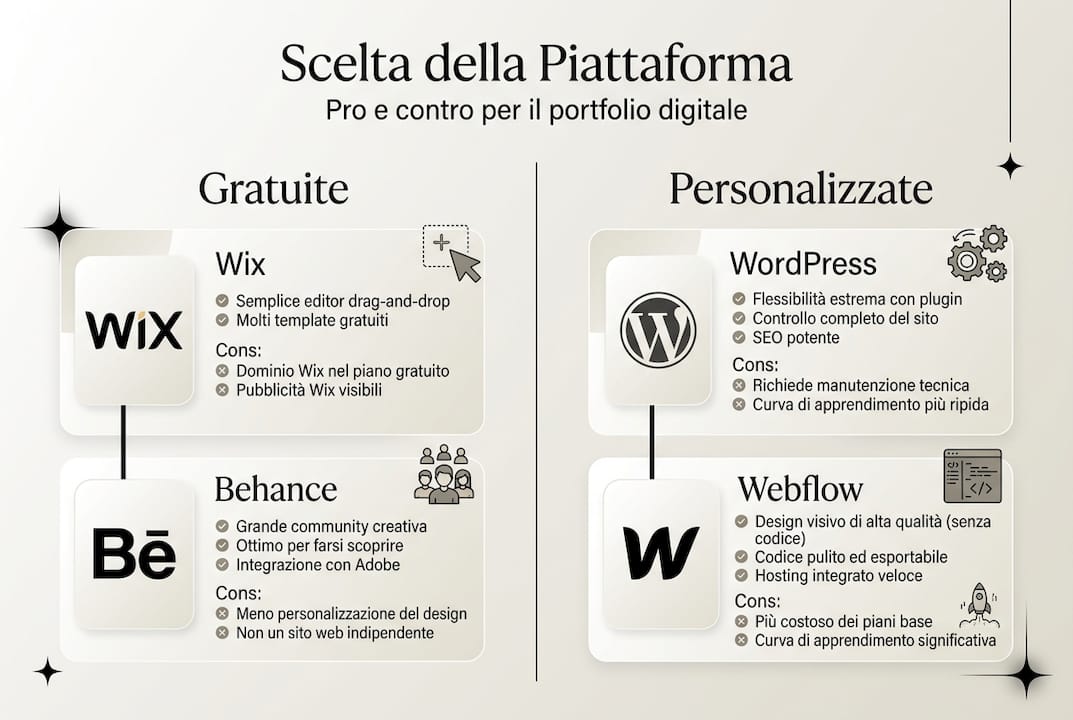
WordPress remains the most reliable choice for anyone looking for a professional portfolio with full control over SEO, scope for future expansion and no restrictions imposed by the platform. With plugins such as Yoast SEO and visual builders such as Elementor, you can create a polished website without necessarily having to write any code.
Behance is useful if you work in design or photography and want to join an existing community. But be warned: it isn’t your own platform, and the rules can change. Webflow offers advanced flexibility but has a steeper learning curve.
Pro tip: Whichever platform you choose, make sure you have a custom domain (e.g. firstname-surname.it). A professional URL boosts perceived credibility and improves organic search rankings.
Online portfolios for various professions: real-life examples and edge cases
Once you have chosen a platform, it is essential that professionals of all kinds tailor their portfolios to their own experience. Not everyone starts from the same position, and not everyone works in sectors where results are immediately visible.
If you don’t have any work experience yet, don’t let that hold you back. Strategies for those starting from scratch include drawing on personal projects, academic work or voluntary work. A project undertaken out of passion demonstrates initiative and competence just as much as a paid assignment.
Here are some practical solutions for specific situations:
- Developers without clients: publish open-source projects, contributions on GitHub or personal applications with technical documentation.
- Administrative staff or consultant: demonstrates optimised processes, cost savings achieved and simplified procedures, backed by real data.
- Trainer or coach: Include testimonials from participants, teaching materials and the achievements of your students.
- Technical professional (engineer, architect): use project sheets containing technical specifications, images and measurable results.
“Storytelling isn’t just for creative professionals. Even an accountant can explain how they helped a client save 15,000 euros in tax thanks to careful tax planning.”
The narrative behind the project is what transforms a list of projects into a demonstration of value. Describe the context, explain the challenges you faced, show how you approached the work and what results you achieved. This approach works in any sector, whether creative or not.
Optimisation and promotion of the digital portfolio
Now that you have a solid and coherent portfolio, maximise your results with targeted visibility and promotion strategies. Having a great portfolio that nobody sees is like having a shop on a deserted street.
As a marketing tool, a portfolio requires a focus on SEO, social media and freelance platforms to generate qualified traffic. Here are the most effective strategies:
- Basic SEO: Optimise your page titles, meta descriptions and image alt text. Use keywords specific to your sector and your town.
- Mobile first: Over 60% of searches are carried out on smartphones. A portfolio that isn’t optimised for mobile loses more than half its potential.
- LinkedIn: Share your case studies as articles or posts. LinkedIn is the most effective B2B channel in Italy for attracting professional clients.
- Freelance platforms: Upwork, Fiverr and Malt allow you to reach clients who are actively looking for professionals like you.
- Regular update: A portfolio that hasn’t been updated since 2023 gives the impression of stagnation. Update it at least every six months with new projects or client testimonials.
To find out more about positioning techniques, you can refer to the section on’SEO optimisation of the portfolio and the portfolio positioning strategies designed specifically for Italian professionals and SMEs.
Pro tip: Always ask for a written testimonial at the end of every project. Genuine reviews boost the confidence of new visitors and improve your website’s ranking in local search results.
Testimonials, active networking and constantly updating your portfolio form a virtuous cycle: the more satisfied customers you have, the more social proof you accumulate, and the more new customers you attract. To understand which features of a professional website To ensure your online presence is truly effective, it’s worth exploring every technical and strategic aspect in depth.
Build your portfolio with someone who has 20 years’ experience
If you’ve read this far, you already know what you need: a well-structured online portfolio, optimised for SEO and built on a reliable platform. But knowing what to do and actually doing it well are two different things. With over 20 years’ experience in web development, Andrea from andreafreelance.com helps Italian professionals and entrepreneurs create websites and digital portfolios that attract real clients. From choosing the platform to SEO optimisation, right through to the graphic and technical design, every project is handled with personalised attention. If you want a portfolio that works for you even when you’re offline, now is the time to take the next step.
Frequently Asked Questions
How many projects should you include in an effective online portfolio?
Ideally, you should select between 3 and 10 projects that really showcase your skills. It’s better to have a few excellent pieces of work than lots of mediocre ones.
How can I create a portfolio if I have no work experience?
Use personal and academic projects or voluntary work to demonstrate your skills and motivation. Initiative counts just as much as paid experience.
What is the basic structure of a digital portfolio?
The key sections are: the home page with the value proposition, a personal introduction, detailed projects with case studies, and a contact page. This structure works for any sector.
How can you promote an online portfolio to attract clients?
Use basic SEO and social media networking – particularly LinkedIn – and sign up to freelance platforms such as Upwork or Malt to increase your visibility amongst qualified clients.
Does an online portfolio still make sense if I work in non-creative sectors?
Absolutely: you can highlight testimonials and measurable results as a guarantee of reliability, even in technical, administrative or consultancy sectors.